







Key Uses of Laser Engraving in FDA Compliance and UDI Marking
In the medical industry, where patient safety, product tracking, and regulatory accuracy matter every day, durable marking is operationally critical. This is why many medical organizations are now evaluating which laser engraver to use, what materials it can mark, and which internal projects justify bringing laser capability in-house.
This is especially true for medical institutions that have to deal with FDA compliance and UDI (Unique Device Identification) marking. If a code wears off, peels away, or becomes unreadable after sterilization, it creates real risk. Key players like hospitals, surgical centers, dental labs, etc., increasingly rely on permanent identification, traceability, and compliance-driven marking systems.

Top 5 Uses of Laser Engraving in FDA Compliance and UDI Marking
1. UDI Marking on Surgical Instruments
One of the most common medical uses of laser engraving is placing UDI codes, serial numbers, and identifiers directly onto surgical instruments such as forceps, clamps, scissors, retractors, and specialty tools.
Metal laser engraving is especially suitable because these surgical tools have to go through frequent steam sterilization, chemical disinfection, repeated washing, and daily handling.
Where printed labels may fall off easily, laser marks are durable and remain readable for far longer.
For UDI marking on surgical instruments, fiber laser engravers are usually the top choice. On steel, titanium, aluminum, or hard alloys, a properly configured fiber laser engraver produces crisp text, barcodes, Data Matrix codes, and annealed marks without damaging functional surfaces when properly configured.
2. UDI Marking on Medical Device Components
Laser engraving is also widely used for many reusable or regulated medical devices that require traceability at the component level. Usually, this includes endoscopic tools, orthopedic devices, device housings, reusable handles, and device accessories
Laser marking is ideal because it provides permanent identification, lot traceability, serial tracking, and anti-counterfeit support. Fiber lasers work very well on metals, while UV lasers are usually preferred for sensitive plastics. Some plastics melt or discolor under standard heat-based lasers. UV lasers can create cleaner, low-heat marks.
3. Instrument Tray and Asset Tracking
Laser engraving is also used in medical institutions like hospitals and surgical centers, which often need to track trays, bins, and instrument sets.
Laser marking is ideal for distinguishing department ownership, clearly displaying tray IDs, and even embedding scan codes into the items. This helps facilitate workflow and reduce instances of missing, misused, or misplaced items.
Because different tray materials require different wavelengths, fiber laser engravers are used for metal trays, while CO2 lasers are used for certain plastics and coated materials.
 4. Dental and Orthodontic Applications
Another medical application that benefits significantly from laser engraving is dentistry. Dental labs and clinics often need identification on tools, components, models, and custom devices.
- Fiber laser engravers are used for metal tools/components.
- CO2 laser for acrylics and non-metal materials.
Laser engraving provides precision on small parts, fine text capability, and a means to create custom patient case identification labelling with a professional-looking finish.
5. Packaging, Labels, and Sterile Product Identification
Some medical organizations use laser engraving to mark packaging or labels with lot numbers, expiration dates, or traceability codes. Usually, CO2 lasers are used for cartons, paperboard, labels, and organic packaging materials, while UV lasers are used for specialty films and delicate substrates.
Laser engraving works because it is fast, clean, and produces high-contrast markings that are bold and visible. It is also highly reliable for production environments.
Laser Engravers for Medical Institutions: All The Benefits
1. Improved Compliance Readiness
Standards continuously evolve in the medical industry, workflows change, and audits always require clearer identification. Having a laser engraver gives an institution the ability to respond quickly and update operations without being affected by external factors like market prices and the trustworthiness of third parties.
2. Turnaround is Faster
Instead of sending instruments or components out to third-party vendors, an in-house laser engraver allows faster marking and re-marking. That means faster onboarding of new assets, quicker replacement cycles, and less downtime.
3. Better Inventory Control
Having a laser engraver in a medical facility gives flexibility when it comes to labelling or marking different kinds of materials within a short time. Need to mark 50 new tools this week? Add tray IDs tomorrow? Replace unreadable codes today? In-house capability saves time, costs, and complexity, which are essential in medical institutions where time is often of the essence.
4. Reduced Long-Term Costs
For medical institutions that need ongoing new device marking, tray updates, tool replacement IDs, and department coding, outsourcing can become expensive. Owning a laser engraving machine can reduce recurring vendor costs over time.
Best Laser Engravers for UDI Marking
1. Fiber Laser Engravers (Best Overall for UDI)
For many medical environments, such as hospitals, device manufacturers, and surgical centers, fiber laser engraving is the ideal option. Fiber laser engravers are excellent for stainless steel, titanium, aluminum, and hard metals, which are what most surgical instruments, orthopedic tools, and reusable devices are made of.
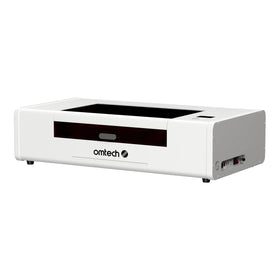
With a Fiber laser engraver like the OMTech 60W fiber laser engraver makes it easy to achieve your aspirations, opening doors to infinite creative potential and ensuring that each creation stands out. You can make Data Matrix codes, serial numbers, logos, annealed marks, and even deep engraving when needed.
2. UV Laser Engravers (Best for Plastics and Delicate Surfaces)
UV lasers are best when heat damage is a concern, and they are widely used by device manufacturers, plastic housings, polymer devices, and medical electronics across the medical industry. A UV laser creates fine marks with minimal thermal stress on plastic housings, polymer devices, medical electronics, and delicate coated surfaces. They are widely used by device manufacturers.
3. CO2 Laser Engravers (Best for Packaging and Non-Metal Materials)
CO2 laser engravers are extremely useful in a variety of medical applications where metals are not the main focus. Because of their strong compatibility with paperboard, acrylic, wood, and certain plastics and packaging materials, labs, packaging operations, and supply departments across the medical industry use them for boxes, label plates, storage aids, and non-metal accessories
4. MOPA Fiber Lasers (Best for Color and Controlled Marking)
MOPA fiber laser systems offer pulse control beyond many standard fiber lasers, which makes them very valuable to manufacturers of medical device equipment, high-end surgical tool suppliers, and precision marking operators for controlled marking on stainless steel.
In UDI specifically, MOPA fiber lasers are used for premium instrument marking, fine Data Matrix codes, and aesthetic branded tools.
Buying a Laser Engraver For Medical Institutions: 4 Key Points to Remember
When buying a laser engraver, the goal for a medical institution must be to ensure permanent, accurate, and compliant identification of medical tools, equipment, and assets to improve safety, traceability, and efficiency.
As such, it must match the materials being engraved/marked, capable of ensuring patient safety and error reduction, while meeting traceability and compliance requirements.
- The main materials being marked: Does the institution primarily mark stainless steel tools, titanium implants, plastic housings, or packaging? The material determines the laser type.
- Required code size: Very small Data Matrix codes require high precision.
- Throughput needs: Does the institution mark 20 items a month or 2,000? The more the need, the bigger the engraving machine to go for.
- Safety and workspace needs: Enclosed systems, extraction, and operator safety are important in healthcare settings.
Final Thoughts
Laser engraving is no longer a niche tool in the medical world; it is becoming a core operational asset. For FDA compliance, UDI marking, inventory control, traceability, and professional-grade permanence, laser systems solve problems that labels and ink often cannot.
For most metal-based UDI work, a fiber laser is usually the best starting point. For delicate plastics, UV lasers are often ideal. For packaging and non-metal marking, CO2 lasers remain highly useful.
Medical institutions that bring laser capability in-house often gain speed, control, cost efficiency, and stronger compliance readiness. Explore more on Laser Precision in Medical and Surgical (UDI).