







What Is Fiber Laser Cutting? How It Works, Machines and Applications
If you are interested in metal cutting, be it for personal/hobby, commercial, or industrial use, the topic of fiber laser cutting is highly relevant to you. That is because fiber laser cutting is widely regarded as teh the industry-standard technology for high-speed precision cutting of bare metals like steel, aluminum, brass, and copper.
The keywords here are “high speed” and “precision”, because, though there are other ways to cut metal, these are the two areas where fiber laser cutting really excels. With the help of fiber laser cutting machines, fiber laser cutting has become arguably the quickest and most precise way you can cut through metal, especially on a large industrial scale.
The easiest way to understand fiber laser cutting is to start with the fundamentals: how it works, what makes it different from CO2 laser cutting, its capabilities, and the tradeoffs involved in it.

What Is Fiber Laser Cutting?
Fiber laser cutting can be defined as a modern metal cutting method that uses an intense, solid-state light beam delivered through fiber-optic cables to melt and slice through metals with high speed and precision.
What makes fiber laser cutting so effective, especially for large-scale or industrial metal cutting applications, is that, unlike CO2 or diode lasers, which excel at organic materials like wood and acrylic, fiber lasers use an optical fiber doped with rare-earth elements to create a highly focused 1,064nm wavelength beam that metals readily absorb.
So, fiber laser cutting is, by nature, more suitable for cutting bare metals, and it is also incredibly quicker and more effective: it delivers exact, clean, and smooth edges even on intricate shapes, and on a much larger scale.
How Does Fiber Laser Cutting Work?
The key to understanding how fiber laser cutting works is to understand how the beam is generated, how it is delivered, and how it cuts the metal. Metal cutting. Here is how fiber laser cutting works in three steps:
-
The beam is generated: The laser beam is generated from diodes. Diodes pump energy into an optical fiber, which is lined with rare elements(usually ytterbium). The optical fiber is equipped to amplify the light, creating a powerful and focused beam.
-
The beam is delivered to the laser cutting head: The focused beam then travels through a fiber optic transport cable to the cutting head, without needing any mirrors. A direct fiber path delivers almost 100% of the generated laser energy straight to the cutting head, slashing electricity bills.
-
Cutting: With the help of the cutting head, the laser beam then targets a microscopic spot on the metal and melts it away while an assist gas (like nitrogen or oxygen) blows the molten material out of the kerf.
Take note that this process is entirely non-contact: the cutting head never physically touches the workpiece, guided instead by computer numerical control (CNC).
What Machines Are Used for Fiber Laser Cutting?
In general, fiber laser cutting requires specialized CNC (Computer Numerical Control) metal-cutting machines that use a high-powered, solid-state fiber laser beam to slice through conductive metals.
However, fiber laser cutting is done at both personal, commercial, and industrial scales, and different types of fiber laser cutters are required depending on the scale you are working at. The different types of fiber laser machines can be grouped into three main power tiers based on the thickness of material they're able to cut.
1. Desktop / Hobby Fiber Marking, Engraving (20W–50W)
Desktop fiber lasers typically range from 20W to 50W. They're well suited to hobby work as well as light commercial use, and they're good for metal engraving, marking, and cutting extremely thin foil, but they aren't built to cut thick, structural metal. Consider the following fiber model from OMTech:
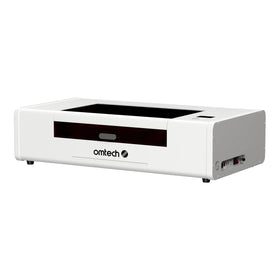
- OMTech MOPA 100W Split Fiber Laser Machine: This machine features a 6.9" x 6.9" working area, paired with 100W laser power and a 10,000 mm/s lightning-fast engraving speed, letting you tackle projects of all sizes and turn your creative visions into reality.
2. Light Fabrication (1.5kW Entry-Level Sheet Fiber Metal Cutters)
1.5kW fiber laser cutters are the optimal entry point into real sheet-metal fabrication, the step up from desktop engraving into machines that can actually cut through metal plate rather than just mark it. At this power level, you can typically cut carbon steel up to about 12mm (using oxygen) and stainless steel up to about 5mm (using nitrogen). Consider:
- OMTech FC22 1500W Fiber Laser Cutting Machine: With 1500W of laser power, OMTech's fiber laser cutter effortlessly cuts through tough metals, like ≤0.2 in. Thick stainless steel and ≤0.4 in. carbon steel, delivering precise results at 27.56 ips. It comes fully enclosed with a front and back pass-through and a built-in water chiller
- OMTech FC22-C 1500W Fiber Laser Cutting Machine: With an open-frame design for easier loading of larger or irregular sheet stock, built-in water chiller, this fiber laser cutter, powered by 1500W of laser strength, easily cuts through tough metals, like ≤0.2 in. of stainless steel and ≤0.4 in. carbon steel, delivering precise results at a remarkable 27.56 ips.
3. Heavy Production (2kW–6kW+)
For cutting thicker materials (like 10 mm+ aluminum or structural steel) at production-viable speeds, you require higher-power fiber cutting machines, which scale up to 6kW. At the top end, a 6kW system can cut carbon steel up to roughly 28mm, stainless steel up to roughly 16mm, and aluminum up to roughly 14mm. Here are some highly rated fiber laser cutters for heavy production from OMTech:
- OMTech FC-105SAT Fiber Laser Cutting Machine. Configurable from 1.5kW up to 6kW, combined sheet-and-tube cutting with a dual shuffle platform for continuous production. The FC-105SA is designed for sheet metal fabrication and can process carbon steel, stainless steel, aluminum, brass, copper, and other metals compatible with fiber laser cutting. With IPG power options from 1.5 kW to 6 kW, it can be configured for anything from lighter sheet metal work to more demanding production applications.
- OMTech FC-510 Fiber Laser Cutting Machine: a flatbed-focused alternative for shops that only need sheet cutting without integrated tube capability. The FC-510 is designed for cutting compatible metals using fiber laser technology: mild steel, stainless steel, aluminum, brass, and other compatible materials.
Fiber Laser Cutting Machines: Summarized Buying Guide
| Machine Type | Laser Power | Best For | Typical Cutting Capability | OMTech Examples |
|---|---|---|---|---|
| Desktop / Hobby Fiber | 20–50W | Metal engraving, marking, personalization, light commercial work, very thin foil | Not intended for structural/thick metal cutting | Galvo 20W, MOPA 30W |
| Light Fabrication | ~1.5kW | Entry-level sheet-metal fabrication, small commercial shops, R&D | Up to 12mm carbon steel; 5mm stainless steel* | FC22 1500W, FC22-C 1500W |
| Heavy Production | 2–6kW+ | High-volume manufacturing, thick sheet metal, structural components | At 6kW: 28 mm carbon steel, 16mm stainless steel, 14mm aluminum* | FC-105SAT, FC-510 |
Take Note(*): Actual cutting capacity varies significantly with material type, grade, thickness, gas, focus, speed, and machine configuration.
Bottom line: Choose the fiber laser's power tier based primarily on the material and thickness you need to cut: 20–50W for marking/engraving, 1.5kW for light sheet-metal fabrication, and 2–6kW+ for demanding production cutting.
Get Fiber Laser Cutter Buying Assistance From OMTech
If you provide OMTech with your material type and thickness, our team can help recommend the appropriate FC-510 configuration.

4 Main Advantages of Fiber Laser Cutting
The key advantages of fiber laser cutting, especially over CO2 lasers, are that it's highly precise, fast, efficient, and low-maintenance. Here's a closer look:
- Lightning-fast cutting speeds: With a high-wattage fiber laser, you can cut through thin sheet metal at speeds far exceeding CO2 or plasma alternatives. An entry-level fiber laser cutter for metal sheets, like the OMTech FC22 Fiber Laser Cutter, cuts at a speed of up to 27.56 ips
- Better high-power air/nitrogen cutting: High-wattage fiber lasers enable clean nitrogen or compressed-air cutting, which eliminates secondary oxide removal and reduces deburring.
- It is comparatively low maintenance: Fiber laser cutters use a solid-state design with fewer moving parts, so you're not constantly aligning mirrors or servicing complex gas-mixing tubes the way you would on a CO2 laser.
- Superior metal marking and engraving: Operating at a 1,064nm wavelength with pulsed modes, fiber lasers excel at precise bare-metal engraving, fine text, and deep marking that standard diode or CO2 lasers can't achieve on metal.
- High energy efficiency: Fiber lasers convert electrical energy into laser light much more effectively than CO2 systems, leading to a smaller carbon footprint and lower power bills.
What Are the Key Applications of Fiber Laser Cutting?
Fiber laser cutting excels at high-speed, ultra-precise fabrication of bare and reflective metals, which is why it shows up across so many industries. An efficient way to break this down is by machine power class:
1. Industrial Sheet Metal Fabrication (High-Wattage: 1kW to 6kW+)
Industrial-grade gantry flatbed fiber laser machines are the workhorses of manufacturing. They're used for:
- Heavy infrastructure: Cutting thick steel plate for machine frames, bridges, and shipbuilding.
- Automotive and aerospace: Producing body panels, bracket systems, and complex structural components with tight tolerances.
- Electrical enclosures: Rapidly punching out precise knockouts and vents in sheet-metal electrical boxes.
- Architectural hardware: Creating custom fences, heavy gates, monograms, and architectural panels.
2. Micro-Cutting and Jewelry (Low-to-Mid Wattage: 20W to 100W MOPA)
Smaller, high-precision fiber laser cutters ( like the 20W–100W MOPA fiber lasers mentioned above) focus on applications involving intricate geometry, including:
- Custom jewelry: Precise blanking and micro-cutting of precious metals like gold, silver, brass, and titanium.
- Medical devices: Cutting surgical instruments, stents, and small medical-grade steel components that demand zero thermal distortion or burrs.
- Intricate crafts: Blanking out tiny hardware, such as scale-model brass keys or miniature cosplay props.
3. Industrial Serializing and Part Marking (Galvo Systems)
While technically engraving rather than cutting, "galvo"-style pulsed fiber lasers are heavily used to mark or deeply abrade localized areas for identification:
- Automotive and asset tracking: Etching permanent, high-contrast VIN plates, barcodes, and asset tags.
- Locksmithing: Custom labeling, master-key system tracking, or deep engraving directly onto brass or steel key blanks.
- Tooling: Part numbering and branding on hardened steel hand tools, drill bits, and injection molds.
Are There Any Limitations to Fiber Laser Cutting?
There are two major limitations to fiber laser cutting: the range of materials it works on, and how expensive it is to set up and use.
1. There Are Material Limitations
Fiber laser cutting works exceptionally well on metals, but not on much else. Standard fiber lasers are generally restricted to reflective and bare metals, slate, and select plastics. This is a real tradeoff, since CO2 lasers are far more versatile; they handle wood, glass, and clear acrylic seamlessly. Choosing fiber laser cutting comes with a kind of opportunity cost in terms of the other materials you give up.
2. Initial Cost of Entry is Very High (Especially Compared to CO2 Lasers)
Fiber laser cutting is expensive, especially at the industrial level. Entry-level and industrial fiber machines carry a steeper price tag because of the specialized multi-core fiber components and complex optics involved in building them. Fiber laser cutting can be capital-intensive for hobbyists, entrepreneurs, and manufacturers alike.
Fiber Laser Cutting vs. CO2 Laser Cutting: What Are the Differences?
The main difference between fiber laser cutting and CO2 laser cutting comes down to the inherent differences between the cutting capacity of the machines used in each application: there are significant differences in material compatibility, efficiency, and cutting performance between the two.
1. Material Compatibility
Fiber Lasers are best for cutting and/or engraving bare metals (stainless steel, brass, aluminum, titanium) and some plastics. They cannot cut wood or paper, as the beam scatters or burns poorly on organics.
CO2 Lasers are best for laser cutting and/or engraving wood, acrylic, leather, glass, fabric, and paper. They generally cannot cut bare metal, though high-powered industrial models can process some materials with assistance.
In summary, fiber lasers are built for metal, while CO2 lasers are designed for organic, non-metal materials. This means that a fiber laser cannot handle what a CO2 laser does, and vice versa.
2. Efficiency and Performance
Fiber lasers aren't just more suitable for metal cutting; they're also faster, more efficient, and more convenient to use for that purpose than CO2 lasers.
- Cutting speed: Fiber lasers offer much faster speeds on thin-to-medium metals.
- Electrical efficiency: Fiber lasers have a photoelectric conversion rate around 30%, versus around 10% for CO2 lasers, making fiber systems more energy-efficient.
- System design: Fiber units typically use fixed galvo-mirror scanning heads with smaller work areas, while CO2 units commonly use moving 2D gantry setups that accommodate larger bed sizes.
In short, fiber lasers are much cheaper to operate and maintain long-term. They're highly energy-efficient and don't rely on consumable glass laser tubes or the complex mirror alignments that traditional gantry CO2 systems need.
Fiber vs. CO2 Laser Cutting: Core Differences at a Glance
| Feature | Fiber Lasers | CO2 Lasers |
|---|---|---|
| Best Materials | Stainless steel, aluminum, brass, titanium, bare metals | Wood, acrylic, leather, glass, fabric, paper |
| Wavelength | 1,064 nm (easily absorbed by metals) | 10,600 nm (absorbed by organics, reflected by metal) |
| Speed (Metals) | Extremely fast | Very slow (requires massive, expensive industrial power) |
| Speed (Organics) | Cannot cut/burns badly | Fast and clean |
| Motion System | Typically galvo (high-speed mirrors) | Typically gantry (X/Y axis rails) |
| Work Area | Small, fixed focal fields | Large, spacious cutting beds |
| Efficiency | 30% photoelectric conversion | 10% photoelectric conversion |
Which One Do You Need?
- Choose CO2 if you're a hobbyist or small business making wood signs, leather goods, custom acrylic keychains, or working with fabric.
- Choose fiber if you're marking tools, manufacturing metal parts, engraving jewelry, or working heavily with bare metals.
Key Insights, Tips, and Reminders on Fiber Laser Cutting
- Metal vs. non-metal: Fiber lasers are built for bare metals (steel, aluminum, brass), whereas CO2 lasers handle organic materials like wood, leather, and acrylic.
- Cutting vs. engraving: Hobbyist, lower-wattage fiber lasers (like 20W–100W) are mostly used for surface marking and shallow engraving, while high-wattage industrial systems excel at fast, clean metal cutting.
- Assist gas matters: Using high-pressure nitrogen on high-wattage machines creates clean, oxidation-free edges that need little to no secondary cleanup.
- A hobbyist CO2 laser can remove paint, anodizing, or powder coating from a metal surface to reveal the metal underneath, but it can't engrave or cut the bare metal itself. A fiber laser physically carves into bare metal.
Final Thoughts on Fiber Laser Cutting
Fiber laser cutting has earned its reputation as the go-to method for fast, precise metal work because it's purpose-built for the job: a wavelength metals actually absorb, a solid-state design with little upkeep, and cutting speeds that scale cleanly from hobbyist engraving all the way up to full production runs.
The tradeoff is real; you give up the material versatility of a CO2 system, and the entry price climbs quickly as you move up in power, but for anyone whose work centers on steel, aluminum, brass, or other bare metals, that tradeoff is usually worth making.
The right starting point depends entirely on scale. If you're marking tools or engraving jewelry, a 20W-50W desktop fiber engraver like the OMTech Galvo 20W or MOPA 30W will cover you. If you're stepping into real sheet-metal fabrication for the first time, a 1.5kW machine like the OMTech FC22 is the natural entry point.
And if you're running a production shop that needs to cut thick plate, or both sheet and tube, at speed, a configurable higher-wattage system like the OMTech FC-105SAT gives you the headroom to grow into.
You may also be interested in fiber laser engravers vs. fiber laser cutters, and how they differ.