





How Many Watts Laser Engraver Do You Need?
The goal, when deciding how many watts of laser engraver you need, should always be to choose the lowest wattage that can consistently deliver the right engraving depth, marking quality, and production speed you need for the type and scale of cutting or engraving projects that you do. Whether you're looking to buy a CO2 laser engraver or a fiber laser engraver, you want to get precisely what you need without paying for unnecessary power or sophisticated features you are not going to use in the long run.
What Does Laser Engraver Wattage Really Mean? CO2 vs. Fiber Laser Engravers
One very important lesson to keep in mind when choosing the right wattage for a laser engraver is that wattage ratings do not scale the same way between CO2 and fiber lasers. CO2 and fiber laser engravers use different wavelengths (10.6 micrometers for CO2 versus 1.064 micrometers for fiber), and they target completely different materials. Here’s what that means in practical terms:
1. You cannot compare the numbers directly
A 30W fiber laser will slice or deeply engrave metal, but a 150W CO2 laser can't even touch it. On the other hand, a 10W or 30W fiber laser is useless for cutting wood or acrylic sheets, but a cheap 40W CO2 laser handles it easily. So, it is not about the number, but about compatibility with different materials.
2. Also, speed and control matter just as much as wattage when it comes to fiber laser engravers.
On a fiber laser, the numbers usually don't tell the whole story. For example, the main advantage of jumping from 30W to 60W or 100W could be how fast you can remove bulk metal or run fine frequency/pulse adjustments (like MOPA setups for color marking); it does not really change the size of a non-metal kerf.
So, when deciding how much wattage you need for a laser engraver, the first step must be to decide whether you need a CO2 or a fiber laser engraver. Laser engraver wattage does not work the same on both types of lasers.
CO2 vs. Fiber Laser Engraver Wattage Comparison
| Feature | CO2 Laser Engraver | Fiber Laser Engraver |
| Common Wattage Range | 40W–150W+ | 20W–100W+ |
| Laser Wavelength | 10.6 μm | 1.064 μm |
| Best Materials | Wood, acrylic, leather, glass, and other nonmetals | Stainless steel, aluminum, brass, and other metals |
| Entry-Level Wattage | 40W–45W | 20W–30W |
| Recommended Business Wattage | 60W–100W | 50W–60W |
| High-Production Wattage | 120W–150W+ | 80W–100W+ |
|
Main Advantage of Higher Wattage |
Faster cutting and greater cutting thickness |
Faster metal engraving and deeper material removal |
|
Best Applications |
Crafts, signage, woodworking, acrylic products |
Jewelry, metal marking, industrial parts, metal customization |
Buying a Fiber Laser Engraver: How Many Watts Do You Need?
If you are looking for a versatile, general-purpose fiber laser engraver for hobbyists or small business use, a 50W to 60W MOPA fiber laser is the ideal sweet spot. Fiber laser engravers within this range are highly recommended because they give you a better balance of engraving and cutting performance than an entry model would, are safe for hobbyist/business projects, and are still relatively affordable compared to larger commercial/industrial models.

20W to 30W (Entry-Level Fiber Laser Engravers)
- Pros: Lower cost. You can find affordable 20W Q-switched fiber laser engravers from about $1600-$2,000.
- Cons: While great for light marking or thin business cards, they can be too slow for deep engraving or cutting; they require many passes to achieve depth, which can wear down the source over time.
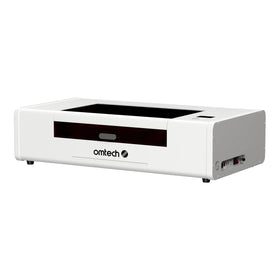
- Recommended model: The OMTech Galvo 30W is a compact and integrated fiber metal engraving machine with a 5.9" x 5.9" working area.
50W to 60W (The Sweet Spot for Serious Hobbyists and Entrepreneurs)
- Pros: Cuts thin metals and handles deep engraving (like coins, firearms, and watch dials) twice as fast as a 20W/30W unit. Offers a great balance of speed, cost, and power.
- Cons: Slightly more expensive upfront than a 30W, though prices have dropped.
- Models to consider: OMTech Galvo 50W Fiber Laser Engraver. A compact and Integrated fiber laser marker for metal with a 5.9" x 5.9" Working Area
80W to 100W+ ( For Industrial / High-Production Use)
- Pros: Best for rapid production, large-area applications, or heavy-duty deep engraving.
- Cons: Diminishing returns on fine details, potential plasma formation issues on specific precious metals like silver, and often limited to smaller lens fields (like 4" x 4") to keep maximum power density.
- Models to consider: The OMTech MOPA 80W Fiber Laser Engraver. This model is a split-fiber laser marking machine with a 6.9" x 6.9" Working Area
Fiber Laser Engraver Wattage Chart
| Fiber Laser Power | Best For | Typical Applications |
| 20W–30W | Light marking and basic engraving | Serial numbers, logos, QR codes, and text on stainless steel, aluminum, and other metals |
| 50W–60W | Deeper engraving and more versatile production | Deeper metal engraving, detailed designs, jewelry, tools, and personalized products |
| 80W–100W | Faster production and deeper material removal | Industrial components, deeper engraving, and high-volume customization |
| 100W+ | Demanding industrial applications | Heavy-duty engraving, deeper material removal, and specialized production tasks |
As a rule of thumb: Choose 20W–30W for basic marking and personalization, 50W–60W for a balance of versatility and productivity, and 80W or more for demanding jobs or higher production volumes.
Choosing Fiber Laser Engraver Wattage: Why MOPA Matters
When it comes to fiber laser engravers, whether or not the unit is a MOPA or Q-switched laser engraver matters just as much as its wattage. When you cut or engrave with a fiber laser engraver, the final results are determined not just by the wattage of the machine, but also by
- Its laser source type (MOPA or Q-switched)
- Pulse frequency and pulse duration
- Lens choice.
A MOPA fiber laser gives you greater control over these factors (especially the pulse parameters). This explains why, for applications like color marking on stainless steel, you need MOPA capabilities in addition to choosing the right wattage. Choosing a MOPA source gives you a wider frequency range, allowing for color marking, finer control on delicate parts, and better annealing on various metals.

Consider the following OMTech MOPA fiber laser engravers based on which wattage range is best for you:
- 20W to 30W: OMTech MOPA 20W. A compact and integrated fiber laser engraver for metal with a 5.9" x 5.9" working area
- 50W to 60W:OMTech MOPA 60W. A split fiber laser engraver with a 6.9" x 6.9" working area. Best for brass, carbide, granite, stainless steel, metal, plastic, etc.
- 80W to 100W+: OMTech MOPA 100W. A split fiber laser engraving machine equipped with two workspaces, 6.9 x 6.9 in. and 4.3 x 4.3 inches. Capable of engraving at speeds of up to 10,000 mm/s,
What Wattage CO2 Laser Do You Need?
When it comes to deciding what wattage CO2 laser engraver you need, the principal deciding factor has to be your level of experience and the type of projects you intend to cut or engrave with the machine. In general, 40W to 45W is best if you are a beginner; 60W to 100W is an ideal wattage range for commercial and business use, while 90W or higher is often chosen by experts and business owners who value extended tube longevity.

1. 40W- 45W (e.g., K40+ models)
40-watt- 45-watt CO2 laser engravers are best if you are an amateur in laser engraving, or a hobbyist focusing on small crafts (keychains, phone cases, coasters), light engraving, and cutting thin materials (up to 3 mm wood or 5mm acrylic). Here are the pros and cons of CO2 lasers in this range:
- Pros: They are budget-friendly, have a smaller footprint, and provide good low-power detail control for fine engraving.
- Cons: Limited cutting depth; cannot process bare, unpainted metals.
Recommended model: OMTech K40+ 45W Desktop CO2 Laser Engraver. This is a K40+ 45W desktop CO2 laser engraver with 8" x 12" working area and detachable honeycomb workbed
2. 60W – 100W CO2 Laser Engravers
60W – 100W is the ideal range to go for if you are looking for a laser engraver for business or serious hobby use. CO2 lasers in this power range provide much faster engraving speeds ( 600+mm/s) and can cut thicker non-metal sheets (like 1/4" to 3/8" plywood or acrylic) and handle heavier use. Here are some pros and cons:
- Pros: Because they are higher power ( 80W or 100W system), you can run them at a lower percentage of their max output so the tube works less hard and can last longer.
- Cons: They are usually more expensive (about $1500+ more expensive than entry-level desktop models), take up much more space due to their bigger sizes, and require proper water cooling (and potentially an industrial chiller).
Recommended models
- OMTech 60W CO2 Laser Cutter and Engraver is a 60W CO2 laser cutter and engraver with a 20" x 28" working area and autofocus.
- OMTech Pronto 40 90W CO2 Laser Cutter: 90W CO2 laser cutter and engraver with a 24" x 35" working area and autofocus.
3. 120W+ CO2 Laser Engravers (Heavy Duty / Industrial)
For most hobbyists and business owners in the laser engraving industry, a 120W model will not even be in your consideration. These are only recommended if you are constantly cutting thick acrylic (1/2 inch or more) or doing high-volume commercial production. Here are some pros and cons:
- Pros: Maximum cutting speed and power.
- Cons: Harder to fine-tune for delicate, low-power surface engraving because of higher minimum firing thresholds.
Recommended Model: OMTech Pro 3655 130W/150W CO2 Laser. This is a 1300/150W line of CO2 laser engravers that engrave up to a top speed of 1200 mm/s and feature built-in air assist, autofocus, and water chillers.
CO2 Laser Engraver Wattage Comparison
| CO2 Laser Wattage | Best For | Typical Applications | Recommended OMTech Model |
| 40W–45W | Beginners and hobbyists | Small crafts, keychains, coasters, light engraving, thin wood and acrylic cutting | OMTech K40+ 45W |
| 60W | Small businesses and serious hobbyists | Custom gifts, wooden signs, acrylic products, small-batch production | OMTech Pronto 35 60W |
| 80W–100W | Growing businesses and professional workshops | Larger signs, thicker materials, faster cutting, regular commercial production | OMTech Pronto 40 90W |
| 120W–150W+ | Industrial users and high-volume businesses | Thick acrylic cutting, large-scale production, demanding commercial applications | OMTech Pro 3655 130W/150W |
How Many Watts Do You Need for Common Laser Engraving Projects?
| Project or Application | Recommended Laser Type | Suggested Wattage | Why This Wattage? |
| Engraving wooden keychains and coasters | CO2 | 40W–45W | Sufficient for detailed engraving and light cutting |
| Cutting thin plywood | CO2 | 40W–60W | Suitable for small woodworking projects |
| Cutting acrylic signs | CO2 | 60W–100W | Provides faster cutting and handles thicker sheets |
| Producing wooden signs commercially | CO2 | 60W–100W | Balances production speed and cutting capability |
| Cutting thick acrylic sheets | CO2 | 120W–150W+ | Better suited for demanding cutting applications |
| Engraving metal jewelry | Fiber | 20W–60W | Suitable for detailed designs and personalization |
| Marking serial numbers and QR codes on metal | Fiber | 20W–30W | Sufficient for basic metal marking |
| Deep engraving on stainless steel | Fiber | 50W–100W | Higher power improves material removal efficiency |
| Color marking stainless steel | MOPA Fiber | 20W–60W | Adjustable pulse parameters allow greater control over marking results |
| High-volume industrial metal engraving | Fiber | 80W–100W+ | Higher power supports faster material removal and production |
Final Thoughts on Deciding How Much Wattage You Need in a Laser Engraver
Choosing the right laser engraver wattage starts with understanding what you want to make. For metal marking and personalization, a 20W–30W fiber laser may be sufficient, while a 50W–60W MOPA model offers greater flexibility for deeper engraving and more demanding production. For wood, acrylic, and other compatible non-metal materials, a 40W–45W CO2 laser can suit hobby projects, while 60W–100W models are often better suited to growing businesses.
Ultimately, the key is to buy for the materials you work with and the production demands you expect, not wattage alone. The right combination of laser type, power, features, and working area will help you get the results you need without overspending.
You may also be interested in how to choose a laser cutter for business