






How to choose a laser cutter for business
Once you have a unique product idea and have identified your target materials, it is time to choose the best laser cutting machine for your business.
While there is no strict process to follow when deciding which laser machine will be best, it always helps to have a framework that helps you narrow down your options to not just a machine that suits the materials you currently work with, as well as your present size and business needs, but one that is likely to remain adequate in the short to medium term, even if your business expands quickly.
Here is a practical framework for selecting the right machine for commercial use.
Choosing a Laser Cutter For Business: 4 Key Factors to Consider
1. Match the Laser Type to Your Materials
This is the first and most important rule when choosing a laser cutter for business: your material choice dictates which type of laser source your business needs. In other words, you need a laser cutter that is designed to cut 90% of the material (s) you will be working with most frequently. This is very important because the different types of lasers have different wavelengths and are optimized for cutting different materials:
-
CO2 Laser cutters (10,600 nm wavelength) are best if you are cutting organic materials like wood, acrylic, leather, paper, and fabric. A CO2 laser cutter is the standard workhorse for general crafting and signage businesses.
-
Fiber / MOPA Lasers (1,064 nm wavelength) are best if you plan to do deep engraving, marking, or color-shifting on bare metals and stone. Diode or CO2 lasers cannot effectively process raw metal.
-
UV Lasers (typically 450 nm wavelength) are best if you are doing "cold processing" on delicate materials like glass, acrylic, and delicate organics without the burn marks or heavy soot associated with infrared or diode lasers.
Choosing a Laser Cutter For Business: Material Compatibility Matrix
| Material | CO₂ Laser (10,600 nm) | Fiber Laser (1,064 nm) | Blue Diode (450 nm) | Important Notes |
| Wood & MDF | Excellent | Cannot Process | Good (Slow) | CO₂ cuts quickly with clean edges. Diodes work but take multiple slow passes on thicker wood. |
| Cast Acrylic | Excellent | Cannot Process | Color Dependent | CO₂ cuts all colors, including clear. Blue diodes cannot cut clear or white acrylic at all. |
| Anodized Aluminum | Engrave Only | Excellent | Engrave Only | CO₂ and Diodes can strip away the colored anodized layer, but only a Fiber laser can actually cut or deeply engrave the metal underneath. |
| Stainless Steel / Brass | Cannot Cut | Excellent | Cannot Cut | CO₂ requires an expensive chemical spray (like Cermark) just to leave a surface mark. Fiber cuts and engraves raw metal directly. |
| Leather | Excellent | Cannot Process | Good (Slow) | CO₂ is ideal for production. Warning: Never cut faux leather/PVC, as it releases toxic chlorine gas. |
| Glass | Engrave Only | Cannot Process | With Modifiers | CO₂ fractures glass beautifully to engrave it. Diodes require painting the glass black first so the light has something to absorb. |
2. Evaluate How Much Power and Production Speed You Need
Once you have settled on which laser cutting machine you need, the next step is to decide how much power you need. Laser engravers are generally classified into three power tiers: entry-level laser engravers (<40W), mid-range laser engravers (40-150W), and industrial lasers (1000W+).
40W-150W Laser Cutter: Best for Small Business Use
For laser cutting on a commercial scale, any laser cutting under 40W is generally too slow for batch production. A 50W to 80W+ CO2 laser is usually the minimum sweet spot for a viable cutting/engraving side-hustle or small business.

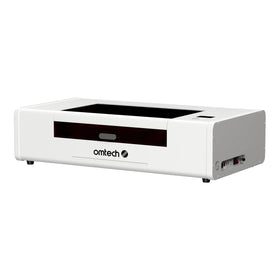
For a business entering the 50W–80W CO₂ range, the OMTech Maker AF2028-60 is another example worth considering. It provides 60W of CO₂ power, a 20" × 28" work area, autofocus, and a maximum engraving speed of 600 mm/s. OMTech laser engravers within this power range are best for small businesses and growing operations that need more workspace and production capability without moving immediately into a larger industrial machine.
On the other hand, industrial laser cutters are also a bit of an overkill for a laser cutting business. Large models like the OMTech F-22 (1500W) are for laser sheet metal, which is way above the level of a laser cutting business making precision products, custom signage, and personalized goods, etc.
Pro Tip
Ensure the machine supports industry-standard, third-party software like LightBurn. As much as you can, stay away from laser cutting machines that are only compatible with proprietary cloud-locked systems: these tend to limit workflow reliability and third-party repair.
3. Factor in Infrastructure and Safety
Enclosure and Ventilation: Commercial operation requires a Class 1 enclosed cabinet with an aggressive inline exhaust fan or a dedicated fume extractor. Do not attempt to run open-frame or poorly vented diode lasers indoors unless you want toxic fumes or smoke filling your workspace.

Laser Cutter For Business: Which Machine Category Should You Choose?
1. The Custom Giftware and Sign Shop (Wood, Acrylic, Leather)
If your business focuses on layered wood signs, custom acrylic cake toppers, leather patches, or cardboard packaging, the best option is a CO₂ laser cutter. Consider a mid-range prosumer unit like an CO2 cabinet system. These provide the speed, enclosure safety, and material versatility needed to turn a profit.
The OMTech Pronto 35 60W is a natural fit for this category because its 20" × 28" work area provides room for larger signs and multiple smaller products, while its 60W CO₂ source is suited to materials such as wood, acrylic, and leather. Its autofocus and 1,000 mm/s maximum engraving speed are also useful for businesses handling repeated orders rather than occasional hobby projects.
2. The Metal Customizer (Tumblers, Jewelry, Tool Marking)
If your business revolves around engraving stainless steel tumblers, permanent serial number tags, custom brass jewelry, or knives, you must choose a Fiber Laser. A 30W to 50W Galvo Fiber laser from brands like OMTech Fiber or Con Maker will engrave metals in seconds compared to the minutes or hours a hobby machine would take.
3. The Low-Volume Side Hustle (Craft Fairs and Prototyping)
If you are operating out of a tiny spare bedroom, have a limited budget, and primarily work with thin wood or dark opaque materials at low volumes, a Diode Laser is a viable starting point.

Some Important "Hidden" Costs of a Laser Business
When budgeting, veterans always emphasize that you must allocate roughly 20% to 30% of your total funds to essential accessories that often aren't included with the base machine:
- Fume Extraction: An inline fan or dedicated filtration unit to pull toxic smoke out of your workspace ($200 – $1,500).
- Cooling Systems: A dedicated industrial water chiller (like a LightBurn-compatible CW-5200) to keep CO₂ tubes from overheating and cracking ($400 – $600).
- Software: A license for LightBurn, the universal industry standard ($60 – $150).
Machine Recommendations Based on Budget Tiers
1. The Entry/Side-Hustle Budget: $1,000 – $3,000
At this price point, you are buying a machine for low-volume customization, prototyping, or a part-time hobby business. These machines are slower and require more manual setup, but they have lower entry barriers.
OMTech 40W - 55W desktop laser engravers give you true CO₂ capability (meaning it can cut clear acrylic and wood quickly) at a rock-bottom price. It requires a bit of DIY tinkering but is highly upgradeable.
3. The Small Business Sweet Spot: $4,000 – $9,000
If your business is custom tumblers, metal jewelry, or tool marking, a fiber laser, specifically a MOPA fiber laser in this price range, will permanently etch metal in a matter of seconds. OMTech currently offers high-quality, beginner-to-professional-level Galvo fiber laser engravers as well as MOPA configurations in multiple power levels, allowing businesses to select a machine according to their marking, engraving, and production requirements.
3. The High-Output Industrial Budget: $10,000+
Designed for established storefronts, sign shops, or industrial manufacturing. You are paying for ultimate precision, extreme speeds, and rapid-response technical support packages with virtually zero downtime.
A Pro Tip For Maximizing a Tight Budget When Starting a Laser Cutting Business
If your target machine is out of reach, Reddit's top business strategy is to outsource your initial manufacturing. Use a local or online laser cutting service (like SendCutSend or Ponoko) to fulfill your first few customer orders. Once your product proof-of-concept generates profit, use that revenue to fund a machine in a higher, more reliable tier.
Final Thoughts on Laser Cutting Machines For Business
Choosing a laser cutter for business is ultimately about matching the machine to the work you actually plan to sell. Start with your materials, then work backward through laser type, power, work area, production speed, software, ventilation, cooling, and the amount of work you expect the machine to handle.
You may also be interested in this complete guide on how to laser cut metal and the different projects you can accomplish for your business.