








How to Engrave Stone With a Laser Engraver
The most important thing to know about engraving stone with a laser engraving machine is that your results will depend heavily on the stone itself (how suitable it is for the project) and how well you can control the power of your laser engraver.
Stone engraving is not difficult, but it requires a lot of precision: every decision, from selecting the stone and preparing its surface to choosing power settings and engraving methods, affects how visible and professional the final engraving will look.
So, the best way is to approach stone engraving systematically, so you can achieve reliable results, whether you are making one custom gift or producing products at scale.

Step-by-Step Process for Stone Laser Engraving
I find that stone engraving is really smooth if you prep everything you need and follow a logical sequence. With this method, each step builds on the previous one and helps eliminate variables that could affect the final result.
Step 1: Select the Right Stone
The first step in stone laser engraving is always to choose a stone that can produce the desired contrast and appearance. Remember, dark stones like granite and slate are best for creating high-quality results with a laser engraver. They both absorb heat beautifully, leaving high-contrast, clean engravings.
- Avoid unpolished river rocks or stones containing large amounts of quartz or moisture. These are not ideal because they trap moisture within. When hit with a high-intensity laser, the trapped moisture turns to steam, and this can cause the rock to crack or explode.
- White or multi-colored granite is notoriously difficult because lasers react differently to varying crystalline densities. You’d need a high-quality commercial-grade laser engraving machine like the 130W OMTech Pronto 60 to create anything with them.
This step comes first because the stone itself determines many of the settings and techniques you will use later.
Step 2: Clean the Stone's Surface
Once the stone is selected, the next step is to thoroughly clean and dry it. The objective of cleaning a stone before engraving is to remove anything that could interfere with laser interaction. The way I prep the stone is by wiping it with isopropyl alcohol on a clean cloth to remove dust and body oils. Here’s what to do:
- Wash it: Dust, grease, and dirt block the laser and prevent a clean burn. If you are working with slate or granite, make sure they are wiped thoroughly until the surface is clean and clear.
- Dry completely: There cannot be any moisture in or on the stone. Trapped moisture (even if it is within the stone) interferes seriously with the laser. Always let the stone sit until it is bone dry.
Step 3: Create and Prepare Your Design
Before running the machine, prepare your artwork. It is not really about the design itself because almost any design works on stone. At this stage, you are ensuring the design matches the stone's size, shape, and intended viewing distance.
- Create high-contrast, black-and-white vector or dithered raster files in Adobe Illustrator or Inkscape. I, like most people, go for Adobe Illustrator.
- Then, convert images to laser-ready formats using tools like ImagR or GIMP.
You can enhance visibility by painting the engraved surface or adding a woodcut effect before burning. Even if the design looks excellent on a computer screen, it may become difficult to see on stone if they are too small.
 Step 4: Dial In Your Settings
When it comes to laser engraving stone, there are no universal settings that will work for every rock. This, actually, is one of the peculiarities of stone engraving: stones vary drastically. The correct approach is to run a power/speed test matrix on a scrap piece of the same rock first and get a baseline setting. Then you adjust it from rock to rock as you engrave.
- Fiber Lasers: For machines like a 30W fiber laser engraver, go for around 20kHz, 90% power, and 256 passes (using multiple shallower passes to avoid cracking the stone).
- CO₂ Lasers: For a 60W machine, start at 100% power and 30% speed. If you are using a lower-wattage machine (<60W), drop the speed to 15%.
- Diode Lasers: For smaller or shallower crafts on slate, 20W to 40W diode lasers can mark the material with multiple cross-hatch passes.
At this stage, your goal is to identify the best combination of power, speed, resolution, and number of passes for this project.
Step 5: Focus the Laser
Focusing your laser engraver is a critical skill you must learn if you are going to do stone engraving. For stone laser engraving, you can choose between two primary focusing methods depending on whether your stone is perfectly flat (like a tile) or uneven (like a river rock).
For flat stones/tiles, use a spacer block
- The most common method of focusing your laser to engrave a flat stone is to use your manufacturer-provided acrylic or metal focus block. Place it on top of the stone and lower the laser head until it just touches the block.
- You can also try manual zeroing. Lower the laser nozzle until it rests lightly on the stone's surface, then raise the Z-axis by your machine’s specified focal distance (usually around 2 mm to 10 mm depending on your lens).
For uneven rocks, use the defocus trick
Because natural stones are highly uneven, what experienced engravers do is set the focus point 2 mm to 4 mm above the material. This slightly increases the laser beam's spot size and depth of focus. It makes lines softer but prevents the laser head from crashing into bumps on unpolished, irregular rocks.
Step 6: Secure the Stone
The stone must remain stable throughout the engraving process: any movement will ruin alignment and distort your detail.
To secure a stone for laser engraving, most people use modeling clay to level the surface or build a custom jig using cardboard or wood so it does not shift during the process. I personally prefer Plastalina: it is solid, hugs the stone tightly, and is dependable.
- If the stone is natural, uneven, or round (like a river rock), use standard modeling clay (like Plastalina). Press the rock to create a custom cradle that fits its contours, locking it firmly in place, so it doesn't shift.
- If you are engraving several identical stones, you craft a custom jig using a sacrificial piece of cardboard or craft foam. Place a piece of cardboard on your laser bed, create a vector box the size of your stone, and use your laser to cut the shape out. Without moving the cardboard, place your stone inside the cut-out hole. The surrounding cardboard will hold the stone rigidly in place while you raster the design.
Stabilizing the rock securely ensures a uniform focal distance and prevents the beam from missing the target.
Step 7: Perform the Engraving
Once preparation is complete, begin engraving. The objective is to produce a consistent contrast across the entire design. Monitor the process and watch for unexpected reactions, especially when working with unfamiliar stone types.

Step 8: Clean and Inspect
After burning, loose particles will remain in the crevices. Use a stiff brush, tweezers, or wash the stone under running water to clear the dust. When you are done, inspect the stone for chipping and fracturing, verify the depth and legibility of the design, and inspect for color staining.
Step 9: Post-Cleaning Maintenance
- Laser engravings on stone are typically pale. To make the design pop, paint-fill the engraved areas with white or colored acrylic paint. Wipe away excess paint while it's still wet so it only stays in the burnt grooves.
- To darken the un-engraved areas and give the stone a finished look, wipe the finished, clean stone with mineral oil.
If the stone sits outdoors or will undergo heavy handling, apply a clear, penetrating stone sealer after it is completely dry. This protects the porous material and keeps your laser-engraved details crisp.
Important Tips for Stone Laser Engraving
1. It is Less About Power and More About Control
Firstly, stone is not like many of the other laser-engraving materials like wood, acrylic, or leather; it is not engraved by removing large amounts of material. Instead, the laser heats the surface of the stone, creating microscopic fractures, texture changes, or color changes that become visible. In many cases, the laser will be creating contrast rather than depth.
This distinction is important because it explains why successful stone engraving is less about power and more about control.
2. Always Start by Finding Baseline Settings
One of the biggest mistakes beginners make is trying to come up with a universal setting that will work for every stone. That's a fool's errand! You can get two pieces of granite from the same supplier, and each piece reacts differently to the laser.
- Slate from different quarries can produce different levels of contrast.
- River rocks can vary dramatically from one stone to another.
Because you cannot predict how stone will react when exposed to laser power, you need to begin with a baseline setting. It gives you a starting point that you can adjust based on results.
Suggested CO2 Laser Engraver Settings
| Machine Type | Power | Speed | Dithering |
| 40W–60W CO2 Laser Engraver | 100% | 15%–30% | Stucki or Jarvis dithering |
| 80W–100W Laser Engraver | 70%–90% | 15%–30% | Stucki or Jarvis dithering |
Suggested Fiber Laser Engraver Settings
| Frequency |
20 kHz–30 kHz for deep material removal. |
| Speed and passes | Slower speeds and multiple passes (100–300+ passes) |
| Hatch spacing |
Use tight cross-hatching (e.g., 0.05mm spacing) with bidirectional lines |
Once you find a combination of power, speed, and resolution that produces acceptable contrast, you can begin fine-tuning for specific projects. With baseline settings, every project becomes a process of refinement.
3. The Proper Stone Preparation Matters
When using a laser engraver for stone engraving, remember that the laser can only interact with the surface it sees. Washing and drying the stone first is critical: if your stone is covered in dust, oils, fingerprints, polishing residue, or dirt, the engraving quality will be poor.
This is why it is you begin by cleaning and preparing the stone. Cleaning improves engraving consistency, reduces the risk of unwanted marks, improves contrast, and helps your details remain sharp.
For most projects, wiping the surface with alcohol or a non-residue cleaner is sufficient. The goal is to provide the laser with a clean, uniform surface so that every area reacts consistently.

4. Understand Color Contrast
Stone engraving stands or falls based on contrast. The amount and nature of contrast determine whether your engraving will remain visible or not. An engraving that creates strong contrast can be read from several feet away, but an engraving with poor contrast may be difficult to see even up close.
So, in some cases, users apply marking compounds, paint fills, or color-enhancing techniques after engraving to increase visibility. Also, different stones create contrast in different ways:
- Black granite often produces bright white engravings because the laser alters the surface structure.
- Slate commonly develops lighter engraved areas that stand out against its dark background. Lighter stones such as marble may produce more subtle results.
The best approach depends on the project. A memorial plaque may benefit from maximum contrast and paint filling, while a decorative stone may look better with a natural engraved appearance. The important point is that contrast should be considered before engraving begins, rather than after the project is complete.
Choosing a Stone Engraving Machine
Except you are making deep, professional-grade stone engravings, go for a CO2 laser engraving machine. CO2 laser engravers remain my preferred option for stone engraving: they provide excellent results on the widest variety of stones, from granite, slate, marble, basalt, to natural stones.

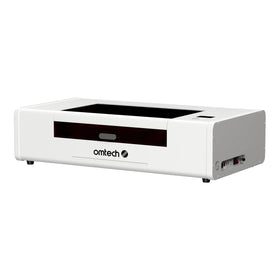
Many users at OMTech have agreed with this. OMTech Pronto Series laser engravers, especially the 60W, 80W, and 100W models, provide an excellent balance between speed and engraving quality.
- Consider the size of your work area: Think about the products you intend to create. Small gift items may only require a compact machine, while signs and memorials may require a larger bed size.
- Look for reliable cooling: Stone engraving jobs can be lengthy. A quality cooling system helps maintain consistent laser performance and extends component life.
- Evaluate software compatibility. Good software can dramatically improve workflow efficiency. Look for machines that support common design and engraving platforms.
5 Best Stones for Laser Engraving
- Granite: Granite is widely considered the best stone for laser engraving. It provides excellent contrast, is highly durable, reproduces fine details, and creates a professional appearance. Black granite is particularly popular for memorials and photo engravings.
- Slate: Slate is a favorite among small businesses and hobbyists. It also offers strong contrast, an attractive natural texture, and is very affordable. This will be the best option if you are going for coasters, serving boards, signs, and gifts.
- Basalt: Basalt is a dark volcanic stone that engraves exceptionally well. It combines excellent durability with strong engraving visibility.
- River Rocks and Natural Stones: Natural stones create unique, one-of-a-kind products. Because every stone is different, testing becomes especially important when working with these materials.
- Marble: Marble can produce elegant engravings, especially for decorative and memorial applications. The contrast may not be as dramatic as granite, but marble also creates that premium appearance for commercial projects.
Final Thoughts on Stone Laser Engraving
Learning how to engrave stone with a laser engraver is largely a matter of understanding the material and following a repeatable process. The most successful engravings are not the result of extreme power settings or expensive tricks. They come from careful preparation, smart testing, proper contrast management, and a clear understanding of how stone reacts to laser energy.
By focusing on strong contrast, establishing reliable baseline settings, and choosing the right machine for your needs, you can consistently produce professional-quality stone engravings that look impressive and stand the test of time.
You may also be interested in our complete guide on how to engrave marble.


![[Latest] Diode Laser vs. CO2 Laser vs. Fiber Lasers - Complete Guide](http://omtech.com/cdn/shop/articles/diode-vs-co2-vs-fiber-lasers_cad89d19-589c-4837-a019-48d69698f6f5.jpg?v=1789898499&width=200)

