







Can You Laser Engrave Silicone?
Yes, you can laser engrave silicone, but you need the right type of laser and carefully calibrated settings to achieve clean results without burning or deforming the material. In fact, when it comes to laser engraving silicone, the question is not whether it is possible, but how to do it effectively.
Silicone is a highly heat-resistant synthetic polymer, which makes it more challenging to engrave than many other materials. Unlike ordinary plastics, it does not necessarily melt and flow when exposed to heat. Instead, depending on its formulation and the laser you are using, it may discolor, decompose, or develop a frosted-looking surface mark.
This is why opinions about silicone laser engraving often vary in the laser engraving community. Some people find it difficult to achieve clean, consistent results, while others successfully engrave products such as silicone wristbands, watch bands, mats, and phone cases using specific laser setups.
In this guide, we'll explore why silicone can be laser engraved, which types respond best to laser treatment, what equipment you need, and how to achieve better engraving results.
Can You Engrave Silicone? 4 Reasons Why Silicone Laser Engraving Works
Silicone can be suitable for laser engraving because of its unique chemical and physical properties. Unlike many conventional thermoplastics, it does not simply melt and deform when exposed to concentrated heat.
Depending on its composition and the laser wavelength, the surface can undergo controlled ablation or thermal decomposition, producing a visible mark. Here are four properties that make silicone a viable material for laser engraving.
1. It can be ablated by a laser beam
High-quality silicone can be processed using CO2 and UV lasers. When exposed to sufficient laser energy, the surface material can break down or be removed, creating an engraved mark.
This is different from what happens with many thermoplastics, which tend to soften, melt, and deform under excessive thermal stress. However, the engraving quality depends heavily on the silicone formulation and the amount of heat applied.
2. It can produce natural color contrast
One of the advantages of laser engraving silicone is the potential for attractive color contrast. Depending on the formulation, laser treatment can remove or alter the surface layer, exposing a lighter underlying material or creating a frosted appearance.
Dark-colored silicone products are particularly useful because light-colored marks stand out more clearly against their surfaces. What this means is, depending on the kind of silicone you are working with, you may not need to resort to external ways to add color to your laser engraving.
3. The markings can be permanent
Unlike printed designs or surface-applied ink, laser engraving physically alters the silicone surface. This means the resulting markings on silicone are generally resistant to water, rubbing, and everyday handling.
This makes silicone laser engraving a useful alternative for applications where printed markings may gradually fade or peel off.
4. It can be easier to process than certain types of rubber
Silicone can be more manageable to process than some conventional rubber materials, depending on its composition. However, this does not mean every silicone product is automatically safe to engrave.
You should always check the manufacturer's material specifications and safety data before processing an unfamiliar silicone product.

Is Direct Engraving Silicone Always the Best Solution?
Although many people successfully engrave silicone directly, achieving clean, consistent results is not always straightforward.
The biggest challenge with engraving silicone products such as wristbands, watch straps, and flexible mats is controlling the amount of heat applied to the material. You need to find the right combination of laser power, speed, frequency, and focus to produce a visible mark without scorching, deforming, or damaging the surface.
This requires experimentation and a good understanding of your laser engraver. If you are new to silicone engraving, there is a considerable risk of wasting material while trying to find the right settings.
Molding: An Alternative to Engraving Directly on Silicone
If you are new to silicone processing, molding can be a more practical alternative to engraving finished silicone products directly.
Instead of engraving the silicone itself, you can use a CO2 laser engraver to create a mold and then cast silicone into that mold to reproduce the desired design. The process generally involves three steps:
-
Design your desired pattern or lettering using laser engraving software.
-
Use a CO2 laser engraver to create the corresponding mold from a suitable material.
-
Pour or inject silicone into the mold, following the silicone manufacturer's curing instructions.
Depending on the application, you can make laserable molds from suitable acrylic, wood, or MDF materials. However, you must ensure that the material is compatible with your casting process and that it can withstand the temperature and curing conditions involved.
The main advantage of using the molding method when engraving silicone is consistency. Rather than experimenting with laser settings on flexible silicone products, you can reproduce the same design across multiple castings.

Types of Silicone That Can Be Laser Engraved
Not all silicone products are manufactured the same way, which means they do not all respond to laser engraving equally. Their composition, hardness, pigments, fillers, and surface finish can significantly influence the results. Three common categories worth understanding are:
1. High-Consistency Rubber (HCR) / Solid Silicone Sheets
High-Consistency Rubber (HCR), also known as solid silicone rubber, is commonly used for industrial seals, gaskets, sheets, and various manufacturing applications.
Certain HCR silicone sheets respond well to CO2 laser processing, allowing users to create engraved patterns, markings, and shallow channels.
However, the quality of the engraving depends on the specific formulation. Some sheets produce relatively clean marks, while others generate excessive residue or discoloration. Always test a small section before processing an entire sheet.
2. Liquid Silicone Rubber (LSR)
Liquid Silicone Rubber (LSR) is a highly uniform material commonly used in injection-molded consumer products, including kitchen utensils, protective cases, and wearable accessories.
Its consistency can make it suitable for laser processing, but finished LSR products often present additional challenges.
For example, watch bands and phone cases may have thin walls, curved surfaces, or intricate shapes that make maintaining a consistent focal distance difficult. Excessive heat can also distort these products.
For these applications, lower-energy processing or a suitable UV laser may be worth testing, particularly when the design requires fine details.
3. Laserable Silicone Rubber for Stamps
Laserable stamp silicone is a specialized material designed specifically for laser processing.
Unlike ordinary silicone sheets, these products are formulated to produce detailed impressions with relatively clean edges and manageable residue. They are commonly used to manufacture custom rubber stamps, logos, and intricate lettering.
Their specialized formulation makes them particularly suitable for applications requiring fine details and consistent results.
How to Engrave Silicone
Although silicone can be laser engraved, its heat-resistant properties create some unique challenges. You need to select the right equipment and use appropriate settings to prevent excessive charring, discoloration, and material deformation.
There are two important considerations:
-
Choose a laser engraver with a wavelength suitable for the silicone formulation you intend to process.
-
Use appropriate laser settings and processing techniques to control heat and achieve the desired engraving depth and contrast.
Let's look at the available laser technologies and how they perform when engraving silicone.
Choose the Right Laser Engraver
The main laser technologies worth considering for silicone engraving are CO2, diode, and UV lasers. Fiber lasers are generally less suitable for this application. Each technology interacts with silicone differently, so your choice should depend on the type of silicone, the desired marking quality, and the complexity of your designs.
CO2 Laser Engravers: A Common Choice for Silicone Engraving
CO2 laser engravers are among the most commonly used machines for processing silicone materials. Their 10.6 μm wavelength can interact effectively with many silicone formulations, allowing the laser to remove or modify the surface and produce visible markings.
A CO2 laser with sufficient power can process silicone sheets, stamp materials, and certain finished products. However, higher wattage does not automatically produce better results. You still need to balance power and speed to prevent excessive heat buildup. CO2 machines are particularly useful when working with larger silicone sheets or producing multiple designs.
ii. Diode Laser Engravers: Suitable for Certain Silicone Materials
Diode laser engravers can also process some silicone products, but their performance is less consistent. Blue diode lasers generally work better with dark or heavily pigmented silicone because these materials can absorb more of the laser's energy. Light-colored or translucent silicone may absorb the beam poorly, making it difficult to achieve consistent markings.
If you are using a diode laser, test the material first and avoid assuming that settings that work on black silicone will also work on other colors.
iii. UV Laser Engravers: Excellent for Fine Details
UV laser engravers are worth considering when your priority is precision and minimal thermal damage. Their shorter wavelength allows them to interact with certain materials through photochemical and photothermal processes, making them suitable for fine marking applications.
On compatible silicone formulations, UV lasers can produce detailed markings while limiting the heat-affected area compared with some other laser technologies.
This makes them particularly attractive for small products, intricate logos, and applications where maintaining the original shape and surface quality is important.
However, not every silicone formulation responds equally well to UV processing, so material testing remains essential.
iv. Fiber Laser Engravers: Generally Not Recommended
Fiber laser engravers are primarily designed for processing metals and certain engineered plastics. Their typical 1064 nm wavelength is not well absorbed by many unmodified silicone materials, making conventional fiber lasers a less reliable choice for direct silicone engraving.
Rather than producing clean, consistent markings, they may cause localized heating, discoloration, or charring without effectively removing the surface material.
Specialized MOPA fiber laser settings may produce different results on certain formulations, but this does not make fiber lasers a dependable general-purpose solution for silicone engraving.
If silicone processing is your primary application, a CO2 or suitable UV laser is generally a better starting point.
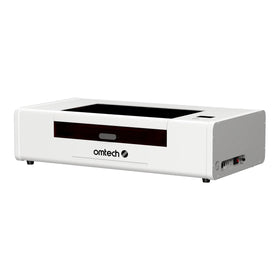
OMTech CO2 Laser Engravers For Silicone Engraving
For silicone engraving, a beginner or mid-tier CO2 laser engraving machine should suffice. Consider the following affordable models from OMTech:
-
The OMTech K40+ Laser Cutting Machine: If you are new to laser engraving or engraving silicone just as a hobby or for personal use, the OMTech K40+ is the most affordable, good-quality CO2 laser engraver you can get. Its fully enclosed design, along with 40W of laser power, 300 mm/s engraving speed, and a relatively sizeable 8" × 12" working area, offers a practical combination of engraving capability and affordability.
-
The OMTech Polar Lite 55W CO2 Laser Engraver: The Polar Lite is an excellent option if you are looking to explore silicone engraving with greater flexibility for commercial use. Its 55W CO2 laser provides sufficient processing capability for experimenting with different silicone formulations, while its 20.1" × 11.8" working area accommodates larger sheets and multiple smaller projects. It also has an inbuilt air assist and water-cooling systems, which are both crucial for demanding silicone engraving projects.
How to Laser Engrave Silicone: The Best Workflow and Tips
If you are planning to engrave silicone wristbands, mats, sheets, or other flexible products, following a controlled workflow will help you achieve more consistent results. Here are five practical tips to consider.
1. Start with low power and adjust gradually
Excessive laser power can cause silicone to char, discolor, or deform. Start with a conservative power setting and gradually increase it until you achieve the desired marking.
The exact settings depend on your machine's wattage, the silicone formulation, and the laser type. Avoid relying on universal power and speed recommendations without testing them on your specific material.
2. Use a single pass whenever possible
Multiple passes can introduce excessive heat into the same area, increasing the risk of charring, residue buildup, and surface deformation.
If you can achieve the desired result in one pass, that is generally preferable. If the engraving is too shallow, adjust your settings and test again rather than automatically repeating the process.
3. Choose dark-colored silicone for better contrast
Dark silicone products are often a good starting point because the lighter marks produced by certain laser-processing methods are easier to see against darker surfaces.
Black, navy, and other deeply pigmented silicone materials can provide attractive contrast, although the final result depends on the material formulation.
4. Clean the engraved surface carefully
Laser processing can leave behind powdery residue and surface deposits. Allow the material to cool, then follow the manufacturer's cleaning recommendations. For suitable silicone products, mild soap and water can help remove loose residue.
Some makers also recommend applying a small amount of vegetable oil to restore the appearance of certain silicone surfaces after cleaning. However, this is not appropriate for every product, particularly food-contact applications. Always follow the manufacturer's care instructions.
5. Use proper ventilation and extraction
Ventilation is essential when laser engraving silicone. Although silicone does not contain chlorine in the way PVC does, laser processing can still release smoke, airborne particles, and potentially hazardous decomposition products depending on the material's additives and formulation.
Use an appropriately sized fume extraction system, maintain good airflow, and follow the laser manufacturer's safety recommendations. Never assume that a material is safe to laser process simply because it is marketed as silicone.
Popular Silicone Laser Engraving Projects to Try
-
Smartwatch and fitness bands: You can customize silicone watch bands (such as Apple Watch or Fitbit straps) with names, geometric patterns, or minimalist logos is one of the most common projects discussed.
-
Personalized baby spoons and teethers: Engraving food-grade silicone baby spoons or teether toys with custom names or icons. Tip: Clean any white residue afterward with rubbing alcohol and a Q-tip.
-
Custom texture sheets and molds: Pouring liquid RTV silicone into a plywood dam to create a solid block or sheet, then laser engraving custom patterns, brick textures, or branding into it to use as polymer clay or resin molds.
-
Silicone keychains and bag tags: Cutting or engraving small, dark-colored silicone blanks to make durable, flexible, and waterproof keychains for small businesses.
-
Grip bands and bottle sleeves: Adding custom text or logos to silicone bands used for water bottles, thermal mugs, or camera lens rings.
Final Thoughts: Is Silicone Worth Laser Engraving?
So, can you laser engrave silicone? Absolutely. However, getting clean, consistent results requires more than simply choosing a powerful laser engraver and adjusting the speed settings.
CO2 and UV laser engravers are generally the most practical options, although diode lasers can also work with certain silicone formulations. Fiber lasers, on the other hand, are usually less suitable for direct silicone engraving.
Ultimately, silicone laser engraving is a specialized but worthwhile application. With the right material, equipment, and processing techniques, you can create durable markings, custom designs, and professional-looking products.