







[Latest] Diode Laser vs. CO2 Laser vs. Fiber Lasers - Complete Guide

When it comes to laser engraving and cutting, choosing the right laser engraving or laser cutting tool is key to getting the best results. The most effective laser tools contain these three laser types: diode lasers, CO2 lasers, or fiber lasers, each with its own strengths and weaknesses.
At OMTech, we’ve seen each laser in practice. Our experts have put together this guide comparing these three laser engraving types to help you understand how they work, what materials they can handle, and which one might be the best fit for your projects. Whether you’re a hobbyist or a professional, read up so you can choose between CO2, fiber, and diode lasers for your projects!
Key Takeaways: Diode vs. CO2 vs. Fiber Lasers
We’ve summarized the major differences between diode, CO2, and fiber lasers in the table below:
|
Feature |
Diode Laser |
CO2 Laser |
Fiber Laser |
|
Wavelength |
800 – 980 nm |
10,600 nm |
1064 nm |
|
Primary Use |
Engraving on wood, plastics |
Cutting/engraving non-metals |
Industrial metalwork |
|
Precision |
High |
Very high |
Extremely high |
|
Power & Speed |
Lower, slower |
Higher, faster |
Very high, fastest |
|
Material Compatibility |
Limited (softer materials) |
Broad (non-metals) |
Metals, hard plastics, ceramics |
|
Cost |
$400 – $550 |
$2,000 – $10,000 |
Similar to CO2 laser for lower-power models Expensive for industrial-grade |
|
Energy Efficiency |
30 – 50% |
10 – 20% |
Higher than CO2 |
|
Maintenance |
Low |
High |
Low |
|
Best For |
Hobbyists, small projects |
Non-metal-focused businesses |
Industrial applications |
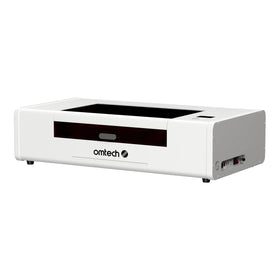
For beginners, OMTech offers a 40W CO2 laser machine around $600. Know more details about the machine.

Diode vs. CO2 vs. Fiber Laser: How They Work
Choosing whether to use a diode laser vs. a CO2 laser might seem like a hard task, but when you understand how each one works, it becomes easier. Here’s what you need to know about each laser technology.
How Diode Lasers Work
Diode lasers are compact and efficient devices that use semiconductor materials to create laser light. The process begins when an electric current passes through the diode, causing electrons in the semiconductor to jump from a higher energy level to a lower one. This transition releases energy in the form of photons, which is the light we see. These photons bounce between mirrors inside the diode, amplifying the light and creating a focused laser beam.
Unlike other lasers that rely on different media like gas or solid-state materials, diode lasers use semiconductor materials as the active medium. Diode lasers use less electricity, making them more efficient and cost-effective. They are also smaller and easier to use. Diode lasers are known for their precision and are often used for engraving delicate or fine details on materials like wood, plastic, and so on.
5W vs 10W vs. 20W vs. 40W Diode Laser Engravers
Diode lasers usually come in different power ranges, from entry-level 5W–10W up to high-output 20W–40W multi-diode modules.
- 5W-10W diode laser engravers are best for fine-detail engraving: they use a single diode, which creates a sharper laser spot. This is why they are ideal for high-resolution images, delicate shading on wood, and glass engraving (using a marking spray).
- A 10W laser combines two diodes to double the cutting and engraving speed of a 5W unit and is better for light cutting (3mm to 4mm plywood) and colored acrylic up to 5mm.
- A 20W to 40W diode laser is best for fine, high-detail engraving and lighter cutting. It is also great for cutting thick wood (up to 10- 12 mm plywood) in fewer passes and engraving detailed vector graphics, photos, and leather at high speeds.
How CO2 Lasers Work
CO2 lasers operate on a different principle compared to diode lasers. These lasers use a gas mixture primarily composed of carbon dioxide (CO2), nitrogen, and helium. When an electric current is applied, it excites the nitrogen molecules, which, in turn, transfer energy to the CO2 molecules.
This energy causes the CO2 molecules to emit light in the infrared spectrum. The light is then directed and focused through mirrors and lenses to produce a powerful and precise laser beam. CO2 lasers, like those available in OMTech’s collection, are widely used for cutting and engraving non-metallic materials such as wood, acrylic, leather, and glass, offering deep cuts and high-speed performance.
CO2 laser engravers use a sealed glass or RF metal tube filled with a carbon dioxide gas mixture to emit an infrared beam (10,600 nm). Power typically runs from 40W up to 150W+.
Types of CO2 Lasers
1. K40" Budget DIY Lasers (40-45W)
These are cheap, affordable entry-level 40W CO2 lasers. Buyers consider these the ultimate rite of passage for budget hackers. They are incredibly cheap, but if you are buying, you must make sure it comes complete with all its parts.
2. Desktop laser engravers (Usually 40W-55W)
These are designed to look like consumer electronics (like a 3D printer). They usually feature user-friendly software, have built-in cameras for material alignment, autofocus function, and internal cooling. Consider a desktop laser engraver if you are a crafter, Etsy seller, or a home user who wants a plug-and-play experience without a massive learning curve.
3. Cabinet CO2 Laser Engravers (60W to 130W+)
These are larger, heavy metal boxes with gantry sizes ranging from 20"x28" up to massive industrial dimensions. They generally utilize reliable Ruida controllers that plug natively into LightBurn. Consider one of these if you are a mid-tier hobbyist or run a small shops that need raw cutting power and plenty of workspace for bulk items or signage.
How Fiber Lasers Work
When a light source pumps energy into a fiber, rare-earth elements (such as erbium, ytterbium, or neodymium) doped within the fiber are excited. These elements have specific energy levels that enable them to efficiently absorb and emit light.
As the light source excites the atoms within the fiber, they reach an excited energy state. If another photon with the same energy as the excited atoms passes through the fiber, it can stimulate the excited atom to emit a photon with the same energy and phase.
The fiber is placed within an optical cavity consisting of two mirrors—one highly reflective and the other partially reflective. This cavity helps amplify the light through multiple reflections, creating a coherent laser beam. The partially reflective mirror allows a portion of the amplified light to escape the cavity, forming the laser beam output. This output beam can be directed and focused for various applications such as cutting, welding, or marking.

Advantages and Limitations of Diode, CO2, and Fiber Lasers
Now, let's explore the advantages and disadvantages of the three types of lasers.
Advantages of Diode Lasers
- Diode lasers are known for their affordability ($400 to $550 on average) and compact size (around 100 grams with a heatsink), making them accessible to everyone. They also consume smaller amounts of power than CO2 lasers, which makes them energy-efficient and cost-effective to operate.
- They’re particularly effective for engraving on materials like wood, plastic, leather, and acrylic. Diode lasers’ precise focus also allows for detailed engravings, making them ideal for intricate designs.
- They often have a longer lifespan (up to 50,000 hours), reducing the need for frequent replacements. These lasers tend to have higher electrical efficiency than CO2 lasers (30 to 50% compared to 10 to 20%).
- Some specially crafted diodes can cut/engrave metals like stainless steel, aluminum, copper, and some plastics and fabrics, making them pretty versatile.
- Diode lasers are generally perfect for fine-detail engraving. Most high-quality 10W or 20W diode modules have an incredibly tight focal spot (often as small as 0.05mm x 0.05mm). Diodes can pull off sharper text and finer photographic details on wood and leather compared to budget CO2 lasers, which tend to have a slightly coarser beam
- Also, there is no need for water cooling. Diode lasers are air-cooled by small attached fans. You don’t have to purchase, monitor, or maintain a heavy water chiller, and you don’t have to worry about a glass tube cracking in a cold garage over the winter. Much more convenient.
- Diode lasers are also very portable. You can easily buy cheap rail extension kits to expand your engraving area to massive proportions (like 400x1000mm) without breaking the bank. Some people even pick the entire machine up and place it directly on top of massive slabs of wood or 4x8 plywood sheets.
- Also, diode lasers have modular upgrades, and this is a huge advantage if you start with a low-power machine. For example, if you start with a 10W module and want more power later, you don't need a new machine. All you have to do is unbolt the head and plug in a 20W or 40W module.
Limitations of Diode Lasers
Despite their benefits, diode lasers have limitations. They’re less powerful than CO2 lasers, so they’re not really suitable for cutting thicker materials or working with very reflective or transparent surfaces. The range of materials they can effectively cut is limited, often restricted to softer substances.
Also, the engraving speed of diode lasers is slower compared to CO2 lasers, which can have a negative impact on productivity in high-demand settings. Their lower power also results in shallower cuts, which might not be suitable for certain applications.
Advantages of CO2 Lasers
CO2 lasers are highly versatile, making them ideal for diverse materials, including wood, acrylic, glass, fabric, stone, marble, leather, and more. One of the best features of CO2 lasers is that they can cut through thicker materials with ease, which really opens them up to many more uses than diode lasers.
- They have excellent cutting speeds, up to 1200 mm/s (the max speed of OMTech machines currently), and high power output, 30 to 150 W typical for home use, up to 400 W industrial. Plus, these lasers operate relatively quietly and produce smooth edges, reducing the need for extra finishing work.
- Their long lifespan and reliability make them a cost-effective option for both small businesses and industrial applications.
- They engrave cleanly with great results. CO2 lasers emit a far-infrared wavelength (10,600 nm) that is completely opaque to glass and acrylic. It vaporizes clear acrylic instantly and leaves behind a perfectly polished, glassy edge in a single pass. It also frosts glass cleanly without requiring messy black paint coatings.
- CO2 lasers are also more “customizable”. You can put in a short-focus lens (e.g., 1.5-inch) for razor-sharp, high-detail photo engraving, or swap to a long-focus lens (e.g., 4-inch) to give you a straight, deep beam profile perfect for cutting thick timber
- They are better for handling thick materials. A 40W–60W CO2 machine can cleanly slice through 1/4-inch to 1/2-inch wood or acrylic in a single, fast pass, and it leaves significantly less charring and smoke damage than a diode trying to do the same job across 4 or 5 slow passes
- You can be sure of true optical wattage with a CO2 laser. Many diodes are marketed using "input power" tricks, but standard CO2 lasers start at a true optical power of 40W, easily scaling up to 100W, 130W, or more.
- CO2 lasers also have versatile optics. They use a standard nozzle head where you can swap out the focal lens in less than a minute
Limitations of CO2 Lasers
One major drawback of CO2 lasers is their inability to effectively cut or engrave metals without extra equipment or treatments. CO2 lasers also tend to have lower energy efficiency compared to diode lasers, which can end up costing you more over time.
The initial cost of CO2 laser machines is often higher ($2,000 to $10,000), and they need regular maintenance, including the replacement of CO2 gas tubes. CO2 lasers are typically larger and need more space, which might be a constraint for smaller workshops or home use.
Advantages of Fiber Lasers
Fiber lasers can be used on a wide variety of metals and hard plastics. Although CO2 lasers can be used on these materials as well, they require a thermal/laser bond spray and multiple passes to achieve the desired results.
- They operate at a 1064 nm wavelength, which is highly absorbed by bare metals like stainless steel, titanium, brass, copper, and aluminum. They can etch or deep-engrave metals effortlessly without coatings.
- Fiber laser engravers are also a lot faster when it comes to engraving. They can complete a highly detailed metal engraving in seconds that would take a diode or CO2 gantry laser 20 to 30 minutes to perform.
- Fiber lasers offer a significantly smaller and cleaner spot size (superior beam quality) than CO2 or diode lasers. This makes them the ultimate choice for microscopic details, micro-text, serial numbers, barcodes, and intricate jewelry designs. MOPA fiber lasers can even tune frequencies to create vibrant colors on titanium and stainless steel.
Another advantage of fiber lasers is that they efficiently deliver energy to the material they are dealing with. This means lower energy costs and a more environmentally friendly production process. Fiber lasers have also evolved recently, sporting compact designs and convenient features like autofocusing. With these new fiber laser technologies, fiber lasers are becoming more versatile and convenient for at-home makers, small businesses, and more.
Besides, fiber lasers have a longer lifespan and require less maintenance compared to other types of lasers. This means less downtime and operating costs.
Limitations of Fiber Lasers
While fiber lasers are known for their power and durability, fiber lasers, particularly industrial models, can have a higher upfront cost. Home-use fiber laser markers are affordable, but often have smaller, specialized work areas designed for intricate and powerful applications, limiting their versatility in processing larger materials.
In terms of the materials they can work with, fiber lasers are generally less versatile compared to CO2 lasers. If your projects involve a variety of materials, not just metals, you may find that a combination of CO2 and fiber lasers is necessary to meet your needs.
Diode Laser vs. CO2 Lasers: Key Differences, and How To Choose Between Them
The main difference between CO2 lasers and diode lasers lies in the material they can engrave or cut, and the speed they run at. Diode lasers cut clear acrylic and run at much faster speeds, while CO2 lasers cost less and require easier maintenance. These two laser types across several core areas:
Materials and Cutting
- Clear and Translucent Materials: CO2 lasers handle clear, colored, and translucent acrylic easily because the infrared wavelength is absorbed by the material. Diode lasers, on the other hand, use blue/visible light that passes right through clear acrylic without cutting it.
- Wood and Organic Materials: Both diode and CO2 lasers cut wood well, but CO2 lasers are better for this purpose because they work faster and leave a cleaner edge. High-wattage diodes (20W to 40W+) can cut thicker wood now, but they still run slower than CO2 equivalents.
- Metals: Neither a diode laser nor a CO2 laser cuts bare metal. Diodes can mark or engrave pre-treated or coated metals, but results vary.
Speed and Mechanics
- CO2 Lasers: A CO2 laser uses a fixed tube in the back with a moving mirror and lens system. Because the laser head is very light, the gantry moves at high speeds.
- Diode Lasers: The heavy diode module mounts directly onto the moving head. This extra weight limits acceleration and overall movement speed compared to CO2 systems.
Maintenance and Setup
- CO2 Lasers: These require water cooling pumps or chillers, periodic mirror alignment, and eventual replacement of the glass gas tube. They also feature a larger footprint and full enclosure.
- Diode Lasers: These use simple electrical modules, often run on open-frame gantries, do not require water cooling, and involve very little alignment or maintenance.
Key Differences Summarized: Diode vs. CO₂ Laser
| Feature | Diode Laser | CO₂ Laser |
| Wavelength / Light Type | Visible blue light (~450nm) | Invisible infrared light (~10,600nm) |
| Clear & Translucent Acrylic | Cannot cut or engrave (light passes through) | Cuts and engraves cleanly and efficiently |
| Speed & Mechanics | Slower; heavy head moves on the gantry | Fast; gantry moves only mirrors/lens; tube stays fixed |
| Maintenance & Setup | Low maintenance; no mirror alignment needed | Higher maintenance; requires mirror alignment and water cooling |
| Best Suited For | Budget hobby crafting, detailed surface etching on wood | Production work, clean thick cuts, diverse materials |
Choosing between a diode and a CO₂ laser comes down to a simple rule: go with a diode if you are a hobbyist on a budget who mostly engraves wood or leather, but upgrade immediately to a CO₂ laser if you need speed, plan to run a business, or want to cut clear and colored acrylic.
CO2 vs. Diode vs. Fiber Lasers
CO2, diode, and fiber lasers are fundamentally different tools for different jobs based on their light wavelength, power delivery, and material compatibility.
A common analogy that is often used to highlight the differences between these three types of lasers is that it is like comparing them is like comparing a paintbrush to a dishcloth: they might both remove material, but they aren't meant for the same tasks
Key Differences at a Glance: CO2 vs. Fiber Lasers
| Feature | Diode Laser | CO2 Laser | Fiber Laser |
| Wavelength | 455 nm (Visible Blue Light) | 10,600 nm (Far Infrared) | 1064 nm (Near Infrared) |
| Best Materials | Wood, leather, cardboard, dark acrylic, slate | Wood, acrylic, glass, leather, rubber, paper | Bare metals (steel, brass, aluminum, titanium) |
| Clear/Transparent | Passes right through (cannot cut/engrave clear acrylic) | Absorbed cleanly (cuts/engraves clear acrylic and glass) | Passes through or reflects off; won’t mark bare transparent items |
| Bare Metal | Cannot cut; can only slightly oxidize coated/marked metals | Cannot cut/engrave bare metal directly (requires marking spray) | The gold standard for deep engraving and etching bare metal |
| Speed and Mechanics | Slower; the heavy diode module moves on the gantry | Fast; gantry moves only a lightweight mirror/lens assembly | Extremely fast via Galvo mirrors (spinning mirror heads) |
How to Choose Between CO2 vs. Diode vs. Fiber Lasers
Choosing between diode vs. CO2 vs. fiber lasers depends on your specific needs, including the materials you plan to work with, the level of detail you want, and your budget.
- Materials: Diode machines are great for engraving on materials like wood, leather, and some plastics. However, they struggle with cutting and engraving on thicker materials. CO2 lasers, on the other hand, can cut and engrave a much broader selection of materials, including glass, acrylic, and thicker woods. Fiber lasers usually work with metals and some hard materials.
- Precision: If you need high detail and precision, especially for intricate designs, CO2 and fiber lasers are generally better. Diode lasers can be precise, but they often don’t match the fine detail that CO2 lasers can achieve.
- Power and Speed: CO2 lasers typically have higher power output, making them faster and more effective at cutting thicker materials. Diode lasers are usually less powerful, so they might take longer to cut or engrave materials. Fiber lasers come in all sorts of power levels, from the low power (under 100W) used for engraving to the high power (over 1,000W) for cutting. The low-power fiber lasers are usually much faster than CO2 lasers.
- Cost: Diode lasers are usually more affordable, making them a good choice for beginners or hobbyists. CO2 lasers are more expensive but offer more versatility and power, which might be worth the investment for more demanding projects. Low-power fiber lasers are similarly priced to CO2 lasers, but high-power fiber lasers can be significantly more expensive.
- Maintenance: CO2 lasers often need more maintenance due to their more complex design. Diode lasers are generally easier to maintain, which can be an important factor for users looking for a low-maintenance option. Fiber lasers demand lower maintenance compared with CO2 and diode lasers.

Diode Laser vs. CO2 Laser and Fiber Laser: Which to Choose
Fiber lasers typically work with a 1064 nm wavelength, while CO2 operates with a higher wavelength (10,600 nm) and diode is lower (800–980 nm). When it comes to usage, fiber lasers are much better for industrial engraving and cutting of metal, hard plastic, and ceramics, and more. They’re a lot more precise and a lot faster than CO2 and diode lasers. However, due to their high performance, they’re much more expensive than CO2 and diode lasers.
Ultimately, the type of laser machine you choose depends on your specific demands. If your business focuses on non-metal materials, CO2 lasers are your best bet. With models ranging from our at-home desktop lasers to our robust high-powered machines, OMTech has you covered on CO2 laser engravers/cutters.
Diode lasers, on the other hand, are a fantastic, affordable option for hobbyists and beginners. Those just starting their laser engraving journey can opt for a substantial diode laser with the benefits of compact designs and nearly infinite bed space.
Last, but not least, fiber lasers are the best option for metal engraving and industrial applications. From dog tags to metal tumblers, fiber lasers get the job done at lightning-quick speeds. With options for colored metal engravings, compact builds, and even autofocus, OMTech fiber markers are perfect for all your metal engraving needs.
At OMTech, we're devoted to creating new laser technologies to benefit our users. From our new Polar+ 55W Desktop CO2 Laser Machine to the Autofocus Fiber Laser Marker, we're equipping small businesses, crafters, and more with the tools for success. Check out our high-quality CO2 laser engravers/cutters and fiber laser markers today!
Also, we've newly launched a dual-laser engraver with both fiber and diode lasers to meet the needs of users who work with both metal and non-metal materials. Don't miss out on it!
Here are the pieces created by OMTech CO2 laser machines.

Here are the pieces created by OMTech Fiber laser markers.

Diode vs. CO2 vs. Fiber Laser Engravers: Decision Matrix
Step-by-Step Selection Guide
1. What material is your absolute priority?
The physical wavelength of the laser determines what materials it can interact with.
- If it's mostly wood or acrylic: Go with CO2 or Diode. If you want to cut clear or blue acrylic, you must buy a CO2 laser. Diode beams pass right through clear acrylic without marking it.
- If it's bare metal or jewelry: Go with Fiber. Diodes and CO2 lasers bounce right off reflective bare metals.
2. What is your budget?
- Under $1,500: A Diode laser is your only realistic choice.
- $2,000 – $4,000: You can afford a high-end desktop CO2 laser (like an OMTech) or an entry-level 20W/30W fiber laser (like a Commarker or Cloudray) depending on whether you want to do woodwork or metalwork.
3. Hobbyist or Business? (Speed vs. Price)
- Diode lasers are notoriously slow. A detailed 8x10 engraving can take hours. If you are doing this for fun in your garage, that's fine.
- CO2 and Fiber lasers are highly efficient. Fiber lasers use Galvo mirrors to move the beam at lightning speeds, marking metals in seconds. If you have production deadlines, skip the diode entirely
4. Space and Ventilation Constraints
- Diode lasers are compact and easy to fit on a standard desk, though they still require an enclosure and a window to vent smoke.
- CO2 lasers are bulky. Even desktop units are quite large, and industrial ones require significant floor space. They require heavy-duty exhaust systems because burning wood and acrylic creates toxic, smelly fumes.
- Fiber lasers are relatively compact (especially desktop Galvo units) and produce less smoke when engraving metal, though a fume extractor is still highly recommended.
Choosing Between Diode vs. CO2 vs. Fiber Lasers
| Laser Type | Best For | Budget | Target Materials | Core Limitations |
| Diode | Casual hobbyists, engraving wood/leather, low budgets. | $300 – $2,000 | Wood, leather, dark acrylic, anodized aluminum. | Cannot cut clear acrylic or thick wood; extremely slow. |
| CO2 | Small businesses, creators cutting wood and acrylic, sign makers. | $1,500 – $10,000+ | Wood, all acrylics (including clear), glass, leather, rubber. | Cannot engrave bare metals without a chemical marking spray. |
| Fiber | Metal workers, jewelry makers, high-volume industrial marking. | $2,000 – $6,000+ | Bare metals (steel, gold, brass, titanium), stone, specific plastics. | Cannot cut or engrave wood, leather, or clear acrylic. |
Diode vs. CO2 vs. Fiber Laser | FAQs
Can I Upgrade from a Diode to a CO2 Laser, or Vice Versa?
Upgrading from a diode laser to a CO2 laser, or vice versa, isn’t easy. Each type of laser requires different hardware and power supplies, so you can’t just swap one for the other in the same machine.
If you’re thinking about switching, it’s usually more practical to purchase a new laser system designed specifically for the type of laser you want to use, CO2 or diode.
How Do Temperature and Humidity Affect Diode and CO2 Lasers
Temperature and humidity can impact the performance of both diode and CO2 lasers. High temperatures can cause overheating, leading to reduced efficiency or potential damage to the laser components. High humidity can cause condensation, which may affect the laser optics and lead to beam distortion or even equipment failure.
What’s the Difference Between a Fiber vs. CO2 Laser
The main difference between a fiber and a CO2 laser lies in their material compatibility and the type of light they emit. Fiber lasers, whether in fiber laser cutters or compact fiber laser markers, are generally faster and emit a shorter wavelength, making them more efficient for cutting and engraving metals.
CO2 lasers, on the other hand, have a longer wavelength and a wider range of materials they can work with. They tend to be better suited to non-metallic materials like wood, acrylic, and glass.