





Fiber vs MOPA Lasers: What’s the Real Difference?
If you are trying to choose between a MOPA laser maker and a standard fiber laser, the key is to understand what a MOPA laser actually offers over a standard fiber laser, and more importantly, whether those benefits are worth the extra cost for your specific use case.
You don't want to end up overspending on features you don’t actually need, or worse, underspending and limiting your capabilities.
So, what are the practical differences between a MOPA laser and a standard fiber laser, and when is it worth it to pay the extra bucks for a MOPA?

Fiber Laser vs MOPA Fiber Laser: What’s the Difference?
At a basic level, both a standard and an MOPA fiber laser machine are fiber lasers used primarily for marking and engraving metals. The key differences come down to how much control you have over the laser pulse, how many colors you get in the results, and how fine/precise these results will be.
1. Pulse Duration Control
Pulse duration affects how heat is transferred into the material, and it is really important, especially if you’re engraving delicate materials or need precision.
- A standard fiber laser has a fixed pulse duration
- With a MOPA laser, the pulse duration is adjustable (typically 2–500 ns)
Because the pulse duration on a MOPA laser is adjustable, you can regulate the heat buildup by keeping the pulses shorter and making sure it does not overheat. The result is cleaner marks with less burning.
A standard fiber, on the other hand, has fixed pulses. Because it is not adjustable, you may get more heat, which is a good thing if you want deeper engraving. But because you don't have control, you may get more heat than you need, and that sometimes means burning.
2. A MOPA Laser Has a Higher Frequency Range
Frequency controls how often the laser fires. On the upper end, higher frequency means smoother, lighter marks, and on the lower end, lower frequency means deeper, more aggressive engraving.
- Standard Fiber Lasers have a limited frequency range
- MOPA Lasers offer much wider frequency control
A MOPA laser gives you the flexibility to switch between fine marking and deep engraving more easily. With a standard fiber laser, you have fewer options.
3. Color Marking Capability
- The color marking capability on a standard fiber laser is very limited (mostly grayscale)
- MOPA Lasers, on the other hand, can produce color markings, even on stainless steel.
A MOPA laser can create blues, golds, and reds on stainless steel. A standard fiber laser usually cannot do this, at least not consistently. In laser engraving, color marking is much more than aesthetic (though that's a huge thing too); it is useful for branding, labeling, and product differentiation. If you want color engraving, MOPA is basically a must.
4. Heat Control and Material Sensitivity
- Standard Fiber Laser has a higher heat input
- MOPA Laser offers better heat control
Too much heat can damage certain materials, and so having more heat control opens up materials that standard fiber lasers struggle with.
A MOPA can mark plastics without burning them, and makes leaner edges on thin metals with less warping and discoloration.
Fiber Laser vs MOPA Fiber Laser: Comparison Table
| Feature / Aspect | Standard Fiber Laser | MOPA Fiber Laser |
| Pulse Duration Control | Fixed pulse duration | Adjustable pulse duration (typically 2–500 ns) |
| Heat Management | Less control; can generate excess heat, which may cause burning | Better control; shorter pulses reduce heat buildup for cleaner results |
| Engraving Outcome | Stronger heat can help with deeper engraving, but may reduce precision | Cleaner, more precise marks with minimal burning |
| Frequency Range | Limited frequency range | Wide frequency control range |
| Engraving Flexibility | Fewer options for adjusting marking vs engraving styles | Can easily switch between fine marking and deep engraving |
| Marking Style | Better suited for consistent, straightforward engraving | Highly versatile—supports both light marking and aggressive engraving |
| Color Marking Capability | Very limited (mostly grayscale) | Can produce colors (e.g., blue, gold, red on stainless steel) |
| Use Cases for Color | Not suitable for color-dependent applications | Ideal for branding, labeling, and product differentiation |
| Heat Sensitivity Handling | Higher heat input may damage delicate materials | Better for sensitive materials like plastics and thin metals |
| Material Impact | More risk of warping, discoloration, or burning | Cleaner edges, less warping, reduced discoloration |
Key Benefits and Ideal Use Cases of a MOPA Laser
It is natural, when you compare MOPA vs standard fiber lasers to standard fiber lasers to lean towards the MOPA. However, the best way to determine whether a MOPA is worth the extra cost is to understand what they excel at and whether that matches your use cases.

1. MOPA Lasers Offer Color Marking on Stainless Steel
With a MOPA laser, you get the ability to create vibrant, controlled colors on stainless steel. This is one of the main advantages of MOPA, because:
- It adds a certain premium appeal to your products,
- It is especially great for logos, branding, and decorative projects.
A MOPA engraver is definitely worth the extra cost if you are a custom product business, jewelry maker, or high-end branding shop.
2. MOPA Lasers Also Mark Plastics Without Burning
MOPA laser offers cleaner, high-contrast marks on plastics. This is one of the areas where an MOPA laser clearly performs better than a standard fiber laser. In fact, standard fiber lasers often melt or char plastic.
Because of its extensive ability to handle plastic, a MOPA laser is almost a must-have for electronics manufacturers, industrial labeling businesses, or anyone working with ABS, PVC, or similar plastics.
3. They are Better for Fine, High-Precision Engraving
MOPA lasers also excel in providing sharper details with minimal heat distortion. They are less demanding for handling small text, QR codes, and designs that are more intricate or complex. With a good quality MOPA laser, the results can be so good that you almost do not have to do any post-processing.
Consider a MOPA laser over a standard fiber laser if you are into:
- Medical device marking
- Tool engraving
- Micro-detail work
4. They Leave Fewer Burn Marks on Metals
MOPA lasers create cleaner engravings with less discoloration, especially on metals. Because the pulse duration is adjustable, control the oxidation and heat spread. A MOPA laser is a better option if you are doing visible surface engraving, decorative metal work, or premium product finishing.
5. Greater Versatility
Another great advantage of a MOPA laser, especially over a standard laser, is its versatility with different materials.
With a MOPA laser, you get one machine that handles multiple materials and finishes. Instead of working around limitations, you adjust settings. So, if you are a business handling laser engraving jobs of different kinds, or a shop offering custom engraving services, a MOPA laser is definitely worth the upgrade costs.
 When is a Standard Fiber Laser Sufficient?
While it does offer many benefits, you don't always need a MOPA laser. In fact, there is a good number of applications where a standard fiber laser more than suffices, and there is no real need to splash more cash on an MOPA laser.
1. For Deep Metal Engraving
Standard fiber lasers are excellent at deep metal engraving. With deep engraving, you are creating deep, durable, and permanent marks, so pulse control is not really needed.
If you mostly handle deep metal engraving, you generally do not need a MOPA laser, unless you are comfortable with paying extra for features you won’t use.
2. For Basic Marking (Logos, Serial Numbers)
Clean, permanent marks on metal are easy for standard fiber lasers. If your projects generally do not need color or ultra-fine control, the difference is minimal.
3. For High-Speed Production Work
For high-speed production work, standard fiber lasers are more efficient. They are simpler to set up and can handle the faster workflow for repetitive jobs.
MOPA may slow you down because they have more settings, which means more tuning, and overall less efficiency, especially if you are just dealing with a multitude of rather simple tasks.
4. For Budget-Conscious Buyers
If you have to work within a budget constraint, a standard fiber laser is a good way to get the most out of what you have. Compared to MOPA, the upfront cost of a standard fiber laser is much lower, and there is a strong ROI for straightforward jobs.
With a MOPA laser, you may actually not recover the extra investment unless you use its advanced features regularly. All-in-all, a good standard laser machine is still a solid option that can offer you a lot, especially if you are just starting in the business or under limited budget constraints.
 Buying a MOPA Laser: What Should You Prioritize?
If you’ve decided that MOPA is the right choice, don’t just buy any machine; focus on what actually matters.
- Pulse duration range: A wider range gives you more flexibility across materials.
- Frequency control: Look for a machine that gives you fine control, not just presets.
- Power output (Wattage): Understand how much power you need. 20W–30W MOPA lasers are great for light marking and detail work, while 50W+ lasers are for faster and deeper engraving capability.
- Software compatibility: Make sure it works smoothly with industry-standard software like EZCAD.
- Build quality and support: This is huge. A powerful machine is useless if it’s unreliable or unsupported.
Why OMTech MOPA Lasers?
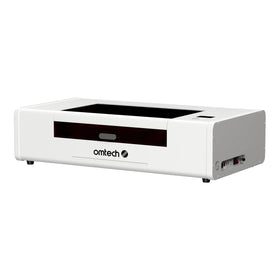
OMTech MOPA lasers stand out for their flexibility, with impressive max per-pass depth, 1.5mJ pulse that allows you to build flawless engravings pass by pass. The color possibilities and settings are versatile, and you can dial in the exact color parameters you want for durable, never-fading engravings. They are compatible with a variety of software, including every Windows version since XP, and macOS.
- OMTech MOPA 30W Split Fiber Metal Engraving Machine: 10,000 mm/s marking speed, 0.08mm max marking depth, EzCad2 included, with 6.9" x 6.9" working area
- OMTech MOPA 60W Split Fiber Laser Engraver: 10,000mm/s max marking speed, 0.1mm per-pass depth, 100,000 hr lifespan, infinite color possibilities, and a 6.9" x 6.9" working area.
- OMTech MOPA 100W Split Fiber Laser Engraving Machine: 10,000mm/s max marking speed, 0.15mm maximum marking depth, EzCad2 included, with 6.9" x 6.9" working area.
Final Thoughts on MOPA vs Fiber Lasers
The choice between a fiber laser and an MOPA laser comes down to one simple question: Do you need precision and flexibility, or just reliable marking?
If you’re doing basic metal engraving, a standard fiber laser will do the job beautifully. If you need color marking, plastic engraving, or fine detail control, a MOPA laser is absolutely worth the investment.
The key is to match the tool to your actual work, not just the spec sheet. If you get that right, you’ll save money, avoid frustration, and get results that actually match your expectations.
You might also be interested in how to perfect color laser engraving with a MOPA laser.