







From Hobby to Side Hustle: Laser Engraving Tips for Entrepreneurs

Many small engraving businesses don’t start with a plan they start with curiosity.
Take Hasan, a university student who bought a small CO2 machine just to experiment with wood engraving. His first products were simple name keychains for friends. Within a few weeks, people started asking for more birthdays, gifts, even small bulk orders for events.
He didn’t change machines at first. What changed was consistency. He refined his settings, improved his designs, and started charging properly. Within three months, what began as a hobby turned into a steady side income all from a single product category.
The lesson is simple: your first sale rarely comes from perfect equipment it comes from starting and improving fast.
Part 1: Machine Setup Tips

Material choice often becomes the turning point between hobby-level output and real business growth.
A small Etsy seller in the US started with random wood scraps and single-unit purchases from local shops. Her results were inconsistent some engravings looked great, others burned unevenly.
Once she switched to bulk materials and tested batches properly, everything changed. Her products became consistent, customer reviews improved, and she could confidently accept larger orders.
Within six months, she shifted from occasional sales to fulfilling repeat bulk orders for wedding favors all because she treated materials like a production asset instead of an afterthought.
Tip 1: Nail Your Ventilation Before You Run a Job
Poor ventilation is the single most common setup mistake new laser operators make. Laser engraving burns material it produces smoke, particulate matter, and fumes that are harmful to breathe and damaging to your machine's optics over time.
Minimum ventilation requirements:
-
Exhaust fan rated at 200+ CFM connected directly to the machine exhaust port
-
Ducting routed outside through a wall, window, or ceiling penetration
-
Air assist engaged on every job to keep fumes away from the lens
If you're working in a shared living space, a dedicated inline carbon filter before the exhaust exit reduces odor significantly. Don't skip this step on your first day.
Tip 2: Calibrate Your Laser Power and Speed for Every New Material

No two wood sheets engrave identically. Moisture content, grain density, and surface finish all affect how the laser interacts with the material. Running a power/speed test matrix before every new material stock is non-negotiable if you want consistent results.
Standard test matrix approach:
-
Set up a grid in LightBurn with 10–20 small squares
-
Vary power in 10% increments across columns (20%–80%)
-
Vary speed in 100–200 mm/s increments across rows
-
Engrave and label the result with each parameter combination
-
Choose the setting that hits your target depth, contrast, and edge quality
Keep a physical or digital log of your best settings for each material. This becomes a reference library that eliminates guesswork on repeat orders.
Tip 3: Check Mirror Alignment Every 2–3 Weeks
Mirrors drift especially on machines that are moved, bumped, or run at high speeds for extended periods. A misaligned mirror reduces engraving power, produces inconsistent results across the work area, and can damage your lens if the beam is severely off-center.
Mirror alignment check:
-
Use burn tape or thermal paper on each mirror target
-
Fire a single pulse at low power (5–8%) on each mirror
-
The burn mark should be centered on each target
-
Adjust mirror set screws in small increments until centered
On the OMTech K40+ 45W and other open-frame CO2 lasers, mirror alignment is a manual process you'll need to learn early. Machines with enclosed beam paths or autofocus systems are more stable but still benefit from periodic checks.
Tip 4: Clean Your Lens After Every 8–10 Hours of Operation
A contaminated lens reduces power transmission and focus quality. Even small amounts of smoke residue on the focal lens surface scatter the beam, producing softer engraves and requiring higher power settings to achieve the same depth.
Cleaning procedure:
-
Remove the lens from the lens holder (use the included removal tool)
-
Apply a single drop of isopropyl alcohol (90%+) or dedicated lens cleaner to a lint-free optical wipe
-
Wipe in a single circular motion never back-and-forth
-
Inspect against a light source; repeat if haze is visible
-
Replace the lens in the correct orientation (convex side down for most CO2 setups)
Part 2: File and Design Tips
The most preventable laser engraving mistakes happen before the machine even runs in the design file itself.
Tip 5: Use LightBurn, Not Free Web-Based Tools
LightBurn ($60–$80 one-time license) is the industry-standard software for CO2 laser engravers. It supports every major file format (SVG, DXF, AI, PDF, PNG, JPG), gives full control over power, speed, and layer order, and lets you set up tiles, arrays, and batch jobs that free tools don't support.
For operators running more than 5–10 orders per week, LightBurn pays for itself in the first month through time saved on file preparation alone. The alternative RDWorks (included with most OMTech machines) is functional but less efficient for production workflows.
LightBurn features that matter most for a side hustle:
-
Array and tiling for batch engraving multiple items per run
-
Text variable fields for personalized names without editing each file manually
-
Cut optimization to reduce unnecessary laser head travel
-
Real-time preview of burn paths before running a job
-
Camera integration for precise material positioning (Polar Lite 55W includes a 5MP camera)
Tip 6: Prepare Files at 1:1 Scale in the Correct Color Mode

One of the most common beginner laser engraving mistakes is importing a design at the wrong scale or with mixed vector and raster elements that weren't intended to behave differently. LightBurn reads layer colors as job types blue might be set to engrave, red to cut. If your design file uses different colors, it may cut lines you intended to engrave and vice versa.
File preparation checklist:
-
✓ Set document size in your design software to match your blank dimensions
-
✓ Export at 1:1 scale do not resize on import
-
✓ Separate cut paths and engrave fills onto different color layers
-
✓ Convert all text to paths/outlines before exporting (prevents font substitution)
-
✓ Remove hidden layers, artboards, and unused elements
Tip 7: Build a Design Library From Day One

Every file you create for a customer is reusable. A monogram font set, a standard name template, a product outline at common blank dimensions building a structured library of base files dramatically reduces per-order prep time as your order volume grows.
Organize your library by:
-
Product type (tumbler, keychain, wood sign, etc.)
-
Blank dimensions
-
Customer name (for repeat corporate clients)
-
Seasonal collections (Christmas, Valentine's Day, graduation)
The difference between an operator spending 20 minutes on file setup per order and one spending 3 minutes comes down almost entirely to library discipline.
Part 3: Material Tips
Tip 8: Buy Materials in Bulk From the Start

Material cost is your largest variable expense. Buying in bulk reduces per-unit cost, ensures consistent batch results (same stock = same settings), and prevents you from running out of material mid-order.
|
Material |
Small Quantity Cost |
Bulk Cost Per Unit |
Savings |
|
20 oz tumbler (single) |
~$10–$12 each |
$6.17 (6-pack) |
~40% |
|
Basswood 12"×12" (single) |
~$3–$5 each |
$1.67 (12-pack) |
~55% |
|
Leather key fob (single) |
~$1.00–$1.50 each |
$0.46 (50-pack) |
~55% |
|
Colored acrylic 8"×12" (single) |
~$5–$6 each |
$3.33 (6-pack) |
~40% |
Browse OMTech laser engraving materials for bulk blanks across wood, acrylic, leather, tumblers, and stone all tested for direct CO2 laser compatibility.
Tip 9: Test New Blanks Before Accepting Orders
Not all blanks are equal even within the same material category. A new batch of wood from a different supplier may have different moisture content, veneer thickness, or surface finish that changes your optimal settings. Always run a test engrave on 1–2 blanks from any new batch before committing to a customer order.
This is especially important for tumblers and coated drinkware. Powder coat quality and thickness varies significantly between suppliers. A tumbler that marks beautifully at 60% power with one brand may scorch or under-engrave at the same settings from another.
Tip 10: Use Transfer Tape to Protect Acrylic and Wood Surfaces
Laser engraving produces smoke and residue that deposits on the material surface around the engraving area. On light-colored acrylic and finished wood, this residue is difficult to remove without scratching the surface.
Transfer tape technique:
-
Apply standard painter's tape or transfer tape to the entire working surface before engraving
-
The laser burns through the tape into the material below
-
Residue deposits on the tape surface, not the material
-
Peel the tape off after engraving for a clean, residue-free result
This adds 60–90 seconds of prep time per job but eliminates the cleanup work and prevents customer complaints about surface residue on premium materials.
Part 4: Business Transition Tips
Tip 11: Start With 3–5 Core Products, Not 20
The most common entrepreneurial mistake in laser engraving businesses is launching with too wide a product range before the workflow is optimized. Every new product type requires its own file templates, material settings, packaging approach, and photography setup.
Start with 3–5 products that use the same machine settings and similar materials. Build volume and operational confidence in those before expanding. A focused Etsy shop with 15 listings in 3 product categories consistently outperforms a scattered shop with 50 listings across 15 categories the focused shop ranks better in search and the operator produces orders more efficiently.
Recommended starter product set:
-
1 drinkware item (tumbler with rotary)
-
1 wood item (keychain or small sign)
-
1 acrylic item (keychain or award)
Tip 12: Photograph Products Professionally Before Listing
Etsy and social media sales are driven by photography more than any other single factor. A laser engraved item photographed on a clean white or natural wood background with good lighting sells for 30–50% more than the same item photographed on a cluttered desk with overhead fluorescent light.
Basic product photography setup:
-
Foam board or white poster board as background (~$3)
-
Natural window light (diffused through a white curtain) or a $40 ring light
-
Phone camera at 1–2 feet distance at eye level with the product
-
Multiple angles: flat lay, front-facing, close-up of engraving detail
Consistent photography builds the visual brand identity that distinguishes professional Etsy sellers from casual hobbyist listings.
Tip 13: Track Machine Time Per Order From Day One
Most new laser engraving entrepreneurs have no idea how much machine time each order actually takes. Without that data, you cannot price accurately, cannot identify which products are most profitable per hour, and cannot make informed decisions about when you need a higher-throughput machine.
Simple machine time tracking:
-
Note start time when the job begins running
-
Note end time when the last piece of an order is complete (including setup)
-
Log: product type, quantity, material, machine time, and sale price
-
Calculate net margin per machine hour monthly
This data will tell you more about your business than any other metric. It will show you which products to prioritize, which to discontinue, and when your current machine is the bottleneck holding revenue back.
Tip 14: Know When to Upgrade Your Machine
Knowing when to upgrade your machine is one of the hardest decisions for a growing engraving business.
One small shop owner started with a desktop laser and focused on engraved tumblers. At first, it worked fine 5 to 10 orders per day.
But as demand increased, the machine became the bottleneck. Jobs started piling up, delivery times slipped, and stress increased.
Instead of working longer hours, he upgraded to a higher-power machine with a larger work area. That single decision reduced production time per order and allowed batch processing.
The result wasn’t just more revenue it was less burnout and a more stable workflow.
Sometimes growth doesn’t come from working harder, but from removing the limitations in your setup.
Your current laser engraver becomes a business constraint not a capability when:
-
Your job queue is regularly 5+ days out
-
You're turning down orders because your work area is too small
-
Machine run time exceeds 8 hours/day more than 3 days per week
-
Your per-item machine time is the limiting factor in your margins
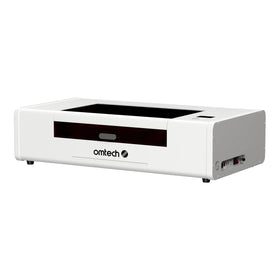
The OMTech Polar Lite 55W is a practical production machine for a growing side hustle. When it's running at capacity, the next step is the OMTech Maker Series 90W–100W with a 20"×28" work area that processes more volume per run and handles larger products that the Polar Lite's bed cannot accommodate.
For a full comparison of laser engraving equipment at every production tier, browse the complete OMTech CO2 laser engraver lineup.
Common Laser Engraving Mistakes to Avoid
These are the errors that cost new operators the most time, money, and customer goodwill:
|
Mistake |
Consequence |
How to Avoid |
|
Skipping ventilation setup |
Health risk, lens contamination |
Install exhaust fan before first run |
|
Not running a power/speed test |
Burned or under-engraved material |
Test matrix on every new material |
|
Importing files at wrong scale |
Mismatched sizing, wasted blanks |
Always set canvas = blank dimensions |
|
Ignoring mirror alignment |
Power loss, inconsistent results |
Check alignment every 2–3 weeks |
|
Buying single units of materials |
Higher cost, inconsistent results |
Buy in bulk from the start |
|
Launching with too many products |
Slow systems, quality problems |
Start with 3–5 focused products |
|
Not tracking machine time |
Mispriced orders, unclear profitability |
Log every job from day one |
|
Pricing without accounting for platform fees |
Undercharging, shrinking margins |
Include Etsy/platform fees in formula |
|
Skipping transfer tape on acrylic |
Surface residue, customer complaints |
Apply tape as standard practice |
|
Running machine unattended |
Fire risk |
Never leave a running machine alone |
Quick-Start Checklist: Hobby to Side Hustle
Use this as a reference when transitioning from casual use to consistent production:
Machine Setup:
-
✓ Ventilation installed and tested (200+ CFM exhaust)
-
✓ Mirror alignment verified
-
✓ Lens cleaned and inspected
-
✓ Power/speed test matrix run on primary materials
-
✓ LightBurn installed and licensed
File and Design:
-
✓ Base file templates created for each product
-
✓ Design library organized by product type
-
✓ File prep checklist printed and posted near machine
Materials:
-
✓ Bulk blanks ordered and inventoried
-
✓ Settings logged for each material batch
-
✓ Transfer tape stocked
Business:
-
✓ 3–5 core products selected
-
✓ Product photography setup ready
-
✓ Pricing formula calculated (cost × 3.5–4 for Etsy)
-
✓ Machine time tracking started
-
✓ First listings live or scheduled
Frequently Asked Questions
What are the most important laser engraving tips for beginners?
The three highest-impact tips for beginners are: set up proper ventilation before running a single job, run a power/speed test matrix on every new material batch, and learn LightBurn over any free alternative.
What are the most common laser engraving mistakes to avoid?
The most costly mistakes are: poor ventilation setup (health and lens risk), skipping material test burns (wasted materials and orders), importing files at the wrong scale (sizing errors), and not tracking machine time (mispriced orders).
How long does it take to learn laser engraving?
Most new operators can produce sellable products within 1–2 weeks of first use. Getting consistently clean results across different materials and design types typically takes 1–3 months of regular operation.
What laser engraver is best for a beginner side hustle?
The OMTech K40+ 45W ($599.99) is a low-risk entry point for validating a business idea before committing to higher-wattage equipment. The OMTech Polar Lite 55W ($1,999.99) is the better choice for operators who are already confident they want to build a production business it runs faster (500 mm/s vs.
How do I turn my laser engraving hobby into a business?
Start by validating demand sell 10–20 items to friends, family, and at a local craft market before investing heavily in inventory or a larger machine. Once you have consistent buy signals, build your Etsy shop with 10–15 focused listings, invest in product photography, and set up bulk material purchasing to improve margins.