







Laser Engravers for Guns: What Is Gun Engraving?
Gun laser engraving is typically used for tracking and identifying firearms, but it can also be used to personalize and decorate your weapons. Whether it’s adding an elaborate image or a meaningful quote to your gun barrel, you can provide durable customization with a laser engraver for guns!

Laser gun-engraving involves using a precise beam of light to engrave patterns onto surfaces like metal, wood, or plastic. This accurate laser beam can etch intricate patterns or detailed lettering onto your weapons. Laser-engraved guns also offer more consistent engraving than hand-engraved guns due to the absence of human error.
Read More: Gun Laser Engraving vs. Hand Engraving
What Laser Engraver Do You Need to Engrave Guns?
For engraving metal firearms or NFA items, a Fiber Laser is the gold standard. The most strongly recommended fiber laser engravers for guns are usually 30W to 50W Raycus or JPT MOPA source. These machines start at around $2,000 to $4,000 and offer the precision needed to meet strict ATF depth requirements (.003 inches on metal gun components).
However, depending on the type of material utilized, you’ll need to use either a fiber laser cutter or a CO₂ laser engraver for guns. Generally, for gun laser engraving, you typically need a fiber laser to engrave on the steel and aluminum receivers and slides.
Standard CO2 and blue diode lasers do not work directly on raw metals because the wavelength is wrong; they will only strip coatings like Cerakote or mark plastics like PMAGs. However, you can use a CO₂ laser engraver to create the best markings on the wooden parts of the gun.
Choosing a Laser Engraving Machine for Guns: Key Tips
When it comes to choosing a fiber laser engraver for guns, there are three important criteria you must absolutely consider:
- Whether it has the precision to meet ATF depth requirements (i.e., 0.003 to 0.010 inch depth). Usually, you need about 30W fiber laser power.
- The laser source (Raycus vs JPT).
Choosing the Right Wattage
- 20W Fiber Lasers: A 20W fiber laser engraver is usually not the best for gun laser engraving, but a decent model can work up to an extent. It will get the job done on aluminum lowers but requires many slow, repeated passes to achieve depth. 20W is the absolute bare minimum for NFA engravings.
- 30W Fiber: 30W fiber lasers are generally considered the "sweet spot" if you are a hobbyists an individual gun owner. It offers a balanced price point and cuts serial numbers and deep slide patterns efficiently.
- 50W–60W Fiber: A 50W–60W fiber laser engraver is best if you have the budget or intend to run a business. High wattage vastly increases engraving speed and permits a larger workspace/lens size without losing power density.
Laser Types: Source Matters
When configuring a laser for gun engraving, always check the internal components and determine the power source:
- Raycus vs. JPT: Raycus is the basic budget option. Most gun laser engraving enthusiasts suggest paying slightly more for a JPT laser source, simply because it handles frequency ranges better and is more reliable.
- MOPA Lasers: If you intend to stipple Glock polymer frames and engrave steel slides, a MOPA fiber laser is highly recommended. Unlike standard Q-switched fibers, a MOPA allows you to adjust pulse duration, preventing you from burning or melting polymer grips.

Polar Lite 55W CO₂ Laser Engraver
The engraving examples of OMTech CO2 laser engravers:
1. Laser Engraving Metal and Plastic: When to Opt for a Fiber Laser Marker
If your gun is made of metal or tough plastic, your best bet for engraving is a fiber laser marker. Fiber laser markers engrave denser materials like metal and polymers much more quickly and deeply than CO₂ machines. This is due to the intense laser beam generated by stimulated radiation, resulting in incredibly durable and precise fiber laser engraving on your firearm.
2. CO₂ Laser Engravers for Guns: Laser Engraving the Wood of Your Firearm
CO₂ laser machines offer the best engravings for wood due to consistent wavelengths and even beam absorption. You should not use a fiber laser for engraving wood—a fiber laser creates poor, charred etchings on wood due to the short wavelength. CO₂ engravers, however, work well with organic and non-metal materials, making them the ideal choice for laser engraving guns made of wood.

Laser Engraving both Metal and Non-Metal with OMTech Solis Duo
If you run a business of laser engraving guns, the best choice is the OMTech Solis Duo. This is because it can engrave guns made of both metal and non-metal. It has a speed of 10,000 mm/s, comes with a 16 MP camera, and is also compatible with a conveyor. This allows you to easily engrave guns in batches.

Here are the samples engraved by OMTech Solis Duo.

Laser Engravers For Guns: Budget, Mid-Tier and Premium Options
For complete and versatile gun engraving, both metal slides (which require an Infrared or Fiber laser to properly bond or etch the metal) and polymer frames (which react beautifully to a Blue Diode laser), you have two distinct approaches.
You can either choose a dual-source laser that houses both wavelengths in one desktop head, or buy a dedicated freestanding fiber laser cabinet and use specialized lens settings to carefully manage the heat on polymer.
Here are some budget, mid-tier, and premium laser engravers that I have tested myself (the OMTech ones) or that reliable and trusted colleagues in the industry have recommended to me.
Budget Laser Engravers For Guns (Under $2,000)
These are desktop machines that give you entry-level access to both laser types without taking up a massive footprint.
1. LaserPecker LP4 Dual-Laser Engraver (Desktop)
This highly portable unit houses a 10W blue diode laser and a 2W infrared (IR) laser in a single head. The 10W diode performs extremely well when you are stippling and engraving polymer frames without melting them.
The 2W IR laser, however, may be quite weak for metal; it will easily mark or change the color of metal slides, but it will take an immense number of passes to reach the If you are working with this machine, you need a lot of patience, and of course, multiple passes to reach that ATF-required 0.003-inch depth for serial numbers.
However, at around $1,099, it is an affordable option that will handle metal parts extremely polymer extremely well.
2. OMTech Galvo 30W Autofocus Fiber Laser (Desktop / Benchtop Split)
The OMTech Galvo 30W Autofocus Fiber Laser is a true, dedicated fiber laser for gun laser engraving, especially if you are mostly engraving metal components. It features a 30W Raycus source that will effortlessly deep-engrave steel slides, barrel hoods, and aluminum receivers to legal depths in seconds.
This machine does not have a diode laser for polymer, but there is a trick I use to overcome that setback. If you drop the power significantly, speed up the Galvo head, and blur the focus slightly, you can use this (as well as any) 30W fiber laser engraver on polymer frames.
The Galvo 30W Autofocus is currently on sale at around $1,899.99
Mid-Price Laser Engravers For Guns ($2,500 – $4,500)
This tier contains some gun laser engravers with significantly higher wattages that enable fast production cycles, deep metal engraving, and native dual-source capabilities.
1. xTool F1 Ultra 20W Fiber & Diode Dual Laser (Desktop Enclosed)
The xTool F1 Ultra 20W Fiber and Diode Dual Laser combines a beefy 20W Fiber laser (for deep metal engraving and embossing) with a 20W Blue Diode laser (for blazing-fast stippling on polymer frames). It is entirely enclosed with a safety shield, runs on LightBurn, and can achieve deep engravings on slides in a fraction of the time of a budget unit.
2. OMTech Solis Duo 50W Fiber & 40W Diode (Desktop Heavy-Duty)
If you want a laser engraver for guns that packs industrial-grade power in a benchtop form factor for your gunsmith shop, the OMTech Solis Duo 50W Fiber and 40W Diode Laser Engraver is the best you can get at mid-price.
This machine stacks a massive 50W Fiber laser against a high-power 40W Diode. With the 50W fiber source, you can strip finishes and carve deep 3D reliefs into hardened slide steel almost instantly. The 40W diode can also handle polymer frames efficiently, though you will need to turn down the power to find the sweet spot for clean stippling. The Solis Duo 50W Fiber and 40W Diode is currently on sale at $4,199.99.
Premium Laser Engravers For Guns ($4,500+)
These are standalone, freestanding workstation cabinets designed for high-volume commercial production, maximum safety compliance, and advanced custom tuning.
1. OMTech MOPA 60W Autofocus Freestanding Fiber Laser Cabinet ($4,099.99- $4,219.99)
The OMTech MOPA 60W Fiber Laser Cabinet is a heavy industrial workstation built as a complete floor unit with a built-in electronic lift bed and a fully enclosed Class 1 safety cabinet. Instead of a standard fiber source, this machine uses a MOPA laser source. MOPA allows you to independently control pulse width and frequency.
- For metal slides, this means you can engrave in brilliant frosted whites, deep blacks, or even colors on titanium/stainless steel.
- For polymer frames, the adjustable pulse width allows you to engrave clean, dark stipples on plastics without melting the material.
You can get this unit currently at $4,099.99 (base cabinet) to $4,219.99 (with rotary axis bundle).
Laser Engravers For Guns: Best Budget, Mid-Tier, and Premium Options
| Model | Form Factor | Laser Sources | Best For |
| LaserPecker LP4 | Ultra-Compact Desktop | 10W Diode / 2W IR | Hobbyist frame stippling & basic slide surface marking |
| OMTech Galvo 30W | Split Benchtop Desktop | 30W Fiber | Deep legal serial numbers & heavy slide carving on a budget |
| xTool F1 Ultra | Enclosed Desktop | 20W Diode / 20W Fiber | All-in-one professional gun customization shop tool |
| OMTech Solis Duo | Industrial Desktop | 40W Diode / 50W Fiber | Ultimate benchtop speed for deep slide engraving |
| OMTech MOPA 60W | Freestanding Cabinet | 60W MOPA Fiber | High-volume commercial use, color etching, and damage-free polymer tuning |
Choosing a Fiber Laser Engraver For Gun Engraving: Key Tips Based On Personal Experience
Two types of laser engravers are best for engraving guns: fiber laser engravers (ideally 30W to 50W) and diode laser engravers. Which of these works best depends on whether you are engraving metal firearm parts or polymer parts.
- Fiber Lasers, specifically those with MOPA sources (i.e MOPA fiber laser engravers), are the best laser engravers for metal firearm parts like slides.
- For polymers (like frames), budget-friendly diode lasers are normally used, though they require extreme caution to avoid weakening the material.
1. Begin with the Appropriate Laser Type
A 30W-50W Fiber laser (such as OMTech, Raycus, JPT, or an xTool F1 Ultra) is universally considered the minimum requirement for properly marking and engraving steel or aluminum parts.
2. Pay Attention To ATF Requirements
If you are engraving serial numbers (e.g., for NFA items), you must pay attention to ATF requirements. The ATF requires a minimum depth of 0.003 inches and a print size of no smaller than 1/16th of an inch. The good news is, this depth is easily achievable with almost any decent fiber laser if you use multiple passes at low speed and high power.
3. Ensure LightBurn Compatibility
When it comes to gun laser engraving, LightBurn is, without doubt, the best software you can use. Gun engraving requires a lot of precision and versatility, which EZCAD (I have heard some people call it "EZ-Crash") will not give you.
4. Pay attention to Legal Requirements
Not everybody is authorised to do laser engraving on guns. If you are working on guns that belong to someone else, you must possess a valid Federal Firearms License (FFL) to engrave. Doing so without a license is a federal offense.
Recommended Settings for Gun Engraving
- For a 50W fiber laser, the settings I used for NFA aluminum engraving are: 3000 mm/s speed, 40% power, and 15 to 18 passes.
- Alternatively, you can also engrave at 2000 mm/s speed, 50% power, at 75 kHz for 20 passes, which achieves the required 0.003 to 0.010 inch depth. Always test on scrap.
Legal and NFA Requirements for Gun Laser Engraving
-
Depth: For NFA engraving (like an SBR), the minimum legal depth is 0.003 inches. However, it is always better to aim for 0.005 to 0.010 inches deep to account for inconsistencies and material coatings like anodizing or Cerakote.
-
FFL Rules: If you are engraving serialized parts (frames or receivers) for other individuals, you must hold an 07 FFL (Federal Firearms License). This license is not required if you are only engraving non-serialized parts like slides or if you are engraving your own personal firearms.
Gun Laser Engraving: Hardware Requirements, Best Software, and Everything You Need to Know.
A fiber laser engraver is the primary hardware you usually need for gun laser engraving. It gives you the ultimate control over graphics, allows for maximal shading, and produces the best contrast. Many gun engravers prefer MOPA fiber lasers over standard fiber lasers, mainly because they add that special touch of color.
1. Software and Settings for Gun Laser Engraving
For gun laser engraving, the consensus is that Lightburn is the best software, mainly because it handles vector mapping better than many of the alternatives. Take note, however, that Lightburn works best for gun laser engraving when you use a laser engraver that uses an EXCAD 2.0 board or compatible controller.
2. Best Laser Engraving Settings For Gun Laser Engraving
For deep steel engravings on pistol slides, the best approach is to use tighter interval passes (e.g., 0.002 mm to 0.05 mm intervals) paired with cleaning passes to strip away the charred material and produce crisp lines. This is the best strategy for achieving crisp and clean lines.
3. A Fume Extractor is a Must.
For gun engraving, you must use a dedicated fume extractor. Vaporizing metals like 7075 aluminum produces toxic dust, and engraving polymer components (like Glock frames) releases highly hazardous gases. You need an effective, reliable way to get rid of those fumes.
Legal Warnings for Gun Engraving
For Form 1 or SBR builds, there is an NFA Minimum Depth. Federal law mandates that you use a minimum engraving depth of 0.003 inches (roughly 1/16 inch in text height). There are also FFL licensing rules.
Generally, you can legally engrave your own personal firearm without any special license. But if you perform engraving as a commercial service or business for others, the ATF classifies you as a gunsmith, meaning you must possess a Type 01 FFL.
How Much Does Laser Engraving a Gun Cost?
Laser-engraved handguns can cost anywhere from $8 to $300, depending on the design and area you want engraved. Engraving something as small as a magazine might run you around $8-$15, while engraving the barrel might cost you well over a hundred.
Also, the expected cost of gun laser engraving may generally differ depending on whether you are working with a DIY machine or outsourcing the engraving tasks. If you have many guns and intend to engrave them yourself, you may need a fiber laser. A small 30W to 50W fiber laser can cost between $3000 to $6000. That is about how much it will cost you to take on gun laser engraving by yourself.
If you need a single NFA lower slide engraved, the obvious pathway is to pay a local shop. The typical prices can be between $30 and $60 per engraving.
If you’re wondering, “What’s the best laser gun engraving near me?” make sure to weigh all your options before committing. Getting fair prices for fine craftsmanship will make laser engraving your gun even sweeter.
Gun Laser Engraving Designs
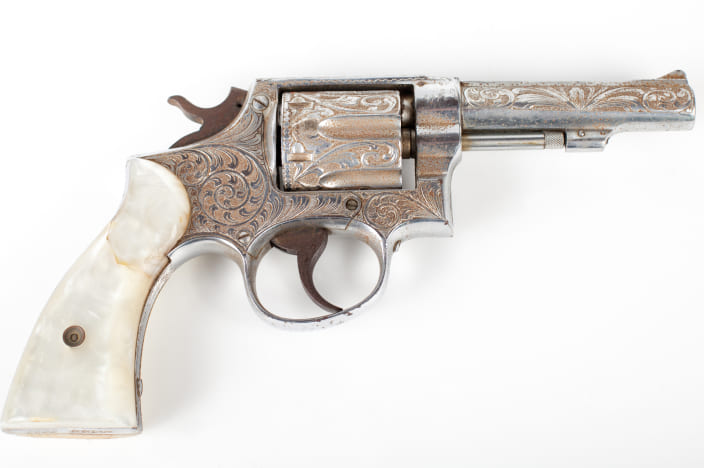
From tribal designs to intricate murals to favorite quotes, the possibilities for firearm laser-engraving patterns are virtually limitless! Imagine a revolver with the words, “Memento mori” carved into the handle or a Glock with Red Hood pictured on the side.
Just like the cowboys of the Wild West had fancy revolvers to accompany them, you, too, deserve a beautiful, bespoke firearm. The personality and customization offered by laser machines are truly priceless!
Tips for Laser Engraving Guns
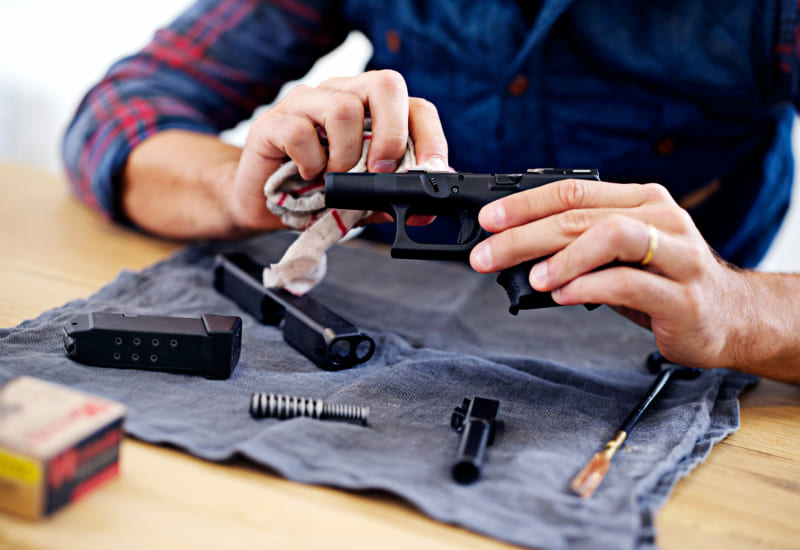
First, you should ensure your gun is not loaded before performing any laser engraving. Practice proper gun safety when managing your firearm. You must also determine the materials your gun is made out of, so you know whether to use a CO₂ laser engraver or a fiber marker.
Next, before laser engraving firearms, determine the design you will be engraving onto your firearm. You should also consider where you want the image or quote to be. Then consider the location of the design. Do you want to engrave the sides of the barrel, the magazine, the grip, or all of the above?
Finally, upload the image or create the design on Lightburn—OMTech’s designated laser-machine software. Lightburn connects to your laser machine to turn your designs into near-perfect renderings on your chosen material. Use Lightburn to send the instructions to your laser engraver and watch your OMTech laser machine work!
Laser Engravers For Guns: Key Requirements, Tips, and Warnings
- Power and metal: True material removal on steel, titanium, or aluminum requires a fiber laser. If you plan to do deep engraving for serial numbers, it is highly advised that you step up to a 50W or higher model like the OMTech Galvo 50W fiber laser engraver.
- Budget Diode vs. Fiber: Cheaper $300–$500 diode lasers are fine for light surface marking or burning polymers (like polymer frames for stippling). However, they cannot engrave metal deeply without the use of chemical sprays like CerMark, which can easily wear off.
- Polymer Warning: Engraving and stippling on polymer frames can be risky because different polymer recipes react uniquely to heat and can release harmful off-gases or weaken the structural integrity of the frame.
- Software: For an easier gun engraving experience, pair your laser with LightBurn Software (it is often bundled with fiber laser packages), and not the stock EZCAD software.
- Alternative Options: If you do not want to spend thousands of dollars on a machine, a more affordable gun engraving solution is to mail the parts to specialized services like Tar Heel State Firearms, which typically charge around $30 for NFA engravings.
- The FFL Rule: If you are engraving your own guns, you are perfectly legal. However, if you take money (or even do a favor for a friend) to engrave a serialized receiver, know that ATF requires you to hold a Type 01 or 07 FFL. You can work on un-serialized slides without a license.
- Practice First: Never test a new laser directly on a firearm. Buy scrap steel, aluminum blanks, or cheap Magpul magazines to dial in your speed, power, and frequency settings.
Pull the Trigger with OMTech
Personalizing your handguns isn’t just about showcasing your unique style—it’s also about exploring the possibilities of laser technology. With a suitable laser engraver for firearms, like OMTech fiber marker or CO₂ laser engraver, you can create amazing pieces of art and even make a business out of it!
With a fiber marker, you have the power and precision to engrave durable materials like granite and marble, along with hard plastics and various metals. Our MOPA fiber laser markers can even engrave in color, adding a bit of flair to your engravings!
On the other hand, our CO₂ laser engravers and cutters offer versatility in the range of objects they can cut and engrave. An OMTech CO₂ laser machine can engrave and cut acrylic, wood, leather, glass, and more!
If you’re looking for a compact model for your small business, we offer the sleek OMTech Polar Lite Desktop Laser Engraver.

Find the best laser engraving machines at OMTech! Whether you’re a professional engraver or an inspired hobbyist, we understand your desire for precise and affordable laser technology. Luckily, we’ve combined the best of both worlds—offering our customers top-of-the-line machines at economical prices. Pull the trigger with OMTech and start your engraving journey today!


![[Latest] Diode Laser vs. CO2 Laser vs. Fiber Lasers - Complete Guide](http://omtech.com/cdn/shop/articles/diode-vs-co2-vs-fiber-lasers_cad89d19-589c-4837-a019-48d69698f6f5.jpg?v=1789898499&width=200)

