






What Is a MOPA Fiber Laser? A Guide For Buyers in 2026
The wisest approach, when you are looking to get into metal laser engraving, is to start by considering all the different types of fiber laser engravers there are and what each of them can do best. Once you have a clear idea of the kind of metal items you want to engrave and the kinds of designs you want to make, I daresay it will be hard not to see how a MOPA fiber laser can make it better. That is how awesome these machines are.
The only thing most people know about MOPA fiber lasers is that you need them for color laser engraving, but MOPA fiber lasers offer a lot more than that. In fact, there are many applications where a MOPA fiber laser engraver can make a difference, and these are definitely worth knowing about, especially if you want to choose a laser engraver for metal, engrave sensitive materials like plastics, or work with anodized aluminum.

What Exactly Is a MOPA Fiber Laser?
Here is a simple way to define what a MOPA fiber laser is: it is a more versatile type of laser engraver that gives you direct control over the pulse duration (or pulse width) as well as the frequency and power settings during the engraving process.
The “M.O.P.A.” in “MOPA fiber laser” is an acronym that means Master Oscillator Power Amplifier, and it highlights how different they are from the more common standard entry-level fiber lasers, which are called Q-switched lasers.
Here is what that means in more practical terms: the "master oscillator" generates the initial low-power laser pulse, and the "power amplifier" stage boosts it afterward. Because those two stages are separate, you can tune the pulse independently of its final power, which is exactly what a Q-switched laser can't do, since it generates and amplifies the pulse in a single fixed step.
If this is still a bit too technical, there is a simpler way to understand what a MOPA fiber laser is, what it does, and why it matters: it starts with the importance of pulse duration in laser engraving.
What is Pulse Duration in Laser Engraving?
Pulse duration is the length of time that a laser emits a single burst of energy: it determines how long the laser beam touches the material during a single pulse cycle. The pulse duration can be flexible or fixed, depending on whether you are using a Q-switched or MOPA fiber laser, and that has a bearing on your engraving results on different materials:
- Q-switched fiber lasers have a fixed and unchangeable pulse duration: they emit laser energy in fixed, aggressive bursts.
- A MOPA fiber laser, on the other hand, does not emit light in the same way: it separates the light-generation process into two distinct stages, which allows you to fine-tune it to a desired precision.
The primary advantage of the adjustable pulse duration offered by a MOPA fiber laser is that it allows for heat management. When you use a MOPA fiber laser, you can drop the pulse width down, even to a fraction of a microsecond, to achieve a much slower engraving intensity that has been called “cold marking”. This is what allows you to engrave plastics without melting them, burn deep blacks into anodized aluminum without stripping away its coating, and achieve color engraving on stainless steel.
A standard Q-switched fiber laser cannot do this: it delivers immense peak power spikes that can usually reach 18kW in short bursts. As powerful as these are, they can also easily melt or warp delicate materials.
This adjustability and flexibility, and the effects it can achieve on these different materials (anodized aluminum, plastics, and stainless steel), are what make MOPA fiber lasers special.

MOPA vs. Q-Switched Fiber Lasers: What Are The Technical and Functional Differences?
There is a common analogy that has been used online to describe the differences between a MOPA and Q-switched fiber laser, and it goes like this: “A MOPA laser is like a manual transmission car, while a Standard Q-Switched laser is an automatic.” This is a very accurate comparison because it highlights the fact that, though both are fiber lasers, they control and deliver their energy entirely differently.
1. Pulse Width Control (Fixed vs Adjustable)
On a standard Q-switched laser, every single pulse lasts the same amount of time. This can be highly restrictive because it dumps a heavy, unchangeable amount of heat into the material.
A MOPA, on the other hand, is more versatile. It allows you to change the "waveform" or pulse duration. You can use a long pulse width to mimic a Q-switch for heavy material removal, or a tiny 2-nanosecond pulse for delicate tasks.
2. Frequency Range
Q-switched lasers typically reach a maximum frequency of about 100 kHz. Because a MOPA can scale into the thousands of kilohertz (MHz range), it can fire pulses incredibly fast at lower power. This high frequency allows users to smoothly "anneal" the surface of metals for different finishes rather than deeply melting or texturing them.
Annealing marks work by using heat alone to change the oxide layer just under the metal's surface, rather than vaporizing material, which is why a wider, more controllable frequency range gives you a broader palette of finishes, from light gold tones to dark blacks, all on the same piece of steel.
3. Beam Precision on Plastics and Fine Details
Because Q-switched lasers have huge spikes in peak energy, they tend to melt, scorch, or warp plastics, and can even warp very thin metal sheets (like laptop backing). A MOPA can cleanly change the chemical color of plastics (foaming) without melting the surrounding geometry.
MOPA vs. Q-Switched Lasers: Highlight of Key Differences
| Feature | Standard Q-Switched Fiber Laser | MOPA Fiber Laser |
| Pulse Width (Duration) | Fixed (Usually locked between 80ns and 140ns) | Adjustable (Can be tuned from 2ns up to 500ns) |
| Frequency Range | Narrow (Typically 20 kHz to 100 kHz) | Extremely Wide (1 kHz up to 4,000+ kHz) |
| Power Control | Limited lower-end scaling (often starts at 10% power) | Highly granular (0% to 100% power scaling) |
| Heat Management | Delivers heavy, aggressive bursts of peak power | Delivers "cold marking" via ultra-short pulses |
| Material Versatility | Excellent for raw metals, rocks, and basic tags | Metals, sensitive plastics, thin alloys, and anodized layers |
| Color and Black Marks | Restricted to high-contrast monochrome (white/grey/dark) | Vibrant colors on stainless steel; deep blacks on aluminum |
| Price Point | Budget-friendly (Entry-level) | Premium cost (Often thousands more) |
When Do You Need a MOPA Fiber Laser?
You mainly need a MOPA fiber laser when you want to achieve specific visual or material results with a fiber laser engraver. For basic fiber laser engraving, you do not need a MOPA fiber laser engraver. However, some laser engraving results require precise control over your laser pulse settings to achieve them, and that is when you need a MOPA fiber laser. Here are three scenarios where you absolutely need to upgrade to a MOPA laser:

1. You Want Vibrant Color Engraving on Stainless Steel
Color engraving is the most common reason people choose a MOPA. With a MOPA fiber laser, you can generate many colors, like reds and pinks, oranges and yellows, blues, purples, violets, etc. A standard Q-switched fiber laser generally would achieve only a very limited palette of colors, if any at all.
2. You Want True Black Marks on Anodized Aluminum
If you want a rich, deep black mark on anodized aluminum, you have to upgrade to MOPA. Standard fiber lasers do engrave anodized aluminum, but they tend to leave a dull gray mark or strip away the anodized coating entirely. A MOPA laser can create black marks on anodized aluminum or titanium without destroying the protective surface layers.
3. You Are Working with Sensitive Plastics (e.g., MacBooks, ABS, PMAGs)
If you are looking to engrave electronics casings like phone chargers, USB casings, or firearm cases, a MOPA laser is pretty much the only way you can do it. Because you can fine-tune the intensity, a MOPA modifies the color of the material (foaming/color change) cleanly without melting the object. It is much safer
4. You Need Faster, High-Quality Deep Engraving
A standard fiber laser can do deep engraving, but you need to run multiple passes, which can be very time-consuming. A MOPA gives you the ability to fine-tune hatching patterns, angles, and pulse variations. This control is important because it makes deep engraving much faster and cleaner because you don't burn the edges of the metal as easily.
When do you NOT need a MOPA Fiber Laser?
If you are just engraving steel, brass, copper, or silver to get a simple light or dark mark, a standard Q-switched fiber laser is perfectly fine. You will save thousands of dollars going with a non-MOPA unit if your only goal is basic metal marking.
The key is to consider what materials or types of projects you are planning to work on, and your budget. From there, you can figure out if a MOPA is worth the extra cost for your workflow. As a rule of thumb: if the word "color" or "anodized" doesn't appear anywhere in your project brief, you likely don't need to pay the MOPA premium yet; a standard fiber engraver will cover the job.

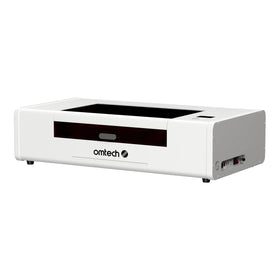
The collection of OMTech Galvo Fiber Lasers consists of standard fiber lasers equipped with a Galvo Laser Drive and optical lenses. As a metalworker, you can depend on the fiber laser etching machine to provide accurate and effective metal etching and engraving.
Also, Q-switched fiber lasers are very affordable, compared to their MOPA counterparts. The OMTech Galvo 20W Compact and Integrated Fiber Laser Engraver, for example, starts at $1,599, which is a lot cheaper than the 20W MOPA Model. It does have a smaller 4.3"x4.3" working area, and other key features differ, but it also provides a10,000 mm/s lightning-fast engraving speed, and is sufficient for you to tackle projects of all sizes if you are on a budget.
Buying a MOPA Fiber Laser Engraver: What Should You Look For?
When you are buying a fiber laser engraver, the first thing to keep in mind is that you are buying an expensive piece of commercial hardware, and so the details are going to matter a lot. The devil really is in the details because MOPA machines rely entirely on very complex electronics
So, here are four things to evaluate when choosing a MOPA laser. We have grouped them by hardware priorities:
1. Get the Right Laser Source Manufacturer and Series: JPT vs. M7 vs. M8
The actual laser engine inside the chassis dictates the machine's capabilities.
- JPT is the gold standard for MOPA fiber lasers: JPT is universally recognized as the top-tier manufacturer for MOPA laser sources.
- The M7 Series vs. M8 Series: If you have to choose between the M7 and M8 series, it is important to ensure you know exactly what model you are getting. The JPT M7 is great for general metal marking, plastic foaming, and vibrant color generation on stainless steel. The JPT M8 is newer, and it is more specialized for delicate glass and ceramic texturing.
2. Wattage (Power Tier)
Wattage on a MOPA fiber laser engraver is not the same as on a Q-switched fiber laser. The key is to choose your wattage based on the demands or expected demands of your core workflow. Here’s a summary:
-
20W to 30W MOPA Fiber Lasers
A 20-30W MOPA fiber laser is perfect if your primary goal is color laser engraving on steel, surface etching, or engraving delicate electronics and sensitive plastics. The OMTech MOPA 20W Split Fiber Laser Engraver (6.9" x 6.9" working area, JPT source) is a good example of this tier: it reaches a marking depth of 0.04nm and a top speed of 10000mm/s.
It is also built around the same JPT engine as OMTech's larger MOPA machines, so you get the full color-marking range without paying for power you won't use. Perfect as a starting point for jewelry marking, small-batch personalization, or testing whether MOPA capability is worth the investment for your shop.
-
60W MOPA Fiber Lasers
A 60W MOPA fiber laser is the perfect fiber laser engraver for a small shop. It gives you enough low-end control for clean "cold marks" on plastics, but it can still provide the raw power you need for efficient deep engraving into common materials like silver, gold, and thick steel.
The OMTech MOPA 60W Split Fiber Laser Engraver (6.9" x 6.9" working area, $4,399.99) fits squarely in this tier and is the model most small engraving businesses graduate to once they've outgrown a 20-30W unit's speed or depth on production runs.
-
100W+ MOPA Fiber Lasers
Only choose this tier if you need maximum production line speeds or are planning heavy material ablation and basic sheet metal cutting. The OMTech MOPA 100W Split Fiber Laser Engraving Machine (6.9" x 6.9" working area) is OMTech's top-end split MOPA option, aimed at shops running high daily volume or engraving thicker stock where a 60W unit would need multiple passes to hit the same depth.
3. Pulse Width and Frequency Range
The wider the range of pulse frequency, the more versatility your machine will have. Here are some things you must review on the manufacturer's specifications sheet before you buy:
- Pulse width: It must be able to scale down to at least 2 nanoseconds (ns) up to 350ns or 500ns. There are many cheap fiber lasers that mock MOPA features, but they usually can only scale down to 20ns, which is too aggressive for sensitive plastics. This is one of the ways you tell a true MOPA fiber laser from a fake one.
- Frequency: Top-tier MOPA fiber lasers like the JPT M7 60W feature an expansive repetition window running from 1 kHz all the way up to 4,000 kHz. This is a wide enough frequency range to allow you to make the most of your MOPA.
4. Control Board and Software Compatibility
Ensure the machine uses a control board (typically a JCZ board) that natively supports LightBurn. Stay away from these proprietary, locked-down controller platforms that force you to use outdated or clunky software packages like raw EZCAD2 if you prefer modern design workflows.
That said, keeping EZCAD2 available as a fallback isn't a bad thing in itself: some advanced marking parameters, like certain rotary and split-axis calibration settings, are still easier to access in the manufacturer's native software. The key issue is being locked into it, not simply having it as an option alongside LightBurn
OMTech MOPA Fiber Lasers: Split and Intergrated 30W, 60W, and 100W MOPA Fiber Lasers
OMTech 30W, 60W, and 100W MOPA systems let you adjust heat input precisely, unlocking a wide spectrum of permanent colors on stainless steel and flawless, high-contrast black marking on anodized aluminum.
To guarantee a professional, fluid workflow, all OMTech MOPA fiber laser marking machines integrate flawlessly with the Galvo edition of LightBurn as well as standard EZCAD software. Both packages operate smoothly on Windows and Mac OS, allowing you to import complex vector designs, barcodes, and serial numbers with ease.
Choosing between them ultimately comes down to matching wattage to workload rather than simply buying the most powerful unit available:
- The 30W suits color marking and detail work at lower cost
- The 60W is the balanced choice for a small business handling a mix of color marking and deeper engraving
- The 100W is worth the jump only once production speed or material thickness genuinely demands it.
If you are a first-time MOPA buyer, starting at 30W or 60W and upgrading later (that is, once you know exactly how your workflow uses the extra pulse control) tends to be the more cost-effective path for customers.
Final Thoughts on MOPA Fiber Lasers
At its core, the MOPA vs. Q-switched decision comes down to one question: does your work actually need adjustable pulse control, or are you paying a premium for flexibility you won't use?
If your projects are simple metal marking (steel, brass, copper, silver ), a standard Q-switched fiber laser will get the job done for a fraction of the cost. But the moment color engraving on stainless steel, true black marks on anodized aluminum, or safe engraving on sensitive plastics enters the picture, a MOPA stops being a luxury and becomes the only tool that can reliably deliver the result.
You may also be interested in the intricacies of color laser engraving with a MOPA fiber laser, and why it makes such a big difference in laser engraving projects.