








Laser Cutting Machines For Schools
When buying a laser cutting machine for a school, be it an elementary, middle school, or high school, the first and most important consideration must be the safety of the kids. You want a laser cutting machine that meets all the required safety standards: it is fully enclosed, has all the necessary features to facilitate fume extraction, and is safe for use in the classroom.
However, a laser cutter that is best for use in an elementary school will not necessarily be as suitable for high school kids. That is because the age of the kids matters, and the laser cutting projects they do at each stage in their education journey are not the same.
So, though many people speak of buying a “laser cutting machine for schools,” this is a bit of a blanket statement: there are some types of lasers that are best for elementary schools, and some types that are best for middle and high schools, and these are not necessarily the same thing.
What laser cutting machines are best for elementary, middle, and high schools? What are the primary differences between them, and what should you be looking for?

1. Laser Cutters For Elementary Schools: What to Prioritize When Choosing and Best Models
When choosing a laser cutter for an elementary school, the main priority must be the safety of the kids. You simply cannot go for the most affordable machine you can find: it must have robust enclosures and professional-grade air filtration. Here is how to evaluate and choose a laser cutter for young children in an elementary school:
Priority #1: Safety and Compliance
- Class 1 Enclosures: It must have a fully enclosed, locked cabinet that automatically cuts power if the lid is opened. This means those open-frame diode laser engravers are not even to be considered.
- Certifications: You want a laser engraver that has FDA compliance or NRTL (Nationally Recognized Testing Laboratory) electrical listings. Machines without these certifications are non-compliant or uninsurable for U.S. public schools.
- Keyed Power Switches: Make sure the machine has a physical key lock or safety dongle so students cannot operate the machine unsupervised.
Priority #2: Ventilation and Fumes
- Industrial filtration: For use in a classroom, you want a model that comes with, or is at least compatible with, a heavy-duty medical-grade fume extractor (like a Filtrabox). Standard window hose setups are rarely enough for a school classroom. If you have a dedicated commercial HVAC exhaust system venting directly outdoors, that works too.
- Material hazards: You also need to watch which laser engraving materials you work with. Remember, young children cannot safely distinguish between safe woods and toxic plastics (like PVC). Total containment and strict material protocols are mandatory.
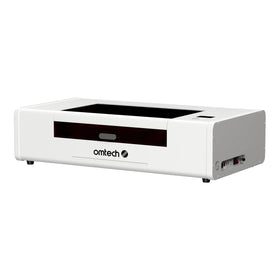
OMTech Desktop Lasers: Safe, Reliable Laser Cutting Machines For Elementary Schools
Since the teacher operates every job at this level, a compact, enclosed desktop CO₂ machine is usually the easiest fit.
- The OMTech Polar Lite (55W) is a sensible starting point: it sits comfortably on a sturdy classroom table or cart and has enough power for the cardboard, paper, and thin wood used in K-5 projects.
- If your budget allows a step up, the Polar 2 Desktop CO2 Laser Engraver and Cutter is another desktop option, available with an RF tube for finer detail work. Whichever you choose, pair it with a fume extractor or outdoor venting, as covered above.
2. Laser Cutters For Middle Schools: What To Prioritize When Choosing and Best Models
The priority when choosing a laser cutter for a middle school should always be safety, reliability, and versatility. You want a laser cutting machine with a fully enclosed Class 1 safety system, certified ventilation, keyed power locks, and robust build quality. Here are four essential factors to consider when choosing a laser cutter to be used in a middle school environment:
1. Safety and Compliance
Look for a Class 1 Enclosed Laser with safety interlocks that instantly kill the beam if a student opens the lid. Avoid open-frame diode lasers: most of them lack FDA/CDRH compliance and NRTL electrical certifications required for institutional use. Like with a laser engraver for an elementary school, ensure the unit has a keyed power switch or physical security dongle so students cannot operate it unsupervised.
2. Fume Extraction and Ventilation
Middle school laser cutting projects are a little more advanced, and therefore are likely to generate heavy smoke and toxic vapors. So, you must vent directly outside or purchase a heavy-duty, certified medical/industrial-grade inline air filter/purifier box (which can add significantly to the overall budget).
3. Laser Type and Power
Again, laser cutting projects for middle schools are much more complex and varied than laser cutting projects for elementary schools. So, you need a laser cutter that is versatile to accommodate a wider range of laser cutting projects and materials.

Recommended Laser Cutters For Middle Schools
CO2 Lasers (typically 40W–80W) are the gold standard for schools because they cleanly cut and engrave organic materials like wood, paper, and safe acrylics. OMTech CO2 laser cutting machines are highly recommended for schools because they balance enclosed safety features with a more accessible budget for school makerspaces.
In addition, they feature built-in cameras, automated autofocus, and closed safety systems that make it approachable for younger students.
- For a budget option, consider the OMTech Polar Lite CO2 Laser Engraver, a 55W desktop machine that handles plywood, acrylic, and leather projects at an accessible price point.
- For a bigger option, the OMTech Pronto 35 has a larger workspace (20" x 28") along with autofocus, and it comes in 60W, 90W, and 100W versions. That extra room helps when several students' projects need to fit on one bed, or when you expect the program to grow.
Many Pronto 35 packages also include a water chiller, a LightBurn license, or a remote monitoring camera with fire detection, so you may not need to source those separately.
Key Note:
Make sure the machine is compatible with educational-friendly or industry-standard software like LightBurn or straightforward proprietary options that feature user-friendly autofocus and built-in alignment cameras.
3. Laser Cutters For High Schools: What To Prioritize When Choosing and Best Models
When choosing a laser cutter for a high school, prioritize a fully enclosed Class 1 safety design, proper external ventilation, and regulatory compliance (such as FDA/NRTL/UL listings). Here is what you must keep in mind: the best laser cutters for high schools meet all the safety and compliance requirements, have sufficient ventilation, and are usually on the more expensive side.
Key Factors to Consider
- Safety and compliance: For a high school, you want a fully enclosed cabinet laser cutter with interlocks. These features are crucial because they provide much-needed safety against the sometimes reckless tendencies of high school students: they prevent students from accessing the active beam or viewing harmful laser radiation. An open-frame diode, for example, would be an open invitation to accidents in a high school: these usually lack the mandatory safety certifications and features and are generally non-compliant with requirements or unsafe for US institutional use.
- Ventilation and fumes: You must budget for a dedicated professional exhaust system or heavy-duty fume extractor (like a Filtrabox) venting outdoors. Cutting wood, leather, or acrylic releases toxic byproducts.
- Total cost and budget: Realistically expect a total investment between $10,000 and $30,000 for a complete, compliant high school setup including the machine, industrial filtration or venting, spare parts, and safety compliance.

OMTech Pronto CO2 Laser Cutters: Safe, Durable, and Affordable For High Schools
OMTech Pronto CO2 laser cutters are durable, lower-cost laser cutters for classrooms. With fully enclosed frames and Class 1 safety, they have all the necessary safety features, and their sizeable workspaces make them ideal for use in a high school. Consider the following models:
- OMTech Pronto 35 (60W, 90W, or 100W; 20" x 28" working area; autofocus): a practical entry point for classes that mostly work with smaller sheet stock.
- OMTech Pronto 40 (90W; 24" x 35" working area): more bed space for architectural models, larger signage, and multi-part assemblies.
- OMTech Pronto 45 (100W; 24" x 40" working area): the largest of the three, suited to advanced CTE programs that work with thicker acrylic and hardwoods.
OMTech Laser Cutters For Schools
| School Level | Recommended Model | Power | Working Area | Why It Fits |
| Elementary (K-5) | OMTech Polar Lite | 55W | 8" x 12" | Compact desktop unit for teacher-led demos with cardboard, paper, and thin wood |
| Elementary (K-5) | OMTech Polar 2 | 70W glass tube or 50W RF tube | 28" x 14" | Step-up desktop option; the RF version is suited to finer detail |
| Middle (6-8) | OMTech Polar Lite (budget pick) | 55W | 20.1" × 11.8" | Accessible price point; handles plywood, acrylic, and leather |
| Middle (6-8) | OMTech Pronto 35 (bigger pick) | 60W, 90W, or 100W | 20" x 28" | More room for multiple student projects; autofocus; many packages include a chiller, LightBurn, or a monitoring camera |
| High (9-12) | OMTech Pronto 35 | 60W, 90W, or 100W | 20" x 28" | Entry point for classes working with smaller sheet stock |
| High (9-12) | OMTech Pronto 40 | 90W | 24" x 35" | More bed space for architectural models, signage, and multi-part assemblies |
| High (9-12) | OMTech Pronto 45 | 100W | 24" x 40" | Largest option; suited to advanced CTE work with thicker acrylic and hardwoods |
Laser Cutters For Elementary Schools vs. Middle Schools vs. High Schools: Key Differences
1. Elementary Schools (Grades K–5)
For elementary schools, students create the artwork or designs (often hand-drawn or via simple drag-and-drop apps), but an adult operates the machine. The focus is on teacher-led demonstrations, basic creativity, and sensory engagement.
Typical projects are name tags, cardboard puzzle pieces, classroom decorations, and simple shape cutouts.
2. Middle Schools (Grades 6–8)
In middle school settings, laser cutters are used for introducing design thinking, basic vector software, and supervised student operation. The goal is usually to educate students on how to begin translating 2D digital drawings into physical objects themselves under close monitoring.
Typical projects are laser-cut keychains, customized bookmarks, layered 2D puzzles, and simple engraved wooden boxes.
3. High Schools (Grades 9–12)
In a high school setting, a laser cutter is mostly used in Advanced Career and Technical Education (CTE), engineering prototyping, and independent student fabrication. At this stage, students are allowed to go through the entire CAD-to-product workflow themselves.
Typical projects are architectural scale models, complex multi-part mechanical assemblies, custom signage, and functional electronic enclosures.
Laser Engravers For Schools: Key Differences Across Grade Levels
| Feature | Elementary School (K–5) | Middle School (6–8) | High School (9–12) |
| Primary User Goal | First exposure to digital-to-physical translation. | Introduction to design thinking and simple assembly. | Advanced CAD/CAM workflows and prototyping. |
| Machine Type | Higher-power enclosed diode or highly enclosed, small CO₂. | Enclosed, medium-power CO₂ laser (30W–60W). | Professional CO₂ (40W–100W+) or specialized fiber lasers. |
| Software Workflow | Visual and Cloud-based (drag-and-drop, camera tracking). | Vector-based programs (2D design tools like Canva or Inkscape). | Industrial CAD packages (AutoCAD, SolidWorks, LightBurn). |
| Typical Materials | Cardboard, paper, thin craft foam, and pre-cut wood templates. | Plywood, acrylic, leather, and dense cardboard. | Hardwoods, thick acrylic, metals, and complex composites. |
| Safety Mandates | Class 1: completely sealed enclosure, automatic lid locks, internal filtration. | Enclosed chassis, mandatory interlocks, external air assist. | Dedicated ventilation/venting setups, safety eyewear, and emergency shut-offs. |
| Operator Model | Teacher-operated entirely; students view from a safe distance. | Teacher-supervised; students learn to set up and run the job. | Student-operated independently after passing a safety certification. |
Final Thoughts on Choosing a Laser Cutter For Schools
In summary, the right laser cutter for a school depends less on the machine's specs than on who will be using it.
- An elementary classroom needs a compact, fully enclosed unit that a teacher operates.
- Middle schools need something versatile enough to grow with supervised student use.
- High schools need the power and bed size for real prototyping and CTE work.
At every level, safety comes first: an enclosed design with interlocks, keyed access, and proper ventilation matters more than wattage or price.
Remember to budget for the whole setup, not just the machine. Fume extraction, a chiller, software, and spare parts are part of the real cost, and they are easier to plan for up front than to add later. It also helps to choose a machine for where your program will be in three years, not just where it starts.
You may also be interested in these 15+ quick and easy laser cutting projects for schools, which are also conveniently organized into the best projects for elementary, middle, and high schools.



![[Latest] Diode Laser vs. CO2 Laser vs. Fiber Lasers - Complete Guide](http://omtech.com/cdn/shop/articles/diode-vs-co2-vs-fiber-lasers_cad89d19-589c-4837-a019-48d69698f6f5.jpg?v=1789898499&width=200)
