







15+ Best Laser Cut Projects For Schools (By Age Group and Class Size)
The best and most beginner-friendly laser cutter projects for schools are those that focus on fast cut times, low-cost materials like cardboard or scrap wood, and high student engagement.
This is very important because having a laser cutting machine in a school is one thing, but making the most of it is another entirely. In other words, you have to find projects that can be laser cut quite quickly, with inexpensive materials, and allow for the highest individual customization.
However, the ages and level of education of the kids are also very important factors when deciding which laser cutting programs are best for any classroom. Remember, the goal is not just to get students to successfully cut the items with a laser machine, but to help them to understand the principles that guide the laser cutting process and how this can help them have a practical grasp of what is being taught to them in class.
Based on these criteria, we have compiled 25+ of the best school laser cutting projects for students, splitting them into general projects that work for all students, and the best projects for elementary, middle, and high school kids.

Best Overall Laser Cutter Projects For All Schools
1. Quick Cardboard and Paper Projects
- Custom storage boxes: Use online generators like MakerCase or MakeABox to teach students about slot-and-tab 3D construction using free corrugated cardboard.
- Layered crests and emblems: Have students design a 3-layer shield or logo using painted cardboard to learn basic vector cutting and depth.
- Geometric tessellations: Cut repeating shapes (like Escher-style lizards) out of cardstock or thin board for younger grade levels to explore math concepts.
Cardboard and paper are both excellent laser engraving materials for students: they are inexpensive, easy to work with, and safe to use in a classroom setting. Plus, there is a wide variety of easy laser cutting projects students can accomplish with them.
2. Wood and Engraving Projects
- Personalized Keychains and Bag Tags: These are quick raster-and-cut exercises that use thin plywood or acrylic where students engrave their names or student IDs.
- Layered topography maps: Simple stacked contour maps made of thin MDF or plywood sheets glued together to represent geographic elevations.
- Painted ornaments: Flat holiday or science-themed wooden silhouettes that students can easily paint after cutting.
Best Laser Cut Projects For Schools By Class Size
For Large Classes: Ultra-Fast and Personalized Laser Cutting Projects and Cardboard Engineering Projects
- Custom name tags and keychain fobs: You can have the students import a simple silhouette and type their own names using software like LightBurn. These projects are hugely popular in schools because they let the kids customize their own names, which gives them a sense of attachment and ownership of the project.
- 3-Layer Shield or Crest: You can also have students design a multi-layered emblem using colored cardboard. This is a good project because it allows them to learn how to group vectors and set different layers for cutting vs. scoring.
- Desk signs and door hangers: The projects work because they are simple; besides, they are also a great introduction to typography and geometric cutouts using thin plywood or acrylic.
Cardboard Engineering Projects (Low Cost and Forgiving)
Corrugated cardboard laser cutting projects are some of the most low-budget laser cutting projects for schools. Corrugated cardboard is usually free (you can have it recycled from big-box store trash), cuts incredibly fast, and it is safe and non-toxic to use in a classroom. Consider the following projects:
- Press-Fit storage boxes: Utilizing free template generators like MakerCase or Boxes.py, students can create custom slotted boxes to organize their desks or lockers.
- Tessellation puzzles: Younger students can design interlocking shapes (similar to M.C. Escher's lizards) to learn how geometry and tolerances work when pieces fit tightly together.
- Cell phone stands: Simple two-piece interlocking designs that require zero glue or hardware to assemble.
For Smaller Classrooms: STEM and Interlocking Designs
For older students or classes with more time, the best laser-cut projects are usually those that cross over into math, physics, or three-dimensional design. These work because they are still fun, but introduce an element of mental challenge and allow them to make practical use of the knowledge they are learning in school. Here are some of the best projects:
- Dice towers: These feature interior angled shelves, and they work because they teach students how to visualize a 3D object built from flat, 2D interlocking tabs and slots.
- Pinewood derby/rubber band cars: You can have students cut the chassis out of plywood or acrylic and attach wheels to learn about friction, momentum, and mechanical assembly.
- Gravity arches: Laser-cut individual segments of a thick parabola out of wood, then task the students with assembling an architectural arch held together purely by gravity.
Best Laser Cut Projects For Schools By Age Group
When it comes to choosing the best laser-cut projects for schools, you cannot ignore the ages of the kids. As many teachers have shared online, a project that delights a high schooler will completely overwhelm an elementary student, while a project that takes minutes for a 4th grader might bore a teenager.
Remember, age group dictates how easy it would be for them to understand the different complications of laser engraving software, how patient they will be to finish a project, and even the reasoning skills required for a project. When selecting laser-cut projects for a school, it always helps to break down your options into three developmental stages:
- Elementary school (K–5): This group lacks advanced computer skills. So, they need projects focusing on "analog-to-digital" tracing or very simple font/shape arrangements. The goal of the projects should be to understand the relationship between a flat drawing and a physical cutout.
- Middle school (6–8): This group is able to understand and work with basic 2D CAD/vector manipulation. They understand tolerances but may struggle with complex multi-part spatial visualization. So, for them, simple slot-together assemblies are perfect.
- High school (9–12): These are older kids who can handle advanced parametric design and 3D modeling programs like AutoCAD or Fusion 360. For them, you can focus on functional engineering, complex mechanisms, and multi-material builds.
1. Best Laser Cut Projects For Elementary School Kids(K–5)
- Hand-Drawn Puzzles: Students draw a picture on paper using a thick black marker. Using the laser cutter's camera system (like on a Glowforge), the machine traces their drawing, engraves it onto thin plywood, and cuts a basic grid puzzle over it.
- Silhouetted Luggage/Backpack Tags: Students pick a preset icon shape (e.g., a dinosaur, star, or rocket) and type their name into the software. The project teaches them basic file preparation and text positioning with instant gratification.
2. Best Laser Cut Projects For Middle School Kids (6–8)
- Slotted desktop organizers: Students design box-jointed or tabbed trays using browser-based vector tools like Vectr or Tinkercad. This introduces the math required to account for material thickness (e.g., ensuring a 3mm tab fits into a 3mm slot).
- Custom gliders and elastic rockets: Cutting wings and body components out of ultra-light balsa wood. Students can test different aerodynamic profiles, introducing them to physics and rapid hardware iteration.
3. Best Laser Cut Projects For High School Kids (9–12)
- Topographic/layered maps: Using GIS data or software tools, students slice geographical landscapes or city maps into distinct layers, cutting each layer out of thin ply or stained wood to assemble a stunning 3D art piece.
- Automated or mechanical enclosures: Designing complex enclosures with integrated living hinges (wood cut so finely that it bends like fabric), custom-cut acrylic gears, or press-fit frames that house actual electronic hardware like Arduino or Raspberry Pi boards.

Choosing a Laser Cutter For Schools: Why The Laser Cutter Means Everything
One of the most frequent mistakes people make in laser cutting is buying the wrong type of laser cutting machine. The type of laser cutter matters fundamentally, especially for a school project, because different laser technologies output light at completely different wavelengths. So, once you have an idea of what laser cutting project you want to introduce in a school, the next step is to decide:
- what kind of laser engraver best fits the needs of the project
- Which specific model best matches the size of your classroom and other facilities you have available.
The 3 Main Laser Cutter Types For Schools and Their Best Projects
| Laser Type | Light Wavelength and Nature | Best Project Materials | Worst Materials |
| CO₂ Laser cutters | 10,600 nm. Absorbed incredibly well by organic materials. | Wood, all colors of acrylic (including clear), leather, glass, cardboard. | Bare metals (without specialty marking sprays). |
| Diode Laser cutters | 450 nm (Visible blue light). Compact and cost-effective. | Wood, cardboard, leather, dark or opaque plastics. | Clear acrylic, blue/transparent materials, metals. |
| Fiber Laser cutters | 1,064 nm. Extremely high precision and absorption in crystalline structures. | Bare metals (steel, aluminum, brass), rigid opaque engineering plastics. | Wood, organic materials, transparent glass or acrylic. |
Choosing a Laser Cutter For Your School: Types and Recommended Models
1. CO₂ Lasers: The Classroom Workhorse
Because a CO₂ laser cuts organic-based materials rapidly and cleanly, it is undisputedly the best for "making flat things into 3D structures." In a classroom, you can easily accomplish laser cutting projects of any of the following types with a CO2 laser cutter:
- Clear acrylic edge-lit signs: LEDs cannot shine effectively through dark plastics. CO₂ lasers can effortlessly cut clear acrylic panels that slot into light-up bases.
- Thick plywood structural assemblies: If your students are building heavy-duty dice towers, mechanical gear clocks, or load-bearing storage boxes, CO₂ lasers cut through 1/4" to 1/2" wood in a single, blazing-fast pass.
For maximum versatility, portability, ease of use, and safety, choose a desktop CO2 laser engraver. These are affordable and safe, and because they are compatible with a wide variety of materials, they allow you to introduce students to the maximum number of laser cutting projects.

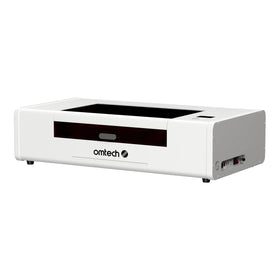
OMTech Polar 2: Most Versatile CO2 Laser Cutter For Classrooms
For schools that want a compact CO₂ laser for projects involving cardboard, wood, acrylic, leather, and other common classroom materials, the OMTech Polar 2 Desktop Laser Cutter is a practical option to consider. Its desktop-oriented format makes it particularly relevant for smaller makerspaces, classrooms, and technology labs where floor space is limited. It is also suited to the type of varied cutting and engraving work described in this section, including personalized projects, signs, and small-scale classroom builds.
OMTech Pronto 35S: Best For Larger Classrooms and Advanced Laser Cut Projects
For a larger class where multiple students may be producing personalized projects, the OMTech Pronto 35 60W is worth considering as a classroom workhorse. It has a 20" × 28" working area, autofocus, and a maximum engraving speed of 1,000 mm/s, giving a school more room and throughput than a small desktop machine. This makes it a particularly relevant choice for schools that expect to handle frequent batches of name tags, keychains, signs, cardboard prototypes, and wood projects.
2. Diode Lasers: Budget and Portability
Enclosed desktop diode lasers are the most common entry points for smaller schools or limited budgets. Because they are slower than CO₂ systems, they excel at small, high-detail raster engravings.
- Custom leather patches and notebooks: Diode lasers burn sharp, dark vector images into organic leather or faux-leather goods flawlessly.
- Cardboard prototyping: While they struggle with thick wood, a 10W to 20W diode machine can cut cardboard shapes instantly, making it fantastic for rapid geometry or puzzle assignments.
If you are on a budget, a diode laser cutter could be a practical option. However, you must accept that there will be limitations when it comes to the thickness of the material you can cut.

3. Fiber Lasers: Engineering and Metal Fabrication
Galvo fiber laser cutters are best for advanced classrooms with older students: They feature a mirror head rather than a slow-moving gantry, which allows them to engrave thousands of times faster than diode or CO₂ systems. However, they only work on metals and hard plastics.
If you intend to introduce your students to any kind of metal laser cutting projects, you will need a fiber laser cutter.
OMTech Galvo 30W Fiber Laser: Best For Laser Cutting STEM Projects
For high school engineering, manufacturing, or advanced STEM programs that want students to work with metal, an OMTech Galvo 30W Autofocus Fiber Laser is a more specialized option. OMTech currently offers this configuration as a fiber marking machine, making it relevant to projects involving metal identification plates, engraved components, tags, tools, and other metal objects.

Unlike a CO₂ machine, a fiber laser should not be treated as an all-purpose classroom cutter. Its value in a school is primarily in giving older students exposure to metal marking and a different laser technology, making it better suited to an advanced fabrication or engineering lab than a general-purpose classroom.
Final Thoughts On Laser Cut Projects For Schools
The best laser cutting projects for schools are not necessarily the most complicated ones. The most useful projects are those that match the students' age, the available classroom time, the school's budget, and the materials the students are expected to work with.
Simple projects such as keychains, puzzles, storage boxes, and desk signs can teach the fundamentals of digital design and laser cutting, while more advanced projects such as mechanical enclosures, topographic maps, and engineering assemblies can introduce students to CAD, physics, mathematics, and fabrication.
You may also be interested in this guide on how to integrate LightBurn into your school curriculum and why it makes laser cutting so much easier for both students and teachers.