







Everything to Know About Knife Laser Engraving in 2026
If you are a knife maker, collector, outdoor enthusiast, gift business owner, or entrepreneur offering personalized products, now is the perfect time to get into knife laser engraving.
The best thing about knife laser engraving in 2026 is that you can make use of advanced laser technology to make your work a lot faster, easier, cleaner, and even more versatile. With a laser engraving machine, you can place names, logos, artwork, serial numbers, patterns, and other details directly onto a knife with a level of consistency that is just not possible with hand engraving.
So, what makes knife laser engraving so attractive, what kinds of knives work best, and what kind of laser engraving machine would you need for knife laser engraving?
Knife Laser Engraving: Why it Works
The biggest reason why knife laser engraving works is because knives are made of materials that are perfectly compatible with laser engraving.
Most modern knives use materials like stainless steel, carbon steel, tool steel, titanium, and aluminum. All these materials are strong, durable, and resistant to everyday wear, which is exactly what you want from a knife, but they also make these knives more difficult to work with when customizing them.
This is why a laser engraver is so attractive for knife laser engraving: it provides a way to mark these hard materials with extremely fine detail.
Fiber laser engravers are generally the go-to for knife laser engraving: they have a wavelength of approximately 1064 nm, which is perfectly suited to metal processing. A fiber laser can directly mark many common knife metals without even needing a marking coating. For context: this 1064 nm wavelength sits in the near-infrared range, which metal absorbs efficiently, and that is precisely why fiber lasers can mark bare steel while a standard diode or CO2 laser, whose wavelengths are tuned for organic materials, will simply reflect off it
Advantages of Knife Laser Engraving
There are many ways to engrave knives: mechanical stamping, hand chiselling, or even chemical acid-etching. However, using a laser is generally considered the best way to engrave a knife. Laser engraving offers significant advantages: it better protects the blade, makes it easy to achieve superior accuracy, and produces clean, crisp results with perfect consistency. Here are three reasons why knife laser engraving works:
1. There is no physical stress on the knife blade
Knife laser engraving is a non-contact process: the laser head does not come in contact with the knife, so there is no mechanical pressure or clamping stress during engraving. This is a very important advantage because it means there is no chance of the knife bending or micro-fracturing, and the pre-sharpened edges remain protected.
2. You Can Achieve Microscopic Precision With a Laser Engraver
The surface area of a knife blade can be very highly restricted. This is usually a setback in traditional knife engraving methods because the hand tool or physical stamp will smudge the design and ruin the final product.
Laser engravers have a finer, tiny focal point, so they can easily handle fine details, tiny serial numbers, custom signatures, and complex logos.
3. The Design is Permanent and Wear-Resistant
Laser engraving marks on a knife tend to be more durable and long-lasting than pad printing, silk-screening, or vinyl stencils. Even when subjected to heavy tactical use, extended kitchen prep, or continuous cleaning, you can be sure that laser-engraved marks on a knife will not peel, scratch off, or fade.
4. The Consistency of the Design Is Perfect
Another major advantage of knife laser engraving is the consistency it gives you, especially if you are working on many engraving projects. Once you have a vector design locked in, the machine can repeat the exact design across hundreds of knives with the same depth, alignment, and line quality. This is impossible to achieve with hand engraving.

What Are The Best Knives For Laser Engraving?
There is almost no limit on which kinds of knives can be laser engraved: as long as a knife is made of a material whose wavelength is compatible with laser engravers, it can be engraved.
Here are some of the best and most common knives for laser engraving, broken down into specific categories based on who the knife is for and how it will be used:
- Everyday Carry (EDC) and pocket knives: These are the most common knives for custom engraving, particularly for gifts like groomsmen presents. Most people prefer knives from Civivi (like the Elementum or Vision FG), CJRB (Pyrite), and Kizer (Original), mainly because they feature clean, flat blade geometries that accommodate text perfectly.
- Culinary/Kitchen knives: Kitchen knives have massive, flat surface areas (these are usually called "canvases") that are ideal for elaborate laser engraving. High-end Japanese knives like Santoku, Gyuto, and Nakiri knives are a favorite in this category because they make excellent presents for culinary artists and home cooks.
- Outdoor, hunting, and tactical knives: Hunters, military personnel, and survivalists love using laser engraving to add a touch of personal identity or utility to their field gear. Large hunting knives (like those by Bison River or Buck Knives) heavily engraved with wildlife scenes, family names, or dates are very popular with people in this community.
What are The Best Laser Engravers For Knives?
Again, fiber laser engravers are the best for knife engraving: they are most compatible with the material most knives are made of. However, with some workarounds, there are (albeit limited) ways you can engrave a knife with a CO2 laser engraver. When searching for a laser engraver specifically for knife engraving, the most important thing to keep in mind is that the metal blade itself dictates the type of laser you need, and not the other way around.
So, you start with the type of knife you want to engrave and what material it is made of, then determine which type of laser engraver you need for that material and what key specs to look for based on the number of knives you intend to engrave and the amount of detail you would like. If you try to use a standard organic-material laser on bare steel, it will simply bounce off.
Here is a breakdown of the best laser engravers for knives, based on what your budget may be, the amount of depth you want on the design, and the part of the knife you are customizing:

1. Fiber Laser Engravers
Fiber laser engravers are generally considered to be the gold standard for knife laser engraving. This is because they have a wavelength of1064nm which is perfectly compatible with steel and aluminum, which is what most knives are made of.
If you want to engrave directly into bare steel, raw aluminum, or titanium handles, you need a dedicated metal-marking wavelength (typically 1064nm), and this is what fiber lasers provide. These machines vaporize metal or create deep, permanent thermal annealing lines with zero chemical prep.
- Choose a hobbyist/ entry level galvo fiber laser engraver if you are a beginner on a budget. An entry model like the OMTech Galvo 20W Compact and Integrated Fiber Laser Engraver can mark and deeply etch stainless blades quickly without taking up an entire shop floor. The OMTech Galvo 30W is a split-head galvo design, meaning the laser source sits separately from the compact scanning head; a layout that keeps the footprint small while still delivering the power needed for annealing marks on knife steel.
- Choose a premium benchtop dual laser engraver if you are running a knife laser engraving business or startup. These hybrid models, like the OMTech Solis Duo laser engravers, combine a fiber laser (for the steel blade) and a diode laser (for cutting wood or leather sheaths) in a single housing. Best if you are launching a business focused on knife engraving, but also have ambitions to expand your business without having to buy new laser engravers. The built-in autofocus of the Solid duo machines is particularly useful here since it removes one of the fiddlier manual setup steps described later in this guide.
- If you want color knife laser engraving, especially on an industrial level, you need to upgrade to a MOPA fiber laser (ideally a 30W–60W machine). MOPA fiber lasers let you adjust pulse frequencies so that you can achieve color laser engraving. They are ideal for makers who want to etch vibrant colors onto steel or titanium. OMTech offers a 60W MOPA split fiber engraver, which has a 6.9" x 6.9" working area for shops that want extra headroom on speed and depth for high-volume color work on knives.
2. CO2 Laser Engravers: A Budget Workaround For Knife Engraving
If you are just venturing into knife laser engraving and you are not yet sure you want to commit to a fiber laser engraver (they are usually more expensive), there is still a possibility of using a CO2 laser engraver.

But there is a bit of a catch when using CO2 lasers for knife engraving: strictly speaking, CO2 desktop lasers have a wavelength of 10,600nm, which only works on organic matter like wood, leather, and acrylic; they cannot etch bare metal out of the box. So, if you must use a CO2 laser for knife engraving, you cannot do so without adopting a few workarounds. Here is how it is done:
- Chemical marking sprays: You spray the raw steel blade with a temporary ceramic coating like Cermark or LaserBond. That way, when a high-powered diode or CO2 laser hits the spray, it will instead fuse the ceramic powder to the steel surface and leave a permanent black mark. This is how you engrave your design.
- Blade coatings: This method works if the knife already has a dark factory coating (like a powder coat, Cerakote, or black oxide). With a diode or CO2 laser, you strip the dark coating away and reveal the silver steel underneath.
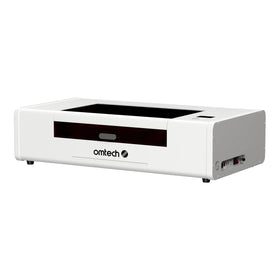
For this application, even the smaller, more affordable desktop laser engravers will do. The Polar Desktop CO2 Laser Engraver Series from OMTech offers two of these: the OMTech K40+ and the OMTech Polar Lite Desktop Laser Engraver. The K40+ is the more budget-friendly entry point for testing the coating-spray method before committing to a larger investment, while the Polar Lite's extra power gives faster, more consistent coating removal on factory-coated blades.
Laser Engravers For Knives Compared
| Laser Type | Wavelength | Direct Steel Engraving? | Recommended Model | Best Uses |
| Fiber / IR | 1064nm | Yes (Deep cuts and annealing) | OMTech 20W-50W Galvo Fiber Lasers | Bare steel blades, raw aluminum, titanium handles, brass. |
| CO2 | 10,600nm | No (Needs spray/coatings) | OMTech Polar Lite | Stripping anodized layers. |
How To Laser Engrave Knives: An Overview of The Process
The process of laser engraving knives differs depending on the type of laser engraver you are using. In fact, laser engraving a knife successfully depends heavily on whether you are working with a metal-marking Fiber/Infrared (IR) laser or a standard Diode/CO2 hobby laser.
However, there are some common challenges with knife laser engraving ( knife blades have an angled, uneven surface and crucial heat treatments); there is a general step-by-step workflow you must follow to get clean results.
Step 1: Design and Alignment in Software
- Start by importing your artwork: Open software like LightBurn and pull in your graphic. As a note, vector files (.SVG or .DXF) usually yield the sharpest text and logos.
- Then build a digital alignment jig: Remember, knife blades are extremely hard to eyeball, and this is why you need a jig. In your software, draw a quick bounding rectangle that matches the physical dimensions of your blade. Then center your graphic perfectly inside this rectangle.
- Set the fill mode: Switch your graphic layer from a basic outline ("Line") to a dense cross-hatch fill pattern ("Fill"). I personally use a cross-hatch setting of 300 lines per cm (that is about 1200 lines per inch). It ensures there will be no gaps in the final mark.
Step 2: Prep the Knife Physical Surface
- Degrease the blade completely: Wipe down the blade and ensure there is no grease on it. This is a very important step: any factory protective grease, finger oils, or polishing compounds left on the blade will block the laser and cause spotty, faint marks. I use isopropyl alcohol or acetone for this
- Apply spray (if you are using a CO2 laser): If you are not using a fiber laser, shake up a can of laser metal-marking spray (I use Cermark) and apply a very thin, even coat. Let it dry completely until it looks matte gray.
- Level the Knife: Knife blades have hollow or flat grinds, so the blade will naturally slope downward when lying flat on a bed. To level it, slip a folded paper towel or an aluminum shim under the thin edge of the blade until the entire face is 100% horizontal and level with your laser head.
- Focus the Laser: I use an OMTech fiber laser machine, which has a auto focus feature, so lock the focal plane directly onto the blade surface. If your machine doesn't have an autofocus option, you can use the focusing stick or twin red-dot alignment lasers.
Step 3: Framing and Laser Execution
- Run the frame function: Your laser engraving software should have a "Frame" boundary function. At this point, you want to watch the low-power red tracking laser trace around the knife. This will help you confirm the design isn't overlapping the handle scales or running crookedly off the edge of the spine.
- Input your settings:
- Fiber/IR lasers (annealing black mark): Set a lower speed with balanced power (e.g., 200–500 mm/s speed, 80–100% power). This will enable the laser to generate high-contrast thermal changes without digging into the metal.
- Fiber/IR lasers (deep etching): If you are working with a fiber laser engraving machine, go for multiple passes. High speed, high power, and high frequency over 3 to 10 rapid, continuous passes will cleanly sweep away layers of steel and help you etch a clean design.
- Diode/CO2 lasers (fusing spray): For a CO2 or diode laser, it is better to run at slow speeds and near maximum power (e.g., 100–300 mm/min speed, 90–100% power). This way, you properly melt the bonding ceramic compound into the steel.
- Run the job: Fire the laser. Remember, always keep your safety glasses on and run your ventilation system.
Step 4: Clean and Finish
- Clean Off Residue: If you used a marking spray (ie., you were working with a CO2 laser), wash it off under a sink using water and a mild scrubbing sponge. If you used a fiber laser, wipe the soot and burn marks away with alcohol and a microfiber cloth.
- Oil the Engraving: Finally, you need to treat the engraved area. This is an important finishing step because the laser heat strips away the factory metal seal, making the freshly engraved area highly vulnerable to moisture and rust. Rub a drop of 3-in-1 oil, mineral oil, or gun oil directly over the engraved area to seal the steel.

Is Knife Laser Engraving Profitable in 2026?
The consensus among the entrepreneurs OMTech has spoken to on this topic is that knife engraving is indeed a highly profitable niche, but like every other laser engraving business idea, it takes a lot of skill, talent, and creativity to stand out in the sector.
Laser engraving knives specifically offers a massive competitive advantage because they solve the biggest issue in the modern laser industry: market saturation. Here are some good reasons why knife laser engraving is still worth a go in 2026:
1. There is a high barrier to entry, which means lower competition
To set up a laser engraving business for knives, you need a dedicated Fiber or Infrared laser that engraves raw metal. This is an advantage because laser engravers for metal cost more (typically $1,200 to $4,000+), and not just anyone can afford them. So, you end up facing significantly less local competition.
2. Engraved knives have a high perceived value
Owners and entrepreneurs in the laser engraving industry emphasize that the real money lies in combining a low-cost base product with high emotional value, and laser engraving knives perfectly fit this criterion. A blank pocket knife you buy cheaply at wholesale price has a much higher resale value when you engrave it for an occasion like a wedding, graduation, or military recruitment. This is where the profit comes from.
3. There is an opportunity for B2B Bulk Orders
Nowadays, B2B orders are how laser engraving businesses make most of their money, and laser engraving knives open doors to commercial, recurring business orders.
You can market to restaurants that usually want their house blades serialized or branded, catering companies that want customized uniform gear, and corporate businesses that usually buy custom-engraved premium pocket knives (like Leatherman or Swiss Army Knives) as high-end client gifts.
4. Your throughput is very high when laser engraving knives.
A CO2 laser may take 15 minutes to slowly etch a large wooden cutting board, but a fiber laser can cleanly mark a name or logo onto a steel blade in 30 to 45 seconds. High throughput means you can handle bulk engraving, making more money practically on a per-minute basis.

Final Thoughts on Knife Laser Engraving
Knife laser engraving sits in a rare sweet spot: the technical barrier is high enough to keep the market from getting crowded, but the workflow itself is learnable in an afternoon once you understand the core principle: match your laser's wavelength to the blade's material. Get that right, and everything else in this guide (jigging, fill settings, coatings, oiling) is just refinement.
If you're just testing the waters, a CO2 machine like the Polar Lite or K40+ paired with a marking spray is the lowest-cost way to find out whether knife engraving is a niche you want to pursue. Once you're confident in the demand (especially if groomsmen gifts, B2B branding, or hunting-knife personalization are proving popular with your customers ), stepping up to a dedicated fiber or MOPA system pays for itself quickly given how fast each piece turns around.
Either way, the combination of low material cost, high perceived value, and strong repeat/B2B potential makes knife engraving one of the more durable niches in the personalization space heading into 2026.
You may also be interested in how you can cut knife blanks with a fiber laser cutter.