







Can You Use One Laser Engraver For All Materials?
At the current level of technology and advancement in the laser engraving industry, no single laser engraving machine can effectively engrave all materials. This is because each type of laser engraver is limited to a single wavelength, but all the different laser engraving materials absorb different wavelengths.
So, owning one type of laser engraver effectively puts a limit on the number of materials you can process: a wavelength that cleanly cuts wood will pass straight through clear acrylic or bounce safely off bare metal.
However, though a single laser engraver cannot do it all, there are two ways you can use one laser engraver to engrave different materials:
- You buy a hybrid or dual-source laser engraver
- You use specialized coatings
These are workarounds that work, but to use any of these methods, you need to have a foundational understanding of the different types of laser engravers: where they excel, which materials they are most compatible with, and their limits. This will help you choose the right hybrid dual-source laser engraver, or know which specialized coatings you need.

Laser Types and Their Limitations: Why There Is No Laser Engraver For All Materials
Again, lasers rely on light absorption. If a material reflects or fails to absorb a laser's specific light frequency, it will not engrave. Here are the primary laser types by their physical limitations:
- Diode Lasers (450nm Blue Light): Great for engraving wood, dark acrylic, and leather. They cannot engrave bare metals (only mark coated metals) and cannot effectively engrave clear or light-blue acrylic, since the light passes straight through instead of being absorbed.
- CO2 Lasers (10,600nm Infrared): The gold standard for organic materials. They slice through wood, cut clear acrylic effortlessly, and etch glass. However, their light bounces right off bare, uncoated metals.
- Fiber Lasers (1,064nm Infrared): Built specifically for metals and certain hard plastics. They excel on stainless steel, brass, and aluminum, but they will simply burn or pass through organic materials like wood.
Quick Material Compatibility Guide: Laser Engravers For Different Materials
| Laser Type | Best Materials | Cannot Engrave | Typical Beginner Machine |
| Diode | Wood, leather, dark acrylic, dark stone | Bare metals, clear or light acrylic | xTool D1 Pro, Sculpfun S9 |
| CO2 | Wood, clear/colored acrylic, glass, leather | Raw/bare metals (copper, brass, steel) | OMTech 40W (K40), Pronto (60-150W) |
| Fiber | Stainless steel, aluminum, brass, gold, plastics | Wood, leather, clear acrylic | OMTech Galvo, Cloudray 30W, etc. |
How Can You Really Get a Laser Engraver For All Materials?
While it is impossible to get a laser engraver for all materials, there are dual laser engraver machines that combine two different types of laser engravers into one unit, giving you the ability to engrave a wider range of materials than you would normally be able to with each laser individually. In a sense, these are the best laser engravers for all materials at the moment.
Apart from dual laser engravers, there is another way you can come close to getting a laser engraver for all materials: by getting a CO2 laser engraver machine. This is a more realistic goal: to aim to get a single laser engraver that engraves the maximum amount of materials.
In this sense, a CO2 laser engraver can be said to be the best laser engraver for all materials because it engraves the maximum variety of materials, as long as you accept its limits on bare metals.

The #1 Choice: Dual-Source Galvo Lasers
If you want to have two different types of laser in a single machine, a hybrid unit containing both a Diode (blue light) and an Infrared / Fiber laser source is the only option that spans both organic items and raw metals without resorting to messy sprays.
For pure material versatility, choose a dual-laser engraver that uses a high-speed Galvo mirror steering system. Here's why: instead of moving a heavy printhead on rails, it uses pivoting mirrors to zip the beam across the surface at extreme speeds.
By hitting a toggle switch in your software, you can jump between a 450nm Blue Diode (for
wood, leather, dark acrylic, stone, and ceramics) and a 1064nm Infrared laser (for raw aluminum, steel, brass, copper, and hard engineering plastics).
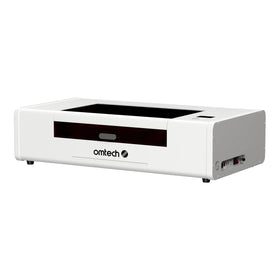
The OMTech Solis Duo 50W Fiber and 40W Diode Dual Laser Engraver is a dual-source galvo machine, combining a 50W fiber source with a 40W diode source in one unit. Of all the models in OMTech's Solis Duo Laser Engravers line, this is the model that matches everything you can get in a single laser engraver for all materials; you can switch between the diode and fiber sources to move from wood, leather, and dark acrylic straight to raw aluminum, steel, brass, and copper without swapping machines or reaching for a coating.
The #2 Choice: CO2 Lasers For Most (Not All Materials)
If your goal is to handle the absolute widest variety of non-metal materials (including clear glass, clear acrylic, rubber, slate, and thick hardwoods) while having the power to cleanly slice all the way through them, then a CO2 laser will work well as a laser engraver for all materials. A CO2 laser handles 90% of all laser engraving materials brilliantly.
However, its 10,600nm wavelength bounces entirely off raw, bare metals. To mark raw metals with a CO2 laser, you must use a specialized chemical backing spray like CerMark.

Recommended OMTech CO2 Laser Engravers For Multiple Materials
1. K40+ 45W Desktop CO2 Laser Engraver
Consider an OMTech K40+45W desktop laser engraver for small space/hobby/surface marking. This machine features an 8" x 12" working area with a detachable honeycomb workbed, priced from $599.99. A compact, budget-friendly entry point if you're mainly marking and engraving smaller pieces rather than cutting thick material.
2. OMTech Maker AF2028-60/80 CO2 Laser Cutter and Engraver
For a growing business, the OMTech Pronto 35 60W CO2 laser engraver can work as a laser engraver for all materials. This machine features a 20" x 28" working area with autofocus, which is a solid step up in bed size and power for a shop handling a wider range of everyday materials and order sizes.
3. OMTech Pronto 45 100W CO2 Laser Cutter and Engraver
If you are in the market for an advanced laser engraver for all materials for a high-volume business, the OMTech 45 90W and 100W CO2 laser engravers are great options. Both feature a 24" x 35" working area with autofocus, and are built for faster, more consistent output; a better fit than the smaller desktop units once you're running a laser as a production line rather than a hobby bench.
Using Specialized Laser Coatings: An Effective Workaround for Laser Engravers For All Materials
Specialized laser coatings do not help engrave all materials; instead, they act as a chemical bridge allowing underpowered or incompatible lasers to permanently mark metals, glass, and ceramics. Take note, though, that these coatings are not meant for organic materials like wood or leather.
When hit by a laser beam, the chemicals in the coating undergo a thermal sintering reaction, fusing directly to the molecular structure of the substrate to leave a permanent contrast mark. Afterward, you simply wash the un-laser-etched powder away with water.

How Coatings Help Specific Materials
1. Bare Metals (Stainless Steel, Aluminum, Brass)
Diode and CO2 lasers have wavelengths that bounce right off shiny, raw metals. A specialized metal-marking compound absorbs the laser's energy, heats up instantly, and chemically bonds a dark ceramic layer to the metal surface. This lets hobbyist lasers create professional-grade, dark-black industrial markings.
2. Glass and Acrylic
Diode lasers pass straight through clear glass and clear acrylic without leaving a mark. (If you're working with a CO2 laser instead, you generally won't need this workaround, as covered above; CO2 already cuts clear acrylic and etches glass on its own.)
Using this method, a thin, opaque coating acts as a "target masking agent". The laser hits the coating first, causing it to heat up and fracture or micro-etch the glass surface directly underneath.
3. Ceramic Tiles
Standard hobby lasers usually leave a faint, barely legible gray mark on white ceramic glazes. A layer of Titanium Dioxide (TiO₂) causes a chemical reaction under the laser beam, changing color and permanently baking a dark black image into the tile glaze.
Which Coatings Should You Get?
There is no consensus on which laser coatings are the best, and most people in the laser engraving community make the distinction based on cost: commercial-grade industry sprays and low-cost DIY household workarounds.
Professional Commercial Sprays
If you need high-contrast, indestructible markings for commercial orders, stick to professional spray brands:
- CerMark Ultra Black Laser Marking Spray: The global industry gold standard. It is expensive but produces dark, highly reliable chemical bonds on steel, glass, and copper.
- LaserBond 100 Aerosol Black Marking Spray: An ethanol-based alternative that dries much faster than other brands. It optimizes energy absorption across diode, fiber, and CO2 formats.
Budget-Friendly Options
- Dry Moly Lube Spray: Industrial lubricants containing Molybdenum Disulfide function similarly to commercial chemical formulas on stainless steel at a fraction of the cost.
- High-TiO₂ White Spray Paint: Brands like Rust-Oleum Painter's Touch 2X Gloss White have high concentrations of Titanium Dioxide. Users spray it over ceramic tiles or glass before engraving to successfully bake a deep black design.
- Dijon Mustard: A popular community trick for stainless steel. (The acidity and sulfur compounds in mustard react with the metal under laser heat, producing a darkening effect similar to commercial marking sprays, at essentially no cost.)
Tips for Getting the Best Results
- Degrease Everything: Always clean your item with acetone or isopropyl alcohol before spraying. Any residual fingerprint oil will prevent the coating from sticking properly.
- Keep it Thin and Even: A thick coat of spray blocks too much energy. Apply a fine, uniform mist.
- Let it Dry Completely: Sintering formulas will fail or blur if they are still wet when the laser strikes.

Final Thoughts on Laser Engravers For All Materials
No single laser engraver can handle every material on the market today, and it's worth being skeptical of any machine marketed as a true do-it-all. The realistic options are a dual-source (diode + fiber) galvo laser, which covers both organic materials and raw metals in one unit, or a versatile CO2 laser paired with specialized coatings for the occasional bare-metal, glass, or ceramic job.
Once you understand why each laser type is limited to certain wavelengths, it becomes much easier to pick the machine, or the workaround, that actually fits the materials you plan to work with. You may also be interested in exploring more about all the different types of laser engravers and what they do best.