







How Car Manufacturers Use Laser Engravers for Traceability and Branding
You push the climate control button on a modern dashboard at night. The symbol glows — crisp, backlit, perfectly readable in the dark. What you're seeing is a laser mark. A production laser removed a precise layer of opaque coating from the button's surface to reveal the transparent substrate beneath, which the backlight illuminates. The symbol's edges are as sharp as the tooling that formed the button itself. That's not an accident — it's a laser marking application that runs on a production line at thousands of units per day, and it's one of dozens of ways laser marking shows up in a finished vehicle without most people ever noticing it.

Laser marking automotive applications span from the obvious — serial numbers on engine blocks — to the invisible: security features in safety-critical components that only reveal themselves under UV light. Car manufacturers and their tier suppliers use laser marking systems for traceability, regulatory compliance, brand protection, and the kind of precision surface design that defines modern vehicle interiors. OMTech's fiber laser engraving machines and MOPA systems serve manufacturers, tier suppliers, and contract fabricators across the automotive supply chain.
The Scale of the Problem: Why Automotive Laser Marking Exists

A single modern vehicle contains between 20,000 and 30,000 individual parts, sourced from hundreds of suppliers across multiple countries. Each part moves through pressing, casting, machining, surface treatment, sub-assembly, final assembly, and then enters service — where it may operate for 15–20 years under extreme thermal, chemical, and mechanical stress.
Tracing a specific brake caliper or airbag inflator back to its production batch, manufacturing date, and quality records is not optional — it's legally required in every major automotive market. Labels peel. Ink fades. Stamping creates mechanical stress and limited data capacity. Laser marking solves all three problems simultaneously: it's permanent, stress-free, and can encode a full data matrix code linking each part to complete production records.
🏭 WHY A TIER-1 SUPPLIER MADE THE SWITCHA transmission component supplier in Germany was marking high-pressure aluminum castings with dot-peen systems. Their OEM customer began requiring data matrix codes with a minimum grade C readability after e-coating — a requirement their dot-peen marks were failing roughly 12% of the time. The issue was surface disruption: the peening process created micro-cracks in the casting surface that the e-coat filled unevenly, distorting the data matrix cells. After switching to fiber laser etching — which marks the surface without mechanical contact — their post-coating readability failure rate dropped to under 0.3%. The OEM customer removed the readability requirement from their incoming inspection checklist for those parts. |
The Five Core Laser Marking Automotive Applications

Automotive laser marking covers five distinct application categories, each with its own material requirements, mark quality standards, and laser technology specifications.
|
⚙️ Production Traceability (DPM) Use Case: Tier 1/OEM production lines Part: Engine, transmission, suspension, brake components Laser: Fiber galvo laser Direct Part Marking (DPM) using data matrix codes linked to production records is the foundational automotive laser marking application. Data matrix codes encode manufacturer ID, production date, shift, batch number, and sequential serial number in a 2D format that requires far less surface area than a barcode. They remain readable at grade B or better through e-coating, powder coating, heat treatment, and shotblasting when applied at correct depth. The data links to the manufacturer's MES system, enabling cradle-to-grave part traceability throughout the vehicle's service life. |
|
🔒 Anti-Counterfeiting & Brand Protection Use Case: OEM parts programs, aftermarket supply chains Part: Safety-critical components, luxury trim, branded parts Laser: Fiber / MOPA Counterfeit automotive parts are a multi-billion dollar problem in global aftermarket supply chains. Laser marking creates brand authentication features that are essentially impossible to replicate at production cost: micro-text (readable only under magnification), hidden 2D codes in part geometry, and MOPA color-shift marks on anodized surfaces that require specific laser parameters to reproduce. Aftermarket parts without authentic laser marks are flagged during service by scanners linked to OEM part databases — protecting both consumers and brand integrity. |
|
💡 Day/Night Design Marking Use Case: Interior trim suppliers, switch manufacturers Part: Dashboard buttons, climate controls, multimedia panels Laser: Fiber laser (ablation) Day/night laser marking is a specialty automotive application where the laser precisely removes opaque coating layers from transparent plastic components to create symbols, icons, and text that are visible in daylight and glow when backlit. The laser ablates the dark surface coating to reveal the clear substrate beneath, with sub-millimeter edge precision that ensures consistent illumination across thousands of production cycles. Automotive interior suppliers use this for climate control panels, multimedia screens, door controls, and instrument clusters across virtually every modern vehicle. |
|
⚡ EV Battery Cell & Module Marking Use Case: EV manufacturers, battery pack suppliers Part: Lithium cells, battery modules, pack housings Laser: Fiber laser Electric vehicle production has created an entirely new laser marking category. Battery cell manufacturers mark each individual cell with a unique identifier, production data, capacity grade, and safety information. Battery modules carry additional marks for the assembly configuration and testing data. Pack housings receive high-visibility safety markings — high-voltage warnings, service cautions, and emergency responder information. The fiber laser's ability to mark aluminum, steel, and coated surfaces without consumables makes it the standard for EV battery marking at production scale. |
|
🏷️ Compliance & Certification Marking Use Case: Global manufacturers and importers Part: All vehicle components requiring regulatory marks Laser: Fiber / UV laser CE marking, RoHS compliance symbols, safety certifications, country-of-origin marks, and recycling information must appear on specific automotive components in every major market. These compliance marks are typically small — 2mm to 5mm character height — and must remain legible throughout the part's service life. Fiber lasers handle metal components; UV lasers handle the plastic housings of sensors, modules, and connectors where thermal damage from fiber wavelengths would compromise the component. |
Laser Technologies Used in Automotive Production

According to Wikipedia's fiber laser overview, fiber lasers use ytterbium-doped optical fiber as the gain medium, producing coherent light at 1,064nm — a wavelength efficiently absorbed by metals. This fundamental property is what makes fiber lasers the production standard for automotive metal marking. Here's how the different laser types map to automotive applications:
|
LASER TYPE |
AUTOMOTIVE MATERIALS |
PRIMARY APPLICATIONS |
PRODUCTION NOTES |
|
Fiber (1,064nm) |
Steel, aluminum, stainless, titanium |
DPM codes, serial numbers, VINs, logos |
Industry production standard. No consumables. |
|
MOPA Fiber (1,064nm) |
Stainless, anodized aluminum |
Color marking, anti-counterfeit features, stainless anneal |
Required for corrosion-safe stainless marking. |
|
UV (355nm) |
ABS, polycarbonate, sensor housings |
Electronic module marking, plastic compliance marks |
Cold marking — no thermal damage to electronics. |
|
Fiber (ablation mode) |
Coated/painted plastics and metals |
Day/night design, backlit panels, coating removal |
Layer-by-layer precision coating removal. |
|
CO2 (10,600nm) |
Leather, fabric, polymer tubing |
Interior trim, fuel lines, airbag covers |
Non-metal interior components only. |
How Automotive Laser Marking Systems Integrate Into Production Lines

Inline vs Station Marking
Inline laser marking integrates directly into a moving production line — the laser marks parts as they pass on a conveyor without stopping the line. This requires fast cycle times (typically 0.5–3 seconds per part), reliable autofocus to handle part-to-part height variation, and direct interface with the production MES for real-time data. Station marking positions the laser at a fixed marking station where parts are indexed, marked, and released — slightly slower but more flexible for complex markings on multiple surfaces.
Vision Systems and 100% Verification
High-volume automotive marking lines include inline barcode verification cameras that read every mark immediately after it's applied. A mark that fails the minimum readability grade is flagged and the part is diverted before it proceeds to the next assembly step. This 100% verification approach — rather than statistical sampling — is now the expectation in tier-1 automotive supply chains for safety-critical components. The laser marking machine and the verification camera operate as a single system, not two separate steps.
MES and ERP Integration
Industrial laser marking systems connect to Manufacturing Execution Systems (MES) and ERP platforms through standard industrial protocols — Ethernet, EtherNet/IP, and serial interfaces. The MES pushes the marking content to the laser in real time: the specific serial number, production data, and batch code for each part. The system confirms mark application and grade, returning the result to the production record. OMTech's professional laser setup support includes integration assistance for production line deployments requiring PLC and MES connectivity.
EV Battery Marking: The Fastest-Growing Automotive Laser Application

The transition from internal combustion engines to electric powertrains has created the most significant expansion in automotive laser marking requirements since the introduction of VIN marking regulations. A single EV battery pack contains hundreds to thousands of individual cells — each of which must be uniquely identified and traceable from manufacturing to end-of-life recycling.
-
Cell-level marking — Each lithium cell receives a unique identifier, capacity grade, and production data that follows it through pack assembly, vehicle service, and eventual recycling or second-life application.
-
Module marking — Battery modules carry assembly configuration data and testing results that link to cell-level records, enabling the full module's performance history to be reconstructed.
-
Pack housing marking — Exterior pack markings carry high-voltage safety warnings, service identifiers, and emergency responder information required by EV safety regulations in all major markets.
-
Electrode and foil marking — Advanced manufacturing operations mark individual electrode foil sheets and jelly rolls for quality tracking through the cell formation process.
⚡ EV PRODUCTION SCALE CONTEXTA single Gigafactory producing 500,000 vehicles per year with 75kWh battery packs (approximately 5,000 cells each) needs to mark 2.5 billion individual battery cells per year — roughly 6.8 million cells per day. Even at 2 seconds per cell per laser, 100 laser systems running continuously cannot meet that requirement. This is why EV battery cell marking uses the fastest available galvo fiber systems with the shortest possible cycle times, and multiple systems run in parallel on each production line. |
OMTech Systems for Automotive Marking Applications

Here are three OMTech systems matched to specific automotive laser marking applications:
|
Galvo Fiber 20/30/50W — DPM Production Marking • High Speed • Inline Galvo scanning head for high-speed inline production line marking. Marks data matrix codes, serial numbers, and barcodes on aluminum and steel automotive components at up to 10,000 mm/s. Autofocus handles part-to-part variation in production fixtures. EzCad variable data integration for MES-connected marking sequences. Used by automotive tier suppliers for engine component marking, transmission part identification, and brake hardware serial number marking. |
|
MP6969 100W MOPA Fiber Laser — Brand Protection • Color Marking • Stainless Anneal 100W MOPA with a 6.9" × 6.9" work area. MOPA pulse control enables color marking on anodized aluminum for anti-counterfeiting programs and premium brand marking on high-value components. Produces corrosion-safe annealing marks on stainless steel exhaust, brake, and fluid-contact components where surface integrity is critical. Used by custom component manufacturers, aftermarket suppliers, and tier-1 parts programs requiring authentication marks that standard fiber lasers cannot produce. |
|
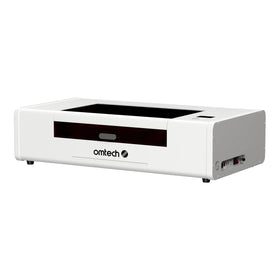
Galvo Fiber 30W Integrated Marker — Small Shops • Custom Fabricators • Aftermarket Parts 30W integrated galvo fiber system with 5.9" × 5.9" work area. Used by small automotive fabrication shops, aftermarket component manufacturers, and custom builders for serial number marking, brand logo engraving, and custom identification on metal parts. Compact integrated design with straightforward EzCad software for batch variable data production. The accessible entry point for automotive parts marking without the footprint and cost of a full industrial system. |
|
💡 CHOOSING BETWEEN GALVO AND FLATBED FIBER SYSTEMS OMTech's Galvo Fiber Laser Marker collection uses a scanning mirror head for high-speed marking on small to medium-format parts — the production standard for automotive DPM marking. The MOPA fiber laser engraving machines add pulse control for corrosion-safe stainless marking and color applications. For larger components or batch fixture marking of multiple parts simultaneously, a flatbed fiber system provides a larger work area at somewhat lower marking speed. |
Ready to add laser marking to your automotive production? |
Frequently Asked Questions
What is laser marking automotive?
Laser marking automotive refers to the use of industrial laser systems to permanently mark vehicle components with identification codes, traceability data, compliance markings, and brand elements. It encompasses production-line applications including data matrix code marking on metal parts, day/night design ablation on interior controls, EV battery cell identification, anti-counterfeiting marks on safety-critical components, and brand marking on premium aftermarket parts. Fiber lasers are the production standard for metal automotive marking; UV lasers handle plastic electronic components.
What is the principle of laser marking?
Laser marking works by directing a focused, high-intensity beam of light onto a material surface where the concentrated energy produces a permanent change. Depending on the material, laser power, and process parameters, this change can be vaporization (engraving), surface melting (etching), subsurface oxidation (annealing), or coating removal (ablation). The beam is controlled by CNC software that translates a digital design — data matrix code, serial number, logo, or symbol — into precise beam movements across the part surface. The process requires no inks, tools, or consumables.
What is a 2D code in automotive laser marking?
A 2D code in automotive marking is typically a Data Matrix code — a square array of black and white cells that encodes alphanumeric data in a format that can be read by machine vision systems at production-line speeds. Data Matrix codes encode significantly more data than linear barcodes in a smaller surface area, making them suitable for small automotive components. They can encode manufacturer ID, part number, production date, batch number, serial number, and quality data. They remain readable under automated vision systems at grade B or better after e-coating, powder coating, and other surface treatments applied after marking.
What is day/night laser marking in automotive applications?
Day/night laser marking is an automotive interior application where fiber lasers precisely remove opaque surface coatings from transparent plastic components to create symbols and icons that are visible in daylight and glow when backlit at night. The laser ablates the dark coating layer from the clear plastic substrate beneath, creating a transparent window in the shape of the desired symbol — climate control icons, multimedia buttons, and instrument panel markings. The process runs on production lines at high speed, marking thousands of components per shift with sub-millimeter edge precision.
Why is laser marking preferred over inkjet and labels in automotive?
Automotive operating environments expose components to temperature extremes (−40°C to 150°C+), oil, coolant, fuel, cleaning chemicals, UV radiation, and decades of mechanical vibration. Inkjet marks fade within months under these conditions. Adhesive labels peel, especially near heat sources. Mechanical stamping creates stress in precision components. Laser marks are physically integrated into the part material — they cannot be worn off, washed off, or removed without destroying the component. This permanence is what enables cradle-to-grave traceability throughout a vehicle's 15–20 year service life.
How does laser marking support automotive recalls?
Each laser-marked 2D code links the physical component to a digital production record containing the supplier, facility, machine, operator, date, batch, and quality data at time of manufacture. When a defect is identified, manufacturers query the production database for all parts sharing the same batch, date range, or production line. The resulting list identifies exactly which vehicles contain the affected components — without laser marking, manufacturers must cast a much wider net, recalling entire model years rather than specific production runs. This precision capability directly reduces the scope and cost of automotive safety recalls.
What automotive parts most commonly use laser marking?
The most commonly laser-marked automotive parts are: engine components (blocks, heads, pistons, camshafts, gears), transmission cases and components, brake calipers and rotors, suspension components, chassis and structural elements (VINs), electronic control modules and sensors, interior trim controls (day/night design), airbag components and safety-critical parts, fuel system components, and EV battery cells and pack housings. The spectrum spans every material used in vehicle construction: aluminum, steel, stainless steel, titanium, ABS, polycarbonate, and coated metals.
What makes MOPA fiber lasers different for automotive applications?
MOPA (Master Oscillator Power Amplifier) fiber lasers add adjustable pulse duration to standard fiber laser marking capability. This enables two capabilities standard fiber lasers cannot achieve reliably: (1) corrosion-safe annealing on stainless steel — forming a dark, permanent mark without disturbing the chromium oxide passivation layer that gives stainless its corrosion resistance, and (2) color marking on anodized aluminum — producing color variations across the visible spectrum for premium branding, anti-counterfeiting features, and color-coded component identification programs.
Can small automotive shops and custom fabricators use laser marking?
Yes — compact 20W–30W galvo fiber systems are practical for small automotive fabrication shops, custom builders, and aftermarket component suppliers. Common applications include marking custom-fabricated brackets and hardware with part numbers, engraving shop logos on billet accessories, producing serial number sequences for small-batch custom components, and marking aftermarket parts with compliance or warranty information. These compact systems mark aluminum and steel at production rates suitable for low-to-mid volume operations without requiring the infrastructure investment of a full industrial inline system.