





Custom Engraved Orthopedic Devices: Techniques and Safety Tips
My first laser was a 40W CO2 I bought secondhand. It had a scorched honeycomb and a lens that hadn't been cleaned in what looked like a year. Still, the first time I ran a wood engraving on it — a simple name plate with a custom font — I understood immediately why people get hooked on these machines. The precision is just different. You draw it in the software, you hit go, and the machine does exactly what you told it to do. Nothing like a router or a hand tool. The path from 'idea' to 'finished part' is the shortest I've experienced in any fabrication process.

A laser engraving machine uses a focused beam of light to permanently alter material surfaces — vaporizing, melting, or chemically changing the material along a programmed path. The machine handles a wide range of applications: custom gifts, business signage, industrial part marking, medical device traceability, artistic work, and much more. OMTech's CO2 laser engraver machines and fiber systems cover the full range of materials and production volumes that small businesses, makers, and manufacturers need.
What Is a Laser Engraving Machine and How Does It Work?

According to Wikipedia's laser engraving overview, laser engraving works by directing a focused beam of high-intensity light onto a material surface, where the concentrated energy vaporizes or ablates material to create a permanent, recessed mark. The beam is controlled by CNC software that translates a digital design into precise beam movements across the work area — the same principle as printing, but with light instead of ink.
The two variables that determine what a laser engraving machine can do are wavelength and power. Wavelength determines which materials absorb the beam efficiently. CO2 lasers at 10,600nm are absorbed by organic materials and non-metals. Fiber lasers at 1,064nm are absorbed by metals. Power determines how fast the machine works and how deep it can engrave.
🛠️ REAL MAKER EXPERIENCESarah runs a custom gifts business in Austin, Texas. She started with a 60W CO2 laser and now operates three machines. Her primary products are laser-engraved cutting boards, slate coasters, and personalized leather goods for Etsy and a local corporate gifts market. 'The first machine paid for itself in four months,' she says. 'I could take a $12 cutting board blank and sell it for $45 engraved. The laser is what made those margins possible. I couldn't do that volume by hand-burning or routing.' She now processes roughly 150–200 custom orders per week across her three CO2 machines. |
CO2 vs Fiber vs MOPA: Which Laser Engraving Machine Do You Need?

The single most important decision when buying a laser engraving machine is which laser technology matches your primary materials. Getting this wrong means buying a machine that can't do the work you need it to do, regardless of wattage or work area size.
|
LASER TYPE |
BEST MATERIALS |
COMMON APPLICATIONS |
TYPICAL WATTAGE |
|
CO2 (10,600nm) |
Wood, acrylic, leather, glass, MDF, fabric |
Custom gifts, signage, décor, cutting |
40W–150W |
|
Fiber (1,064nm) |
Steel, stainless, aluminum, brass, titanium |
Part marking, jewelry, industrial ID |
20W–100W |
|
MOPA Fiber |
Stainless, anodized aluminum, titanium |
Color marking, medical UDI, fine metals |
20W–100W |
|
Diode |
Coated metal, wood, leather (limited metals) |
Hobbyist, home use, lightweight engraving |
5W–40W |
⚠️ THE WAVELENGTH TRAPCO2 lasers cannot engrave bare metals — the 10,600nm wavelength passes through metal without meaningful absorption. Fiber lasers cannot effectively engrave clear glass, wood, or acrylic — the 1,064nm wavelength passes through or reflects off these materials. Many first-time buyers choose a machine based on price rather than material compatibility and discover this limitation after purchase. Before buying any laser engraving machine, confirm your primary materials are on the machine's compatibility list. |
How to Choose the Right Work Area Size

Work area — the maximum material size the machine can engrave in a single setup — is the second most important specification after laser type. Choosing a work area that's too small forces you to split designs across multiple setups, reducing quality and increasing production time. Choosing one that's too large wastes floor space and budget.
|
WORK AREA |
COMMON FORMAT |
BEST FIT |
|
20" × 12" (508×305mm) |
Entry desktop |
Small gifts, tumblers, badges, jewelry |
|
20" × 28" (508×711mm) |
Mid-size professional |
Cutting boards, small signs, mixed products |
|
24" × 40" (610×1016mm) |
Large professional |
Signage, furniture panels, large custom items |
|
36" × 55"+ (914×1397mm) |
Industrial large format |
Commercial signage, production volume, sheet goods |
Laser Engraving Machine Applications by User Type

Different users need different machines. Here are the most common buyer profiles and the applications that drive their decisions:
|
🎁 Custom Gifts & Personalized Products Laser: CO2 Material: Wood, acrylic, leather, glass Wattage: 40W–80W The most common entry point into laser engraving for small businesses. A single CO2 machine handles cutting boards, wine glasses, leather wallets, wooden signs, and acrylic keychains with a single machine and laser type. Etsy sellers, craft fair vendors, and local gift shops use CO2 engravers at 40W–80W for production runs of 20–200 units per day. LightBurn software connects directly to OMTech CO2 machines for variable text, image import, and batch processing. |
|
🪧 Sign Making & Commercial Displays Laser: CO2 Material: Acrylic, MDF, wood, coated aluminum Wattage: 60W–150W Sign shops and commercial display fabricators are the largest CO2 laser user segment by production volume. Laser engraving and cutting acrylic signage, dimensional letter blanks, point-of-sale displays, and architectural signage are the core applications. A 100W–130W CO2 machine can cut 1/4" acrylic in a single pass at production speeds — the work area and cutting speed are more important than engraving resolution in this application. |
|
💍 Jewelry & Custom Metal Products Laser: Fiber / MOPA Material: Stainless steel, titanium, gold, silver Wattage: 20W–50W Jewelers, metalworkers, and custom product makers marking or engraving metals need fiber or MOPA lasers. Standard fiber produces high-contrast marks on gold, silver, stainless, and titanium. MOPA adds color marking capability on anodized aluminum and precise thermal control for stainless steel without surface damage. A 30W fiber in a galvo head configuration marks small jewelry items at 3–8 seconds per piece — viable production rates for custom jewelry businesses. |
|
🏭 Industrial Part Marking & Traceability Laser: Fiber / MOPA Material: Stainless steel, aluminum, coated metals Wattage: 30W–100W Manufacturing shops, fabricators, and contract manufacturers marking parts for serial numbers, barcodes, and compliance identification use fiber and MOPA laser engraving machines. The galvo scanning head design of OMTech fiber systems marks at up to 10,000 mm/s — significantly faster than CO2 gantry machines for small marks on large batches. Industrial users prioritize marking speed, mark durability, and automation integration over work area size. |
What Materials Can a Laser Engraving Machine Engrave?

OMTech offers a wide selection of tested laser engraving materials including acrylic sheets, leather, plywood, slate, and metal blanks. Here's a compatibility reference for the most common laser engraving materials:
|
MATERIAL |
LASER TYPE |
PROCESS |
NOTES |
|
Wood / MDF / Plywood |
CO2 |
Engraving / Cutting |
Most common CO2 material. Stain before or after engraving. |
|
Acrylic / Plexiglass |
CO2 |
Engraving / Cutting |
Cast acrylic engraves frosted white. Extruded cuts cleanly. |
|
Leather (genuine / synthetic) |
CO2 |
Engraving / Cutting |
Low power for engraving. Clean, sealed edges when cut. |
|
Glass / Slate / Stone |
CO2 |
Engraving |
Frosted engraving on glass. Slate produces high contrast. |
|
Stainless steel (bare) |
Fiber / MOPA |
Annealing / Etching |
MOPA for corrosion-safe marks. Standard fiber also works. |
|
Anodized aluminum |
Fiber / MOPA |
Ablation |
High contrast by removing anodized layer. Fast process. |
|
Coated metal (painted, powder-coated) |
CO2 or Fiber |
Ablation |
CO2 with marking spray or fiber for direct coating removal. |
|
Fabric / Denim / Canvas |
CO2 |
Engraving / Cutting |
Low power, high speed. Clean sealed edges on synthetic blends. |
Key Specs to Compare When Buying a Laser Engraving Machine

Wattage and Cutting Capability
For CO2 systems, 40–60W handles most non-metal engraving and cuts up to 1/4" acrylic and 1/4" plywood. 80–100W adds speed and handles denser materials. 130W+ is for production sign and cutting operations. For fiber systems, 20W–30W handles most marking applications. 50W+ adds speed on harder alloys and thicker metals.
Autofocus System
Autofocus adjusts the lens-to-material distance automatically, maintaining optimal focal point as material thickness varies. Without autofocus, every material thickness change requires manual focus adjustment. For production engraving on multiple material types, autofocus is a significant workflow advantage that reduces setup time and operator error.
Software Compatibility
LightBurn is the industry-standard software for CO2 and most fiber laser engravers, and it's compatible with all OMTech machines. It handles design import, vector cutting, rastered engraving, variable text, barcode generation, and batch processing. For diode and galvo fiber systems, EzCad is also widely used. OMTech's laser engraving accessories include camera modules for visual alignment, which integrate directly with LightBurn for precise material positioning.
Enclosure and Safety Class
CO2 laser engraving machines come in open-frame or enclosed configurations. Open-frame machines offer larger work areas and are suitable for dedicated shop spaces. Enclosed Class 1 machines are safe to operate in shared environments, schools, and offices without laser safety barriers. For home and small business use, an enclosed machine is generally the right choice.
OMTech Laser Engraving Machines for Every Application

|
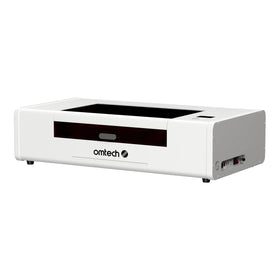
Polar Lite 55W Desktop CO2 — Home & Small Business • Wood • Acrylic • Leather Compact desktop CO2 laser engraver and cutter for home shops, Etsy sellers, and small gift businesses. Handles wood, acrylic, leather, glass, MDF, and fabric. 55W tube provides ample power for 1/4" acrylic cutting and detailed wood engraving at production rates. Autofocus, LightBurn compatible, and enclosed safety design. The entry point for small businesses that need a reliable, versatile CO2 machine with a desktop footprint. |
|
Galvo Fiber 20/30/50W — Metal Marking • Jewelry • Industrial ID • High Speed Galvo scanning head fiber laser for fast, precise marking on metals and coated materials. Marks at up to 10,000 mm/s with 0.01mm accuracy. Handles stainless steel, aluminum, brass, titanium, anodized surfaces, and coated metals. Autofocus and variable data support for batch serial number marking and barcode production. Used by jewelry makers, metal fabricators, and contract manufacturers needing production-rate metal marking. |
|
MOPA 60W Autofocus Fiber — Color Marking • Stainless • Anodized Aluminum • MOPA MOPA pulse control fiber laser for color marking on anodized aluminum and corrosion-safe annealing on stainless steel. Used by custom product businesses, metal fabricators, and medical device contract manufacturers where standard fiber laser marks are insufficient. Autofocus system. Compatible with EzCad for variable data and design automation. The right upgrade from a standard fiber when your business moves into stainless steel or color work. |
|
💡 NOT SURE WHICH MACHINE FITS YOUR WORK? OMTech's fiber laser engraving machines, MOPA fiber laser engraving machines, and CO2 systems cover every production application from single-item custom gifts to high-volume industrial marking. If you're unsure which machine fits your specific materials and output goals, OMTech's consultation team can help match your requirements to the right system before you buy. |
Ready to find the right laser engraving machine for your business? |
Frequently Asked Questions
What is a laser engraving machine?
A laser engraving machine uses a focused, high-intensity beam of light to permanently alter material surfaces. The beam vaporizes, melts, or chemically changes the material along a path defined by CNC software, creating a permanent mark or cut. Laser engraving machines range from compact desktop units for home and small business use to large industrial systems for high-volume production. They handle wood, acrylic, leather, metal, glass, fabric, and many other materials depending on laser type.
What is the difference between CO2 and fiber laser engraving machines?
CO2 lasers produce light at 10,600nm, a wavelength efficiently absorbed by organic materials including wood, acrylic, leather, glass, MDF, and fabric. They are the standard for non-metal engraving and cutting. Fiber lasers produce light at 1,064nm, a wavelength efficiently absorbed by metals including steel, stainless steel, aluminum, brass, copper, and titanium. Fiber lasers cannot effectively engrave wood, glass, or acrylic. CO2 lasers cannot engrave bare metal. Match your laser type to your primary material.
What can you make with a laser engraving machine?
CO2 laser engraving machines produce custom gifts (cutting boards, wine glasses, tumblers, keychains), business signage, architectural lettering, leather products, acrylic display items, wooden décor, and many other personalized or branded products. Fiber laser engravers produce serial numbers, barcodes, logos, and traceability codes on metal components. The applications range from single-item custom work to high-volume production marking, depending on machine type and software configuration.
How much does a laser engraving machine cost?
Entry-level desktop CO2 laser engravers start around $800–$1,500 for 40W–55W machines suitable for home and small business use. Mid-range professional CO2 machines at 80W–100W with larger work areas run $2,000–$5,000. Fiber laser markers for metal start around $1,500–$3,000 for 20W–30W systems. MOPA fiber lasers with pulse control typically run $4,000–$8,000. Large-format CO2 systems and high-power industrial fiber cutters range from $8,000 to $30,000+. The right budget depends on your production volume, materials, and work area requirements.
What work area size do I need for a laser engraving machine?
Work area determines the maximum material size you can engrave in a single setup. For tumblers, keychains, and small personalized items, a 12" × 20" work area is sufficient. For cutting boards, small signs, and standard gift items, 20" × 28" is the most common professional size. For commercial signage, furniture panels, and large format production, 24" × 40" or larger is needed. Measure your largest common product before specifying a machine — running large items in multiple setups significantly increases production time and reduces quality.
What software works with laser engraving machines?
LightBurn is the industry-standard software for CO2 and diode laser engraving machines, including all OMTech CO2 systems. It handles vector cutting, raster engraving, image import, variable text, barcode generation, and batch production. EzCad is widely used for galvo fiber laser systems and supports variable data and database-linked batch marking. Both work on Windows and Mac. LightBurn has an active community, extensive tutorials, and frequent updates that make it the preferred choice for small business and professional engraving operations.
Can a laser engraving machine cut materials?
Yes — most CO2 laser engraving machines also cut, which is why they're often called laser engravers and cutters. The difference between engraving and cutting is power and speed: engraving uses lower power and faster speed to mark the surface, while cutting uses maximum power and slow speed to cut all the way through. A 60W CO2 machine cuts 1/4" acrylic, 1/4" plywood, leather, and most fabrics cleanly. For cutting metal sheets, a dedicated fiber laser cutter with 1,000W or more is required — not the fiber markers used for engraving.
How long does a laser engraving machine last?
Fiber laser sources are rated for 100,000+ hours of operation — effectively maintenance-free for the life of the machine under normal use. CO2 glass laser tubes have a rated lifespan of 8,000–10,000 hours, after which the tube is replaced at a cost of $200–$600 depending on wattage. CO2 RF-excited metal tubes last longer (20,000+ hours) but carry a higher initial cost. With proper maintenance — lens cleaning, rail lubrication, and cooling system care — the mechanical components of a well-built laser engraving machine last 10–15 years in production use.
What safety precautions do I need for a laser engraving machine?
CO2 and fiber lasers produce invisible or semi-invisible radiation that can permanently damage eyes and skin on contact. Always use appropriate laser safety glasses rated for the specific wavelength of your machine. Never operate an open-frame laser without laser-safe barriers or enclosures. Use fume extraction to remove smoke and volatile organic compounds (VOCs) generated during engraving — especially critical when engraving synthetic materials, coatings, and plastics. Never engrave PVC or vinyl chloride materials: the resulting chlorine gas is toxic. Keep a fire extinguisher nearby and never leave the machine unattended during operation.