





What Can You Do With a 100W MOPA Fiber Laser?
Generally, a 100W MOPA fiber laser is the best choice if you own or run a business that needs high-speed production, deeper metal engraving, more demanding material processing, and occasional thin-metal cutting.
Remember, all a 100W MOPA fiber laser really is, is a high-power, industrial-grade fiber laser engraver that uses a MOPA source rather than a standard Q-switched laser.
The biggest advantage it gives you is its high output power, and it is best used for applications that require more processing capacity, especially with larger components, thicker materials, or high-volume orders like marking or engraving custom firearms and tactical gear, bespoke jewelry and minting, medical device fabrication, and so on.
So, what exactly can you do with a 100W MOPA fiber laser, and when is it worth choosing one over an 80W or 60W alternative? Here are five projects where this machine can make a difference.

5 Best Projects To Do With a 100W MOPA Fiber Laser
1. High-Speed and Deep Metal Engraving
One of the biggest advantages of a 100W MOPA fiber laser is its ability to handle demanding metal engraving projects without sacrificing production efficiency. A 100W MOPA fiber laser excels at both fast material removal and deep metal engraving like relief and 3D slicing
-
Fast material removal: At 100 watts, the laser has massive power density, and it allows you to blast through metal surfaces, coins, medallions, and tool parts much faster than lower-wattage units (like 30W or 50W).
-
Relief and 3D slicing: You can use software like LightBurn to generate depth maps for multi-pass 3D-style relief carvings on coins, stamps, watch cases, and jewelry.
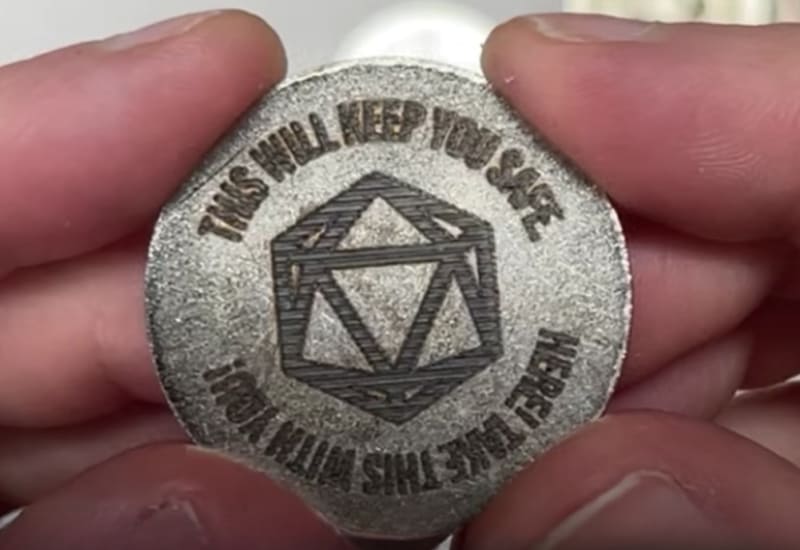
The OMTech MOPA 100W Split Fiber Laser, for example, reaches a maximum speed of 10,000mm/s and an engraving depth of 0.15 mm. Here are three main reasons why I mostly use this machine for large-batch military and commemorative coins:
-
The engraving process is much faster. I can engrave a simple logo, text, and serial number in 10–30 seconds, and complete extensive deep engraving across most of the coin in about 5-9 minutes.
-
The emblems, unit insignias, dates, names, and intricate lettering are incredibly detailed. I get noticeable recessed engraving rather than just surface marking. The designs look more tactile and pristinely defined
-
With the help of the MOPA technology, I can create different finishes, contrast effects, and fine details, especially when engraving the names, serial numbers, logos, and customized messages.
Overall, the process is fast, efficient, and repeatable, and this is why we mainly recommend this machine for businesses processing businesses fulfilling bulk corporate, military, and promotional coin orders.
What features should you look for?
-
Adjustable pulse width: Allows you to control how laser energy interacts with different metals, helping balance engraving depth, surface finish, and heat input.
-
High-speed galvanometer: A galvo scanning system capable of fast, consistent movement helps maintain production efficiency across larger batches.
-
A suitable working area: A larger marking field provides flexibility when processing multiple components or larger workpieces. The OMTech 100W works because it is equipped with two workspaces, 6.9 x 6.9 in. and 4.3 x 4.3 in
-
Reliable cooling: An effective cooling system helps maintain stable operation during extended production sessions.
2. Stainless Steel and Titanium Colour Marking
Colour engraving and marking is one of the most attractive applications of MOPA fiber laser technology. Being a MOPA fiber laser, it allows you to adjust pulse width and frequency independently within the machine's supported ranges.
The advantage here is that it gives you greater control over how the laser interacts with a material's surface and allows you to produce different colors like gold, blue, purple, and even black.
One thing to note is that, while lower-wattage MOPA lasers (like 30W or 60W) can also do color work, the 100W version lets you run larger lenses (such as 300x300mm) and cover wider areas while keeping high power density.
This is another factor that makes the OMTech 100W so easy to use. It has an incredibly diverse color chart file (you can download it here: Color Chart File ), and an Fθ lens that covers the entirety of its 6.9″×6.9″ (175×175 mm) working area.
Together with the recommended LightBurn settings (which you will find in the color chart file), I make detailed marks on anodized aluminum or full-color images and patterns on stainless steel, titanium, and chromium. Here are some easy color marking projects I complete with this machine:
-
Custom business cards: Detailed logos, contact information, QR codes, and decorative patterns.
-
Industrial nameplates: Serial numbers, company branding, product specifications, and identification labels.
-
Personalized keychains with names, photographs, illustrations, and colorful graphics.
-
Challenge coins containing colorful military insignias, commemorative designs, logos, and intricate decorative patterns.
-
Drinkware engraving projects like custom tumblers, bottles, and travel mugs featuring colorful logos and artwork.
Explore this complete guide on color engraving with the MOPA fiber laser machine

3. Precision Cutting of Thin-to-Moderate Metals
Another area where a 100W MOPA fiber laser engraver proves its worth is metal cutting. First, it is important to understand that a fiber laser engraver is not a fiber laser cutting machine.
However, although fiber laser engravers are primarily designed for marking and engraving, a 100W MOPA can also handle certain thin-metal cutting applications.
For example, if you want to produce small metal tags, thin stainless steel components, decorative inserts, or custom metal shapes, the higher power of a 100W MOPA fiber laser provides more energy for material removal and can even provide faster processing than lower-wattage machines.
Again, this is one thing that becomes very apparent when I use the OMTech MOPA fiber laser. This machine has high-quality focusing optics and red dot guidance and can cut through light metals like thin stainless steel foil, thin aluminum foil, and thin brass foil.
-
Thin stainless steel foil: takes multiple passes, but is possible
-
Thin aluminum foil: also takes multiple passes, but can be done
-
Thin brass foil: limited-depends on thickness and reflectivity
As you may have noticed, the only setback is that I often have to use multiple passes, but it does work with a little patience.
Reviewers and entrepreneurs working with OMTech have also revealed that they use their 100W MOPA lasers to cut and shape brass, silver, gold, and copper for custom keychains, coins, and pendants.
In general, you should be able to cut through thin stainless steel (ranging from roughly 0.3mm to 1.5mm depending on the number of passes and settings) with a 100W MOPA fiber laser. It may take multiple passes, and you have to slow down the speed, but it is possible.
Our guide on fiber laser cutters vs. CO2 laser cutters covers a lot more when it comes to the performance of a fiber laser engraver vis-à-vis a CO2 laser cutter.

4. Laser Engraving Plastics and Sensitive Materials
A MOPA fiber laser is not limited to metals. Its adjustable pulse characteristics also make it useful for marking certain plastics and other materials that require more controlled processing.
The advantage of MOPA technology is that you can adjust pulse duration and frequency to influence the amount of heat transferred to the material. This will help reduce unwanted melting, excessive burning, and surface deformation when suitable parameters are used.
What I have found using the OMTech 100W MOPA fiber Laser, is that you have a great advantage when it comes to dark-on-light (or light-on-dark) markings on plastic and when working on anodized aluminum.
-
Dark-on-light or light-on-dark markings: When I turn the pulse duration down ( literally to nonosend ranges), I can mark delicate plastics like engineering plastics and polymer firearm frames (stippling/serial data), and painted or coated metals without burning or melting the substrate.
-
For anodized aluminum, it is very easy to strip with a 100W MOPA fiber. Stripping anodization cleanly or blackening/whitening aluminum surfaces is fast and crisp.
Again, this is not to say that all 100W MOPA fiber lasers are perfect for all kinds of plastics. It depends on the composition of the plastic. While plastics like ABS, polycarbonate, and selected engineering plastics can be marked with fiber lasers, some tend to respond better to lower power, shorter processing times, or alternative laser technologies.
Important warning:
Always verify the material composition before laser processing, as some plastics release hazardous fumes when exposed to laser energy.

5. Rotary and Cylindrical Work
If you want to expand beyond flat metal products, a 100W MOPA fiber laser can also support engraving on cylindrical and curved objects when paired with a compatible rotary axis attachment.
This opens up opportunities to personalize stainless steel tumblers, metal bottles, cylindrical components, tools, and other products with curved surfaces.
Again, the main advantage of using a 100W MOPA fiber laser with a rotary attachment is that it makes it very easy for you to wrap your designs around round objects. I personally use this 80mm Rotary Axis Chuck Attachment from OMTech, which is specially designed for fiber laser engravers only. It adjusts up to 90° vertically and 360° rotationally for engraving around the complete inner or outer circumference of round objects.
It makes it really easy to engrave around round objects like tumblers, rings, pipe fittings, and all kinds of cylindrical tools.
The 100W output is particularly useful when you want to combine cylindrical engraving with deeper markings or higher-volume production.
What Does a 100W MOPA Offer That 60W and 80W Models Cannot?
A 60W or 80W MOPA fiber laser is already capable of handling many professional engraving and marking applications. The question we get from buyers is: why spend more on a 100W model?
The main difference between a 60W, 80W, and 100W MOPA fiber laser is processing capacity. Where the 100W MOPA outperforms a 60W and 80W model is in its higher wattage, which provides more available laser output, which then translates into:
-
faster material removal
-
shorter processing times,
-
greater flexibility when tackling demanding jobs.
Where a 100W MOPA Laser Excels The Most
The biggest advantage of choosing 100W over 60W or 80W is that you have more power available when your projects demand it. This is something I have observed when comparing the OMTech 60W MOPA fiber Laser vs. the OMTech 80W MOPA vs. the OMTech 100W MOPA. For example
-
If you regularly engrave deep identification marks into stainless steel components, the additional output can help reduce processing time significantly (up to about 30% for the basic projects).
-
Also, when working with larger batches, the ability to remove more material per pass can improve overall production efficiency. In other words, it saves you a lot of time without sacrificing the quality of your final results.
However, if your business mainly involves shallow logos, decorative colour marking, and occasional personalization, an 80W or even 60W machine may already provide everything you need.
-
The OMTech 80W MOPA Split Fiber Laser has two work areas: 4.3 x 4.3 in. and 6.9x6.9 in. (11x11 cm & 17.5x17.5 cm), a diverse color chart file (download here), and everything you need to create personalized gifts and industrial engravings.
-
The OMTech 60W MOPA Split Fiber Laser offers a flexible working area of 6.9"x6.9" (about 17.5cm x 17.5cm) and a powerful 60W output combined with high-speed engraving at 10,000mm/s, you can easily handle small to medium projects, catering to various creative needs and allowing your imagination to flourish.
In other words, 100W is most worthwhile when higher processing capacity directly improves your production output or allows you to take on more demanding projects.
60W vs. 80W vs. 100W MOPA Fiber Laser
|
Project |
60W MOPA |
80W MOPA |
100W MOPA |
|
High-speed and deep metal engraving |
Good for standard engraving and moderate-depth applications |
Better material removal and production speed |
Best suited to demanding deep engraving and high-volume production |
|
Stainless steel and titanium colour marking |
Excellent with suitable parameters |
Excellent, with additional processing capacity |
Excellent, but with even more processing capacity |
|
Thin-metal cutting |
Limited, depends on the application |
Better capacity for selected thin-metal applications |
Greater capacity for selected thin-metal cutting applications |
|
Plastics and sensitive materials |
Good control with suitable pulse settings |
Greater power headroom, but requires careful adjustment |
More processing capacity, although lower-power settings may still be preferable |
|
Rotary and cylindrical work |
Good for standard personalized products |
Better suited to more demanding engraving jobs |
More suitable for deeper engraving and higher-volume cylindrical production |
Note: These comparisons are general guidelines based on personal use on different materials, not guaranteed performance ratings. Actual results will still depend on the material, thickness, pulse width, frequency, scanning speed, focusing optics, software, and machine configuration.
Buying a 100W MOPA Fiber Laser Engraver: What Should You Look For?
The ideal 100W MOPA fiber laser should offer more than just a powerful laser source. It should offer the perfect balance of adjustable pulse characteristics, reliable scanning performance, suitable optics, and a practical working area to support different applications. Here are some important features to prioritize when comparing machines.

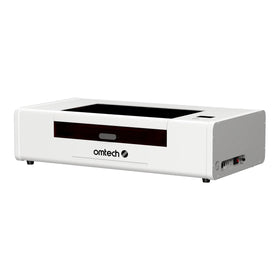
The OMTech MOPA 100W Split Fiber Laser Engraving Machine
Capable of engraving at speeds of up to 10,000 mm/s, OMTech's 100W MOPA Split Fiber Laser is designed to significantly boost production efficiency, which makes it the ideal machine for businesses looking to increase output without sacrificing quality. Here are a few key features:
-
High-speed engraving: Capable of engraving at speeds of up to 10,000 mm/s.
-
Customizable workspace for diverse projects: Equipped with two workspaces, 6.9 x 6.9 in. and 4.3 x 4.3 in.
-
All-in-one capabilities: Effortlessly works with materials like brass, stainless steel, and plastic, and offers impressive color marking features for standout designs.
-
Compact yet spacious: Weighing 66.1 lb., the machine's split design includes high columns and wide processing platforms, making it adaptable for diverse environments.
Available Near You
Whether you choose to email, call, or chat online, OMTech offers detailed support that ensures you grasp all aspects of the machine. You can also book an appointment via the OMTech Demo Room Program or visit OMTech’s Official Showroom in Ontario, California, to see the machine, test your materials, and talk to an expert before purchase.
Final Thoughts
If you are considering buying a high-power MOPA fiber laser engraver, you have probably already realized that a 20W or 30W machine may not provide the processing capacity you need. Perhaps you want to engrave metal parts in large batches, create deep markings on industrial components, produce colourful designs on stainless steel, or expand into more demanding metalworking projects.
-
A 100W MOPA fiber laser engraver is a worthwhile investment for businesses that need more than basic metal marking.
-
Its higher output capacity makes it particularly attractive for deep engraving, demanding metal-processing applications, and commercial production environments where processing time matters.
-
It also offers the flexibility to explore stainless steel and titanium colour marking, selected thin-metal cutting applications, plastic marking, and cylindrical engraving.
Ultimately, the best laser engraver for metal is the one that matches your materials, production requirements, and future business plans. Before making your purchase, consider not only what you intend to engrave today but also the types of projects you want to be equipped to handle tomorrow.