







How to Choose Fiber Laser Cutting Machine Power
Your goal, when choosing the right power for a fiber laser cutting machine, should be to select the machine with just the right wattage that delivers the best balance of cutting speed, material thickness, and production speed for your specific business needs.
In other words, you want a fiber laser cutting machine that matches your output wattage directly to your primary metal types, maximum and average material thickness, and required production speed.
This is a balance that most people often get wrong, and end up spending big on a sophisticated machine with many features that they do not really need.
To avoid that kind of expensive mistake, you need to know exactly what you are looking for. Based on practical advice and information from experts and production at OMTech, here are four rules of thumb to follow when picking the power level for a fiber cutting machine.

Step #1. Start by Differentiating Between Fiber Laser Engraving Machines and Fiber Laser Cutting Machines
The first basic, but very relevant factor to keep in mind is that fiber laser engravers and fiber laser cutters are different, and they have different power ratings. Choosing the right fiber laser cutting machine power depends heavily on whether you are doing low-power marking/thin sheet cutting or full industrial metal sheet cutting.
- 20W to 100W fiber laser engravers are not the same as fiber laser cutting machines. They are meant for etching, annealing, and shallow-to-deep engraving on metals (stainless steel, brass, aluminum). While a high-end 60W to 100W MOPA fiber laser can slice through thin shim stock, foils, or very thin brass (up to 2 mm) with multiple slow passes, they are not a true sheet-metal cutting machine.
- 1,000W to 12,000W+ fiber laser cutting machines are true industrial sheet cutters. If you need to cut out full sheets of carbon steel, stainless steel, aluminum, or brass at production speeds, you need a kilowatt-class fiber laser source (1 kW and up).
The confusion between fiber laser markers and fiber laser cutters is not aided by the fact that some brands advertise their fiber laser engravers as “fiber laser cutters”. It is not always the buyer’s fault.
But this is an important distinction to make. You probably don't want to spend $20,000+ on a fiber laser cutting machine when all you needed was a fiber laser engraver, or vice versa.
Step #2. Choose The Appropriate Kilowatt Power for Industrial Sheet Cutting
Once you are certain that what your application needs is a fiber laser cutting machine, the next step is to decide how many kilowatts you need. There are two main criteria for determining how many kilowatts you need for a fiber laser cutting machine:
- The nature and thickness of the metal you intend to cut,
- The speed you find to be most efficient for your work.
Here is a breakdown of fiber laser cutting machine power by sheet material thickness and speed:
1. 1 kW – 3 kW Fiber Laser Cutters: Entry/Light Industrial Applications
1kW to 3kW fiber laser cutting machines are good for thin-to-medium sheets. Consider a fiber laser cutter in this range; for example, if you are working on carbon steel up to 18–20 mm max under ideal, slow conditions, or clean cuts on 8–12 mm stainless/aluminum.
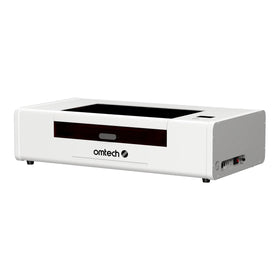
The OMTech FC-22 Fiber Laser Cutter is a fully enclosed 1500W fiber laser cutting machine in this category with front and back pass-through and a built-in water chiller. With 1500W of laser power, this machine effortlessly cuts through tough metals like ≤0.2 in. thick stainless steel and ≤0.4 in. carbon steel, delivering precise results at 27.56 ips.
You can take a closer look at this machine by visiting OMTech’s Demo room near you, or order directly online at just $828/MO.
2. 4kW to 6kW Fiber Laser Cutters: General and High-Speed Fabrication
4kW-6 kW fiber laser machines are generally considered the sweet spot for production because they offer significantly faster cutting speeds, less deburring, and cleaner edges on materials like 8 mm mild steel (often cut with air) or 10 mm aluminum. Consider a 4kW-6kW fiber laser cutter if you work on automotive parts, metal furniture, and general machinery manufacturing.
The OMTECH FC-105SA Fiber Laser Cutting Machine is a 1.5 kW to 6 kW fiber laser cutting machine in this category with an IPG laser source, which is world-renowned for its excellent beam quality, high energy density, superior electro-optical conversion efficiency, and guaranteed stability.
With a Swiss-engineered laser head and a space-saving design, this machine will save space in your shop and increase productivity per square foot. Book a Demo Room to see this machine live before making your purchase.
3. 8kW to 12kW Fiber Laser Cutters: Heavy Duty Applications
8kW-12kW fiber laser cutters are best for heavy-duty reflective metals. That is because they have the higher power required to cut thick reflective non-ferrous metals like copper, brass, and thick aluminum efficiently. Stepping up to 12 kW drastically cuts processing time (e.g., cutting thick stainless steel with Nitrogen gas can see massive efficiency gains-up to 300% faster than 6 kW and 600% faster than 3 kW).
Consider a machine in this category if used in heavy machinery, aerospace, construction, and shipbuilding.
4. 15kW to 30kW+ (Extreme/High-Speed Production):
15kW-30kW fiber laser cutters are best for extreme and/or high-speed production. They are used in factories producing massive plates, heavy infrastructure, wind turbines, railway, and defense applications where maximum penetration and high-speed production on thick ferrous/non-ferrous metals are critical.
Fiber Laser Cutting Machine Wattage: Which Power Range Do You Need?
| Fiber Laser Power | Category | Typical Cutting Applications | Best For |
| 1 kW–3 kW | Entry-Level / Light Industrial | Thin-to-medium metal sheets; carbon steel up to 18–20 mm; clean cuts on 8–12 mm stainless steel or aluminum. | Small fabrication workshops and businesses handling lighter metal-cutting jobs. |
| 4 kW–6 kW | General / High-Speed Fabrication | Faster cutting of materials such as 8 mm mild steel and 10 mm aluminum, with cleaner edges and less deburring. | Automotive parts, metal furniture, general machinery manufacturing, and medium-to-high-volume production. |
| 8 kW–12 kW | Heavy-Duty Industrial Cutting | Efficient processing of thick stainless steel and reflective non-ferrous metals such as copper, brass, and aluminum. | Heavy machinery, aerospace, construction, and shipbuilding. |
| 15 kW–30 kW+ | Extreme / High-Speed Production | High-speed cutting and deep penetration of thick ferrous and non-ferrous metal plates. | Large-scale factories, infrastructure, wind turbines, railway manufacturing, and defense applications. |
Step#3: Consider The Kind of Metal You Will Be Cutting
Considering the type of metal you are cutting is critical when choosing a power fiber laser cutting machine because different metals have unique physical and optical properties that directly dictate how they interact with laser energy.
- Reflective metals like copper and brass bounce laser light back, risking damage to machine optics and requiring higher power to successfully cut.
- Materials like aluminum quickly pull heat away from the cutting zone, which means you need higher wattage and strict speed management; otherwise, you will struggle with slag and material warping.
- The type of gas you must use also differs depending on the type of material you are cutting.
Fiber Laser Cutting Machine Power Recommendation Guide by Material
| Material | Thickness Range | Recommended Fiber Laser Power | Notes | Recommended Model |
| Carbon / Mild Steel | Up to 6 mm8 mm – 14 mm16 mm – 20 mm | 1.5 kW – 2 kW3 kW – 4 kW6 kW | Mild steel is the easiest to cut due to oxygen-assist gas. A 6 kW laser can easily fly through thin gauge material at over 1,000 inches per minute. | OMTech FC-22 Fiber Laser Cutter |
| Stainless Steel | Up to 4 mm5 mm – 8 mm10 mm – 14 mm | 1.5 kW – 2 kW3 kW6 kW | Cut with Nitrogen for a clean, oxide-free edge. Operators note that cutting 10mm stainless on a 3 kW or 4 kW machine is slow and leaves heavy burrs; 6 kW is the "sweet spot" for pristine edges. | OMTech FC-22 Fiber Laser Cutter |
| Aluminum | Up to 3 mm4 mm – 6 mm8 mm – 10 mm | 1.5 kW – 2 kW3 kW – 4 kW6 kW | High thermal conductivity means thin aluminum cuts easily, but anything past 6mm requires serious power to outpace the metal's heat dissipation. | OMTECH FC-105SA Fiber Laser Cutting Machine |
| Brass and Copper | Up to 2 mm3 mm – 5 mm6 mm+ | 1.5 kW – 2 kW3 kW – 4 kW6 kW+ | These are highly reflective materials. Back-reflections can destroy cheaper laser sources. Buy a laser source with anti-reflection protection (like IPG or high-end Raycus) if cutting these regularly. | OMTECH FC-105SA Fiber Laser Cutting Machine |
Summary Rule of Thumb
If you are running a general fabrication shop cutting a mix of everything up to 12mm (1/2 inch), 3 kW to 4 kW is widely considered the absolute entry point for viability.
However, if your budget allows, upgrading to 6 kW drastically lowers your operating costs per part by letting you use cheaper compressed air instead of expensive bottled nitrogen for mid-gauge metals, all while doubling your production speed.
Step#4: Consider Speed vs. Edge Quality
Another important consideration to make when choosing the right power for a fiber laser cutting machine is the balance of speed and edge quality that the machine provides. Generally, speed increases with power: that means the higher the kW of the machine, the faster the cutting speed you can expect.
Here is why this is important: Higher power also allows you to cut thicker plates faster. This means that the time the heat lingers on the edges is greatly reduced, and you have a better chance of obtaining clean edges.
This is an important argument for why you should always choose a higher-power fiber laser cutting machine if you can afford it, and if it lies within the power range you need for the material you are working on.
With a higher-power machine, you get faster cutting speeds and therefore a better chance of obtaining cleaner edges when you cut.
Step #5: Balance Cost vs. Operating Constraints
The cost of a fiber laser cutting machine is not just limited to what you pay for it upfront, and this is the third important consideration to make when deciding on which machine you want.
First, there are equipment and power costs.
Higher-wattage sources (8kW+) not only cost substantially more upfront, but they also require higher electrical capacity and consume more power.
So, you must not only consider whether you have enough money to pay for the machine, but also whether you have enough (or the machine will generate enough revenue) to cover the day-to-day operating costs in the short term or long term.
Then there is also future-proofing to consider.
How hard you push the machine also matters. For example, if you frequently push your machine to its maximum thickness limit (e.g., using a 1kW machine on 12 mm carbon steel), it is better to step up to the next wattage tier to prevent slow processing speeds and excessive wear.
Step#6: Consider Critical Infrastructure Factors
Also, there is the cost of infrastructure and accessories that will be required for smooth installation and daily use of the machine. The cost of buying a fiber laser cutting machine is only half the battle: there are still significant expenses to be incurred on accessories and important infrastructure. Factor the following into your budget when deciding what power fiber laser cutting machine you need:
1. Assist Gas Supply
If you are cutting higher power and thicker cuts, you invariably need massive, continuous volumes of high-pressure Nitrogen (N₂), Oxygen (O₂), or clean compressed air. So, you have to figure out gas bottle or compressor requirements and put aside a sum of money for that.
2. Cost of Reflective Materials
If you are cutting copper, brass, or aluminum at high wattages, you will need a machine with proper isolation/protection from the laser source. Cutting these materials at high wattages sends beam reflections back up the optics, which is extremely dangerous (to say the least).
Final Thoughts: Choose the Right Fiber Laser Cutting Machine Power for Your Business
Choosing the right fiber laser cutting machine wattage is ultimately about finding the right balance between cutting capacity, production efficiency, and operating costs.
- So, start by identifying the metals you work with most frequently, their average and maximum thicknesses, and the production speeds you need to maintain.
- Then consider how much you're willing to invest in the machine, assist gas supply, electrical infrastructure, and other operating requirements.
- Keep in mind that if you regularly work near the maximum cutting capacity of a particular wattage range, moving up to the next power level may be a smarter long-term investment.
If you're looking for a reliable industrial fiber laser cutting machine, explore OMTech's FC series. From the fully enclosed FC-22 to the versatile FC-105SA, OMTech offers solutions designed to help businesses bring more metal-cutting operations in-house, improve production efficiency, and take greater control of their manufacturing processes.