







How to Start a Laser Cutting Business in 2026
Your goal, when starting a laser cutting business, should be to build a repeatable and profitable production business that uses laser cutting to turn materials into products customers are willing to pay for, while keeping production costs low enough to scale.
The good news is, many key principles have been identified by successful laser cutting entrepreneurs, which can act as a guideline to follow, and these usually center around identifying a profitable niche, choosing the right laser machine for your material, minimizing production costs, and pricing your products for healthy profit margins.
You can think of these as the foundational pillars of building and running a successful laser cutting business: you need to find a unique product or an underserved niche before you buy a machine, and treat the laser machine as a tool, not a money printer.

Starting a Laser Cutting Business: 5 Key Steps
Step #1. Find Your Niche First
The key to succeeding in the laser cutting business world in 2026 is to avoid niches or products that are already saturated. Generic items like basic engraved cutting boards or standard signs face intense online competition. Instead, focus on:
- Solving specific problems: Focus on custom local jobs, replacement brackets, unique localized decor, or B2B branding rather than trying to sell mass-market goods on Etsy.
- Combining your skills for more creative projects: In the laser cutting business, success often comes from pairing laser work with woodworking, leathercraft, or local event planning. Try to expand your creativity and reach by combining different types of crafts to create unique products.
2. Define Your Business Model
If there is one thing experienced entrepreneurs in the laser cutting business always emphasize, it is the importance of deciding on your main business model before launching the business. Basically, you have to decide between a service-based model or a product-focused model:
- Product-based model: You design and manufacture unique, repeatable items (e.g., custom cabinet parts, complex 3D wood assemblies, or unique merchandise). The advantage with a product-based laser cutting business model is that margins are higher because you're selling the design, but it demands more creativity up front.
- Service/job-shop model: You offer custom etching or manufacturing for third parties. Success here depends almost entirely on volume. Veterans heavily recommend prioritizing business-to-business (B2B) clients over individual retail customers; landing local corporate clients for bulk promotional materials yields repeatable revenue with far less client-management friction than one-off retail orders.

3. Choose the Machine You Need (Not Want)
Buying a laser machine for business is always a heavy investment, and it is important to pick a tool based on the specific material tolerances your target product demands. For a laser cutting business, your options are between a high-power diode laser, a 60W+ CO2 laser engraver, and a fiber laser cutting machine.
- Diode lasers (20W–40W): Excellent if you have a lower budget and intend to do thin wood scoring and desktop footprints. Take note, though, that they struggle with throughput speed and cutting dense materials.
- CO2 lasers (60W+): A 60W CO2 laser engraver is generally considered to be the industrial baseline for laser cutting businesses by most laser business veterans. A CO2 laser is essentially mandatory if you plan to cleanly cut thick acrylic, organic wood, and plastics.
- Fiber lasers: Fiber laser cutting machines are very highly specialized, and really only necessary if your business centers on deep engraving or cutting/marking metal.
Buying a Laser Machine For a Laser Cutting Business
- A low-cost diode laser works fine for light engraving, but a CO2 laser is preferable for faster, cleaner wood cutting.
- Matching power to your goals matters too: higher wattage (55W to 100W+) cuts thick plywood and acrylic much faster, reducing production time per item.
Before committing to a purchase, consider using a local makerspace to learn the design software and test machine capabilities; it's a low-cost way to validate your workflow before spending thousands on hardware.
4. Establish a Legal and Safe Workspace
Operating a laser business out of a garage or bedroom carries real legal and health liabilities.
- Fume mitigation: Burning materials produces toxic byproducts. You will need to plan inline fan venting routed directly outside, or budget for high-end multi-stage filtration. Laser cutting generates a lot of smoke and debris, so you have to invest significantly in fume mitigation. The absolute best mitigation is a dedicated external exhaust system that places the workspace under negative pressure. "Recirculating filters" or standard air purifiers are a trap for businesses, as they do not capture toxic gases, and the ongoing cost of replacement filters will quickly destroy your profit margins.
- Asset protection: Set up a corporate shield, like an LLC. Standard homeowner's insurance typically excludes commercial operations and will reject claims if a laser malfunction causes a residential fire, so secure commercial business liability insurance from the start.

What Is The Best Fume Mitigation Solution For a Fiber Laser Cutting Business?
If you have permission to drill through a wall or exhaust via the roof, direct exterior venting is the most affordable, low-maintenance, and highly effective option.
Take note that where you place the fan is very important. Place the exhaust fan at the very end of the line (at the wall penetration point or outside), not right next to the laser. This creates negative pressure (a vacuum) throughout the entire length of the ducting. If the fan is next to the laser, it creates positive pressure, forcing toxic smoke out of any microscopic pinholes in your ductwork and right into your shop.
- Duct Size: Upgrade to a 6-inch (150mm) rigid duct rather than a 4-inch flexible hose. Flexible hoses have ridges that create extreme airflow resistance (static backpressure).
- Fan Choice: Use a high-CFM centrifugal blower or a heavy-duty mixed-flow inline fan (like the AC Infinity Cloudline series). It must move a minimum of 150–400 CFM depending on machine size.
- The Chimney Stack: If you have neighbors or are in a commercial strip, build a PVC or metal "stack" to vent the fumes above the roof line/guttering so the smoke can rapidly disperse without entering nearby windows
5. Handle Logistics and Pricing
- Protect yourself: Business liability insurance is essential, since home insurance won't cover fire or damage caused by a commercial laser setup.
- Prioritize local marketing: Spend time building local sales channels, farmers' markets, and partnerships with nearby retail shops, which often yield better early results than crowded online marketplaces.
- Calculate true costs: A common beginner pitfall is underpricing labor. Rather than simply doubling your material cost, use a multi-variable formula that adds material costs, hourly labor rates for design and production, monthly overhead (ventilation, power), and equipment wear and tear.

6. Validate Globally, Sell Locally
Etsy and other online marketplaces are fiercely competitive, and margins tend to spiral downward against massive, automated print-on-demand operations.
- Design originality: Create custom vector art using professional vector design software rather than replicating trending templates. AI tools can also be a useful starting point for generating laser-engraving files.
- Local channels: Early on, prioritize venues where customers can physically inspect the tactile quality of your products, local craft fairs, high-end farmers markets, boutique partnerships, or wholesale direct-to-business networks.
OMTech Pronto CO₂ Lasers for Your Laser Cutting Business
For a laser cutting business, 60W to 150W CO₂ lasers offer an excellent balance of cutting capability, productivity, and operating cost. While lower-powered machines can handle thinner materials, a 40W laser may take longer to cut materials in the 3–6 mm range, which can limit productivity and reduce your potential profit per working hour.
OMTech’s Pronto Series CO2 Laser Engravers ( 60W to 150W ) are designed with small businesses and production-focused users in mind. These CO₂ laser cutters combine high engraving speeds, upgraded transmission systems, generous working areas, and features designed to help you produce more while maintaining consistent results.
With engraving speeds of up to 1,000 mm/s, Pronto machines are built to help you move through production jobs efficiently. Their upgraded transmission system also supports accurate movement and consistent results across detailed designs.
Another advantage is the machines’ 8.7-inch maximum workpiece height, giving you more room to work with taller objects. This represents an 83% increase in workpiece height compared with previous designs, making the Pronto series more versatile for businesses working with a wider range of products.

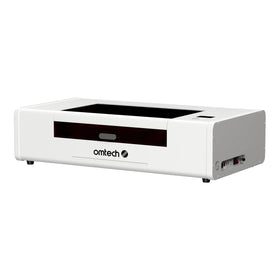
OMTech Pronto 40 90W CO₂ Laser Cutter and Engraver
The OMTech Pronto 40 90W CO₂ Laser Cutter and Engraver is a strong option for businesses looking for a production-capable machine without moving immediately into a much larger industrial system.
It features a 24" × 35" working area, autofocus, and a maximum engraving speed of 1,000 mm/s. With 90W of CO₂ laser power, it can handle a broad range of cutting and engraving applications, making it suitable for businesses producing signage, personalized products, displays, décor, and other custom items.
Why Choose OMTech Pronto Lasers for Your Laser Cutting Business?
Ruida Controller Compatibility
Pronto machines use Ruida digital controllers and are compatible with LightBurn, giving operators access to a familiar workflow for creating, preparing, and controlling laser jobs.
Fully Enclosed Cabinet
For businesses operating indoors, the fully enclosed cabinet helps contain smoke and fumes generated during laser processing. When properly connected to an appropriate exhaust system, the enclosure and exhaust setup help remove potentially harmful fumes from materials such as acrylic and leather from the workspace.
Front and Back Pass-Through Doors
Each Pronto machine features front and rear pass-through doors, allowing you to work with materials that are longer than the standard bed length. This can be particularly useful for cutting oversized plywood, acrylic sheets, and other long workpieces without requiring an oversized, room-filling laser bed.
Together, these features make the OMTech Pronto series a practical choice for entrepreneurs who want to turn laser cutting and engraving into a productive business while keeping their equipment footprint manageable.
How to Choose a Fiber Laser Laser Cutter For Business
If metal work is part of your business plan, there are two main paths when it comes to fiber lasers: a high-power galvo laser engraver, or a flatbed fiber laser cutting machine. Which one you need depends on the size and scale of your business, the thickness of the metal you intend to cut, and your budget.
1. High Power MOPA Fiber Lasers: Best For Metal engraving, marking, and light jewelry Cutting
If your business focuses on metal engraving and marking, with light jewelry or thin-metal cutting on the side, a high-power desktop MOPA fiber laser (like a 60W to 100W JPT MOPA unit) is generally the right starting point.
A 60W JPT MOPA fiber laser, like the OMTech MOPA 60W Split Fiber Laser Engraver, is primarily built for marking and engraving rather than cutting. That said, OMTech notes that with multiple high-frequency overlapping passes, a 60W or 100W MOPA unit can cleanly cut thin precious-metal blanks (gold, silver, or brass jewelry pieces) up to about 1mm thick.
That's enough for light jewelry and token cutting, but it's not a substitute for a dedicated cutting machine if metal cutting is your primary business.
100W MOPA Split Fiber Lasers: Best For Heavier Metal Engraving and Cutting Projects:
For more demanding work, the OMTech MOPA 100W Split Fiber Laser Engraving Machine steps up to 100W output with two selectable workspaces (6.9" x 6.9" and 4.3" x 4.3"), making it capable of handling a wider range of projects efficiently. Like the 60W model, it's still a marking/engraving-first machine, with the same thin-metal cutting capability via overlapping passes.
Flatbed Fiber Laser Cutters: Best For Structural Sheet Metal Cutting
If your business plan requires cutting structural sheet metal ( full 4x8 sheets of steel, for example ), you need to step up to a dedicated, heavy-duty 1,000W+ flatbed fiber laser cutter. The OMTech FC-22 1500W Fiber Laser Cutting Machine is a fully enclosed, entry-level option with front and back pass-through and a built-in water chiller. It reaches a 27.56 in/s cutting speed and can cut through up to 0.2 in. stainless steel and up to 0.4 in. carbon steel.
Fiber Laser Types for a Laser Cutting Business, Summarized
| Business Need | Recommended Laser | Recommended Machine | Best For |
|---|---|---|---|
| Engraving & light jewelry/token cutting | 60W–100W JPT MOPA fiber laser | OMTech MOPA 60W Split Fiber Laser Engraver | Small businesses focused on metal engraving, marking, jewelry, and small tokens |
| Heavier metal engraving & light cutting | 100W JPT MOPA fiber laser | OMTech MOPA 100W Split Fiber Laser Engraving Machine | Businesses handling more demanding metal engraving and light cutting projects |
| Structural sheet metal cutting | 1,000W+ flatbed fiber laser | OMTech FC-22 1500W Fiber Laser Cutting Machine | Businesses cutting thick, large steel sheets, including production work |
Final Thoughts on Starting a Laser Cutting Businesses
The businesses that make it past year one in laser cutting tend to share a pattern: they picked a specific, underserved problem to solve before they picked a machine, and they matched their equipment to that problem rather than the other way around.
A diode laser won't get you far in a metal-fabrication niche, and a 6kW fiber cutter is an expensive answer to a jewelry-engraving question. Get the niche, the business model, and the legal groundwork sorted first; the machine decision gets much easier once those are settled.
If metal work is on your roadmap, start with an honest read of what you're actually doing: marking and light engraving points you toward a MOPA desktop unit, while real sheet-metal cutting means budgeting for a dedicated flatbed cutter like the FC-22 from day one. T
Trying to stretch a marking machine into a cutting role, or vice versa, is one of the more common and avoidable ways new laser businesses waste their starting capital.
You may also be interested in wood laser cutting ideas you can begin with as you launch your business.