







How to Print on Wood With a UV Printer
UV printers allow you to impose colorful, long-lasting images onto a variety of hard surfaces. One of the many materials you can UV print on is wood. It’s affordable, easy to source, and adds a natural warmth and character to finished products. And with UV printing technology, you can decorate wood with full-color graphics, photographs, and branding without vinyl, transfers, or finishing sprays. 
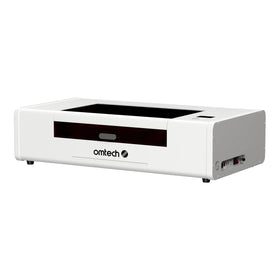
In this guide, we’ll walk through how to UV print on wood with the OMTech Spectra UV Printer. You’ll learn how to prepare your artwork, position accurately, and build a repeatable production setup. If you’re looking to see how UV printing on wood works, keep reading!
Why UV Printing Works So Well on Wood
Traditional printing methods often struggle with wood because the surface is porous, uneven, and textured. Standard inks tend to soak into the grain, causing colors to dull and edges to blur.
UV printers, on the other hand, use inks that harden instantly when exposed to ultraviolet light. Instead of soaking into the wood fibers, the ink cures on top of the surface as a thin, durable layer. This allows for sharp, fine details even on textured boards and bold colors.
The instant curing process also means there is no drying time. As soon as the printer finishes, the wood is ready to handle, package, or laser cut. This makes UV printing especially useful for small businesses that need fast turnaround times without adding extra steps.
The Tools Used in This Test
For this project, we used the OMTech Spectra UV Printer along with a plank of birch wood. You can also use virtually any other wood, as the grain and softness don’t have much effect on the printing process.
We also used OMTech Print software, which controls the printer and manages artwork, sizing, and positioning. A basic measuring tool and painter’s tape were used to dial in accurate placement during setup.
Preparing Your Design in OMTech Print

To begin, download or create the image you want to print. In our case, we used a dog illustration. Once you open OMTech Print and import the file, the software automatically brings up the image settings window.
This is where you control the size of the graphic. You can adjust both the height and width to match the space on your wood plank. While it is tempting to estimate, the best results come from physically measuring the print area on your material and entering those exact numbers into the software.
After confirming the dimensions, the image appears in the workspace exactly as it will be printed. At this stage, the design is ready for placement on the printer bed.
Positioning the Image Accurately on Wood
Positioning is the most important technical step when printing on rigid materials like wood.
UV printers do not automatically detect where your material is on the bed, so you must manually define the design's print area using X and Y coordinates.
To do this, start with scrap wood or test material. Secure it to the printer bed and mark the edges with painter’s tape. These visual guides help you track where the material is located relative to the printer’s zero point.
Next, print small test images while adjusting the X and Y values in the software. Measure how far the image is from your desired position and enter that offset in millimeters. After a few test runs, you’ll reach a point where the image lands exactly where you want it.
Once the correct coordinates are found, write them down. If you place future boards in the same position, you can reuse these values and skip repeated testing.
Although this setup process takes some patience, it dramatically speeds up production later, especially when printing multiple pieces in a batch.
Printing the Final Design

With the artwork sized correctly and positioning calibrated, printing becomes simple.
Place the birch plank onto the bed using your tape guides, confirm the saved X and Y settings in OMTech Print, and start the print job. The Spectra applies UV-curable ink and immediately hardens it with its built-in UV-LED curing system.
When the job finishes, the wood is completely dry and ready for use. There is no smearing, no waiting, and no additional coating required.
Turning This Process Into Batch Production
Once your measurements are locked in, UV printing on wood becomes highly repeatable.
By using identical board sizes and placing them consistently on the printer bed, you can print dozens of pieces using the same software settings. Many workshops keep permanent tape guides on the bed to speed up placement.
This approach is ideal for producing items like signs, ornaments, plaques, coasters, branded décor, and custom gifts. Because both the printing and positioning are digital, personalization can be added with minimal extra effort, allowing small businesses to charge more for customized products.
Printing Beyond Wood: Why UV Printers Are So Versatile
One of the biggest advantages of owning a UV printer is that wood is only the beginning.
The same setup works on acrylic, leather, coated metals, plastics, ceramics, glass, and many promotional items. You don’t need separate machines for different materials, which keeps equipment costs down and product options wide.
For small businesses, this versatility makes it easier to experiment with new markets, fulfill custom orders, and adapt quickly to customer trends.
Why the OMTech Spectra Is Well-Suited for Wood Printing

The OMTech Spectra UV Printer is designed to make workflows like this accessible to growing shops and creators.
It offers an A3-size flatbed, high-resolution printing using Epson technology, and support for CMYK color, white ink, and clear varnish layers. Print speeds reach up to 2.39 square meters per hour, allowing for efficient production runs even on larger batches.
Built-in ink circulation helps prevent clogging, while automated maintenance routines reduce downtime. OMTech Print software simplifies the process by combining image setup, RIP processing, and printer controls into one interface, removing the need for multiple programs.
Together, these features make printing on wood reliable, repeatable, and scalable.
Final Thoughts
UV printing transforms wood from a simple craft material into a high-value product surface. With the right workflow and a capable machine, you can create professional, durable, full-color designs directly on wood in minutes.
Using the OMTech Spectra UV Printer, the process becomes straightforward: size your artwork, position it accurately, print instantly, and move on to the next piece. Once your setup is dialed in, batch production becomes fast and predictable.
And since UV printing works on so many materials beyond wood, it provides long-term value as your business grows.
Ready to expand your workshop with full-color printing on wood and beyond? The upcoming OMTech Spectra UV Printer delivers professional performance in a compact, small-business-friendly system—bringing durable, high-resolution UV printing within reach.