







Laser Engraving Aluminum: A Comprehensive Guide for Aluminum Laser Engraving
As you embark on the fascinating journey of laser engraving, one of the most versatile materials you’ll encounter is aluminum. Known for its durability, affordability, and lightweight nature, aluminum is a popular choice for metal laser engraving projects.

Unlike wood laser engraving, laser engraving on metal requires the right laser and the right parameters to create long-lasting, precise engravings. In this guide, we’ll introduce you to the realm of laser engraving aluminum and show you how to achieve the best results!
Principle of Laser Engraving Aluminum
Laser engraving aluminum uses a focused laser beam that interacts with the surface of the aluminum to etch or remove the material, creating a precise, permanent mark. The laser’s intense energy vaporizes the metal surface without altering the appearance or functionality of the aluminum.
Ultimately, the two main methods for etching aluminum are with CO2 laser engravers or fiber laser machines. CO2 lasers use a light beam of around 10 micrometers, while fiber lasers use a 1-microliter wavelength better suited for marking metal due to its concentrated beam. However, CO2 lasers can still etch painted metal or metal surfaces sprayed with a metal marking liquid, which adds a dark, contrasting layer that can be engraved upon.
CO2 laser engraving machines don’t etch metal as deeply or create as long-lasting marks as fiber markers do. Fiber lasers operate at an optimal wavelength for engraving metal, resulting in visible and durable marks that outlast CO2 laser metal etching.
Approaching Aluminum Engraving with a Laser Engraver: How To Do It
Your approach to engraving aluminum depends on two things: the type of laser you own and the aluminum's finish. For anodized aluminum, a diode or CO2 laser can easily burn away the colored coating. For bare metal, you'll need either a fiber laser or a marking spray like CerMark to bond a dark mark to the surface.
Applications of Laser Engraving on Aluminum
Aluminum’s versatility, durability, corrosion resistance, and lightweight properties make it indispensable in laser engraving, aerospace, construction, and automotive industries. Aluminum can be laser engraved to create personalized signage, decorative art, industrial barcodes and serial numbers, and so much more. With the power of a capable metal laser engraver, the possibilities are nearly endless!

How to Laser Engrave Aluminum
Prepare the Aluminum for Engraving
Before laser engraving aluminum, you should first prep the material for optimal results. This includes clearing the surface of dust, debris, or grease that might deter the aluminum engraving. You can use a mild cleaning solution to cleanse the surface.
Choose the Right Laser Engraver
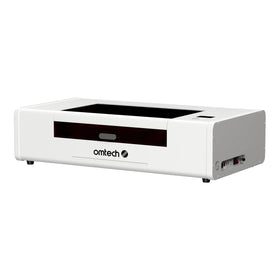
To achieve clear, precise engravings on aluminum, you must use a laser that can accurately manipulate the material’s surface without damage. OMTech’s Integrated Fiber Laser Marker with Autofocus is an excellent choice for this task, exhibiting stellar accuracy and speed for both beginners and seasoned professionals. With a max marking speed of 10,000 mm/s and autofocus capabilities, this adept fiber laser marker offers accurate metal engravings for every task.

This highly cost-effective model now includes autofocus, a feature not available on older OMTech fiber laser engravers, significantly simplifying your workflow by eliminating the manual focusing process for every job. Choose your ideal power with Galvo models available in 20W, 30W, and 50W, and MOPA models in 20W, 30W, and 60W. For basic marking, 20W is sufficient. For the popular capability of color laser engraving, the MOPA laser is your best choice.
Set the Parameters and Test on Scrap Materials
Before you start, you need to find the right settings for your laser. This is the most important part of the process.
Always do a test run first! Find a scrap piece of the same aluminum and test different combinations of speed, power, and frequency. This will help you find the perfect settings to get a clean, sharp mark without ruining your final project.
We use OMTech 60W MOPA autofocus fiber laser engraver to show you examples. The results will vary with different aluminum content, even when using the same parameters.
Here are the settings we use:
- Speed:500 mm/s
- Power:80%
- Line Interval (mm):0.005 mm
- Q-Pulse:100 ns
- Frequency:100kHz
The image below shows our final result. The actual color of the engraving is not as dark as it appears in the photo, due to the lighting used for photography.

- Speed:1200 mm/s
- Power:30%
- Line Interval (mm):0.05 mm
- Q-Pulse:200 ns
- Frequency:30kHz
The image below shows our final result:

Time to Engrave Your Final Piece
Once you’ve found your perfect settings from your tests, it’s time to move on to your final project. Carefully place your aluminum piece in the laser machine and secure it so it doesn’t move during the engraving process. Double-check that your focus is correct and that the laser head is positioned correctly over the starting point of your design. Take one last look at your settings in the software to make sure they match your successful test run. When you are ready, press start and watch your design come to life.
Manage Heat/Dust Generation During Engraving
Efficient heat and dust dissipation is critical during engraving to prevent altering the aluminum’s properties. You can gather errant particles and heat through a fume extractor, which will remove dust and heat from any indoor area. Providing ventilation for your workspace is imperative for maintaining a proper environment.
Avoid Deformation and Discoloration
If you’re using a fiber laser marker, the chance of discoloration during laser engraving is lessened, as the fiber laser wavelength is better absorbed by the metal. However, if you have a CO2 laser engraving machine for metal, utilizing a metal marking powder or using tape to mask the surface before laser engraving aluminum will decrease the chances of discoloration. Of course, utilizing the proper laser settings and focus distance is also one of the main considerations for avoiding deformation and discoloration.
Post-Processing and Finishing
Depending on the project, post-engraving processes might include cleaning the surface, applying a protective coating, or even polishing the aluminum to enhance the final product. You can use a damp towel to wipe off the smoke or a degreaser to get rid of particularly stubborn stains. Buff the metal with cleaners like vinegar or ammonia to give it more shine, or use a polishing cloth or sandpaper.
Best Types of Aluminum for Laser Engraving
1. Anodized Aluminum
Anodized aluminum is the easiest and highest-contrast material to work with, and it's an easy favorite in the laser engraving world. The anodized layer absorbs the laser beam extremely well: with a diode or CO2 laser, you can vaporize the colored dye to reveal the bright silver metal underneath, while a fiber laser can produce crisp white, gray, or charcoal markings on it.
2. Powder-Coated Aluminum
Powder-coated aluminum is also a popular choice, especially for tumblers, railings, and outdoor signage. As with anodized aluminum, the laser burns off the coating to expose the raw metal beneath, producing very durable, high-contrast designs.
3. Bare/raw aluminum
Bare/raw aluminum, most commonly the 6061 and 5052 alloys sold as sheet stock at hardware stores, is the trickiest of the three. It's highly reflective, which can damage diode lasers or bounce the beam unpredictably. To get a permanent mark on bare aluminum, you'll need to either use a fiber laser to alter the metal structurally or apply a metal marking spray (such as CerMark or LaserBond) before engraving.
What Type of Laser Engraver is Best For Aluminum? Laser Compatibility for Different Types of Aluminum
- Fiber lasers (1064nm): Fiber laser engravers, especially Galvo fiber laser engravers, are the undisputed king for metals. They mark bare aluminum easily (leaving gray/charcoal or white marks) and rapidly ablate anodized coatings.
- Diode lasers (blue light): Diode laser engravers are great for vaporizing or removing anodized and powder-coated layers, but they struggle to mark bare aluminum directly without a metal marking spray.
- CO2 laser engravers require higher power to mark metals directly and are mostly used to remove anodized or powder-coated finishes rather than mark bare metal.
Three Ways to Approach Engraving Aluminum
Method 1: Engraving Anodized Aluminum (The Easiest Method)
The laser strips off the thin, dyed anodized layer, exposing the raw silver aluminum underneath.
- Equipment: A basic 5W–20W diode laser or any CO2 laser works perfectly.
- Settings: Run at low power and high speed to avoid melting the metal itself. A common baseline on a 5W–10W diode is 100% power at roughly 6,000–8,000 mm/min, depending on the thickness of the anodization.
- Pro tip: If you're using an IR laser, you can achieve a brighter white/silver mark by running a blue diode laser pass first, followed by an IR pass.
Method 2: Marking Bare Aluminum with a Fiber Laser
Raw, unpainted aluminum reflects laser light, which makes standard diode or CO2 lasers ineffective on it.
- Equipment: A fiber laser (typically 20W–50W) is the industry standard for directly engraving bare metal, since its wavelength reacts properly with aluminum to create deep, dark etchings.
- Settings: For a 30W fiber laser, a good starting point for a deep etch is a frequency of 20–30 kHz, 50–70% power, and speeds around 500–800 mm/s.
Method 3: Using Marking Sprays (For CO2 or Diode Lasers)
If you own a CO2 or diode laser and want to mark bare aluminum, coat the metal with a laser-marking spray such as CerMark Ultra or Brilliance Laser Inks. The laser's heat bakes the spray into a permanent black mark.
- Application: Spray an even, light coat over the aluminum and let it dry completely.
- Settings: For a 40W–50W CO2 laser, this generally means high power and slower speeds, around 60–70% power at 10–15 mm/s, to ensure the heat fully cures the compound onto the metal.
FAQs about Laser Engraving Aluminum
What is the coating on aluminum for laser engraving?
The coating on aluminum for laser engraving is typically anodized or another chemical layer. Laser engraving anodized aluminum is equally possible for fiber lasers and CO2 lasers, as the laser removes the finish and leaves a contrasting design.
What is the best laser for etching aluminum?
Fiber lasers, like OMTech’s Autofocus Fiber Laser Markers, are the ideal aluminum laser engraver, providing the precision and control needed for detailed work. Their compact build and intuitive autofocus features allow you to utilize them in small workspaces—perfect for those looking to add another machine to their arsenal of laser engravers. If you’re also interested in color laser metal engraving, the MOPA Compact Fiber Markers can even laser engrave aluminum in color!
How many watts does it take to laser engrave aluminum?
Fiber lasers as low as 20 watts can effectively mark aluminum, though higher wattages sometimes offer deeper engravings or faster processing speeds. OMTech’s Compact Fiber Markers start at 20W and go as high as 60W, with every model featuring quick, long-lasting, and accurate results.
How can I differentiate the different types of aluminum?
Here are some common types of aluminum:
Pure Aluminum: Soft, ductile, and malleable. Used for electrical conductors, cookware, and foil.
Aluminum Alloys: Stronger and more durable than pure aluminum. Common alloys include:
- Aluminum-copper alloys: Used for aircraft parts, engine blocks, and marine hardware.
- Aluminum-magnesium alloys: Used for beverage cans, automotive parts, and construction materials.
- Aluminum-silicon alloys: Used for casting, die-casting, and engine blocks.
Anodized Aluminum: Has a protective oxide layer, resistant to corrosion. Can be colored. Used for architectural finishes, cookware, and electronics.
Recycled Aluminum: Made from recycled aluminum cans and scrap. Environmentally friendly.
You can differentiate the different types of aluminum through visual inspection. Here are some key characteristics to look for:
- Color: Anodized aluminum can be colored in a variety of hues. Pure aluminum and alloys are typically silver or gray, but can vary depending on alloy composition and surface treatments.
- Surface: Anodized aluminum often has a smooth, even finish. Forged or extruded aluminum may have a more textured or rough finish. Cast aluminum can have a porous or pitted surface.
- Markings: Manufacturers often stamp or etch information that indicate the type or alloy.
- Corrosion: Anodized aluminum is more resistant.
While visual inspection can provide some clues, a more accurate method to identify a specific type of aluminum involves testing, for example, metal testing kits, which use chemical reactions or magnetic properties to identify different metals.
Conclusion
Laser engraving aluminum opens up a world of creativity and professional opportunities. With the right equipment and knowledge, you can transform ordinary aluminum items into works of art or branded masterpieces. If you're ready to start or elevate your laser engraving journey, explore OMTech Fiber Laser Markers and turn your visions into reality with precision and ease.
Dive into the endless possibilities of laser engraving with OMTech today and bring your creative dreams to life!